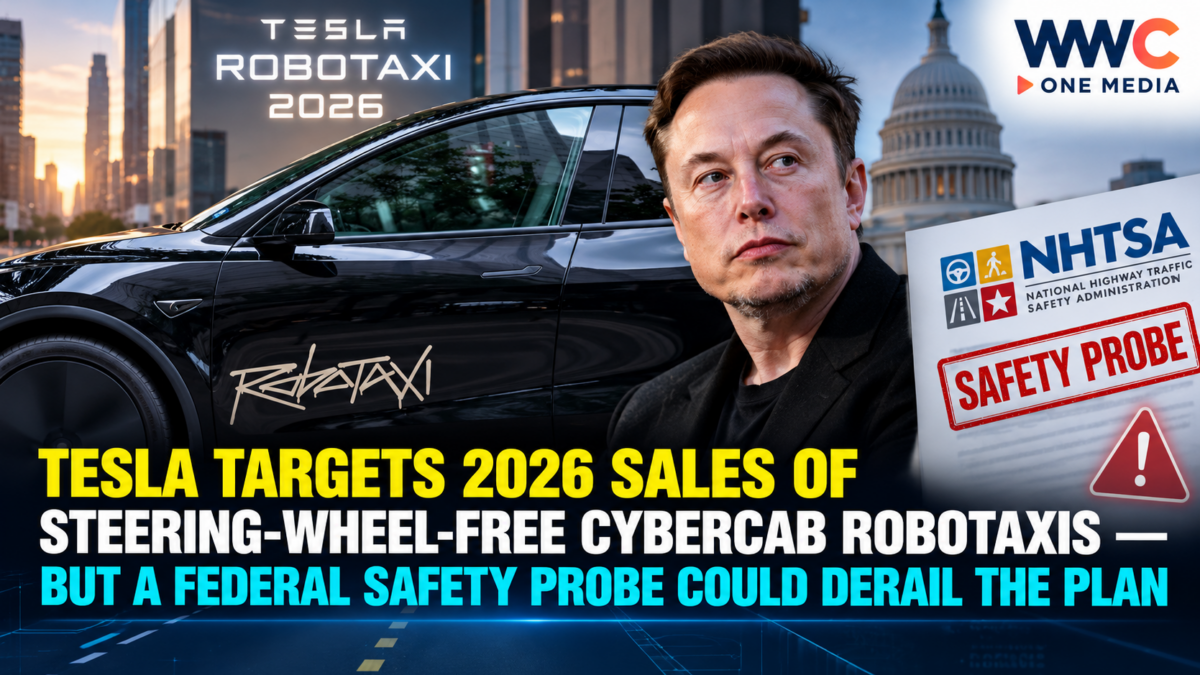
SAN FRANCISCO, UNITED STATES — Tesla is targeting the first public customer deliveries of its Cybercab robotaxi before the end of 2026, accelerating CEO Elon Musk’s ambition to transform the electric vehicle manufacturer into a major player in autonomous transportation.
The announcement came during Tesla’s third-quarter earnings discussion on Wednesday, October 21.
Lars Moravy, Tesla’s vice president of vehicle engineering, told analysts that the company intends to begin delivering a small number of Cybercabs to customers this year before gradually expanding production, deliveries and fleet operations.
But the sales target comes at a difficult moment.
The U.S. National Highway Traffic Safety Administration (NHTSA) is investigating how Tesla certified the Cybercab as compliant with federal vehicle safety standards despite the absence of traditional driver controls.
Unlike conventional cars, the futuristic two-seat Cybercab has no steering wheel, accelerator pedal, brake pedal or conventional side mirrors.
The biggest unanswered question is whether Tesla can satisfy federal regulators while maintaining its aggressive rollout schedule.
Tesla Cybercab: A Car Designed Without a Human Driver

The Cybercab is central to Tesla’s long-term vision of autonomous mobility.
Its design replaces the conventional driver’s cockpit with a two-seat cabin intended for passengers.
The company aims to use autonomous driving technology to transport people without the need for a human driver.
TESLA CYBERCAB — KEY DEVELOPMENTS
Passenger capacity
2
Public sales target
End of 2026
Existing paid service
Austin, Texas
Next planned city
DallasNovember 2026 target
Vehicle design: Two seats, butterfly doors and no conventional manual driving controls.Company plans as reported October 21–22. The sales and Dallas expansion targets have not yet been completed.
The Cybercab represents a different approach from conventional vehicles equipped with driver-assistance features.
Tesla’s goal is a purpose-built car that can operate as part of an automated ride-hailing service rather than relying on a human driver to intervene.
However, a vehicle’s intended capability is not the same as independent verification that it can operate safely in every traffic environment.
Tesla’s Engineering Chief Targets First Deliveries Before December Ends
During the earnings discussion, Moravy said Tesla hopes to place its first Cybercabs with customers before the end of 2026.
The company intends to start with limited deliveries, learn from customer ownership and fleet management, then expand operations.
That approach would allow Tesla to study how its purpose-built robotaxis perform outside company-controlled environments.
However, an announced delivery target is not a guarantee that consumers will be able to purchase a Cybercab nationwide by December.
Tesla has not confirmed the final number of customer deliveries, a comprehensive retail sales schedule or universal eligibility for private ownership.
There is also a potential distinction between a vehicle being sold to a customer and that vehicle being legally permitted to operate without a driver in every U.S. jurisdiction.
Those questions remain subject to regulatory and operational requirements.
Why U.S. Regulators Are Investigating the Cybercab
The federal investigation is one of the most significant obstacles facing Tesla’s plans.
On September 4, 2026, NHTSA announced an audit examining Tesla’s certification of the Cybercab under the Federal Motor Vehicle Safety Standards.
These regulations set safety requirements for vehicles sold or operated on U.S. roads.
Many standards were originally written with human-operated vehicles in mind.
Consequently, they contain requirements involving traditional driving controls and other equipment.
Tesla’s Cybercab creates an unusual regulatory challenge because its design eliminates those features entirely.
The investigation is examining how the company concluded that its vehicle meets applicable safety requirements and whether certain rules can legitimately be treated as inapplicable.
An investigation does not automatically establish that Tesla violated the law. It means regulators are reviewing the company’s compliance determination.
October 30: Tesla Faces an Important Federal Deadline
NEXT KEY REGULATORY DATE
October 30, 2026
Tesla’s deadline to respond to NHTSA’s Cybercab certification questions, following an extension.
The regulator originally requested information about Tesla’s compliance approach.
Tesla later sought additional time to assemble and review the requested material.
NHTSA granted an extension until October 30, according to reporting on the agency’s correspondence.
That deadline matters because the company’s response could help regulators determine what additional scrutiny or enforcement action, if any, is necessary.
It does not mean a final approval or rejection must be issued on October 30.
Drive Tesla
Cybercab Is Already Carrying Paying Passengers in Austin
Tesla began operating a limited paid Cybercab service in Austin, Texas, in early September 2026.
The deployment gave the company an opportunity to test its purpose-built autonomous vehicles with passengers in a commercial setting.
However, the rollout involved a relatively small fleet rather than widespread availability across the United States.
NHTSA opened its audit shortly after the initial service began.
Tesla’s broader robotaxi network also includes Model Y vehicles operating under different arrangements, some involving human safety monitors.
These distinctions matter when evaluating Tesla’s progress.
A small commercial trial demonstrates that the company has deployed the vehicle, but it does not establish that a nationwide, fully autonomous robotaxi service is ready.
MarketScreener
+1
Dallas Could Be Tesla’s Next Robotaxi Market
Tesla AI chief Ashok Elluswamy said the company intends to expand Cybercab service into Dallas in November 2026.
The proposed expansion would move the programme beyond its initial Austin operations.
For Tesla, additional cities would provide opportunities to assess its vehicles across different road networks, traffic conditions and operational challenges.
Elluswamy also expressed confidence in Tesla’s ability to scale Cybercab manufacturing.
He said that obtaining the required regulatory permissions was a key priority for expanding deployment.
However, Dallas service had not launched at the time of the October 21 announcement, and Tesla’s statements remain forward-looking.
Why Tesla’s Robotaxi Plans Could Change the Transportation Industry
Tesla’s long-term ambition goes beyond selling individual electric vehicles.
The company wants to build a transportation network in which autonomous cars carry paying passengers, potentially allowing vehicles to generate revenue while their owners are not using them.
Cybercab is intended to become a central part of that network.
Musk said the vehicle would initially remain primarily owned by Tesla and deployed within the company’s ride-hailing operations.
That means the first customer sales may coexist with a larger company-operated fleet.
A separate development discussed during Tesla’s earnings call could expand the idea further: Tesla aims to allow eligible privately owned vehicles to join its robotaxi network beginning around the second quarter of 2027.
However, this depends on software capabilities, geographic restrictions, regulatory requirements and fleet-management systems.
Tesla’s Financial Results Reveal the Stakes
Tesla’s October 21 earnings report also demonstrates the scale of the investment behind its autonomous-driving ambitions.
TESLA THIRD-QUARTER 2026
Revenue
$28.0B
GAAP net income
$0.8B
Operating cash flow
$6.3B
Free cash flow
$1.5B
Tesla’s official third-quarter results. Rounded figures; GAAP and adjusted profit must not be conflated.
Tesla is investing in artificial intelligence, robotics, energy systems and autonomous vehicles while continuing to rely heavily on its established vehicle business.
A successful Cybercab rollout could eventually introduce a new source of revenue.
But delays in regulation, production or commercial adoption could increase the time required for that investment to pay off.
What This Means for Asia and the Philippines
Autonomous vehicles are attracting attention from governments and transportation businesses worldwide.
Potential applications include ride-hailing, airport transfers, controlled industrial zones and other environments where vehicle operations can be carefully monitored.
In the Philippines, any future driverless taxi rollout would depend on local traffic regulations, safety requirements, road conditions, insurance arrangements and operational readiness.
Tesla has not announced a confirmed Cybercab sales launch or commercial robotaxi rollout in the Philippines.
The December 2026 target concerns Tesla’s initial customer deliveries, not an announced worldwide release.
The Bigger Question: Can Tesla Meet Its Deadline?
Tesla has made progress by deploying a limited paid Cybercab service in Austin.
Its engineering team believes the vehicle can be manufactured at scale, and management is targeting initial customer deliveries before the end of this year.
But the regulatory investigation creates uncertainty around how quickly the company can expand.
The October 30 response deadline is especially important, although it is not itself a final decision on whether the vehicle may be sold.
The bottom line: Tesla wants to begin Cybercab customer deliveries by December 2026, but the plan remains subject to safety-compliance scrutiny, operating restrictions and the practical challenges of scaling autonomous transportation.