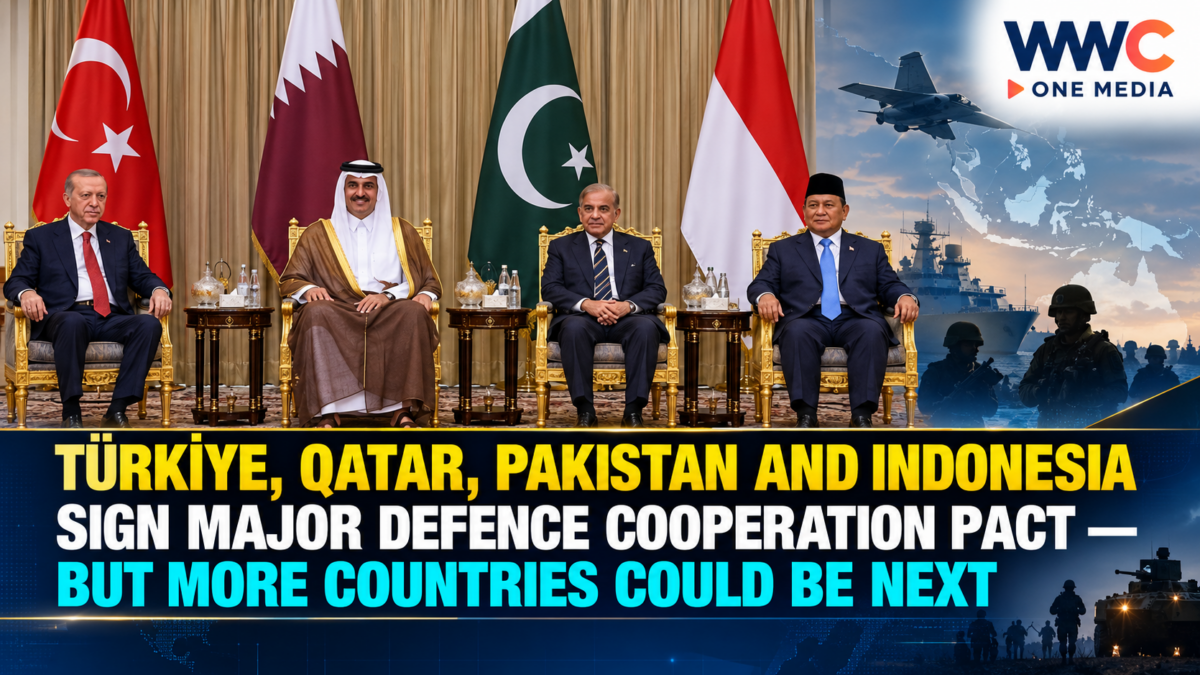
DOHA, QATAR — Türkiye, Qatar, Pakistan and Indonesia have signed a multilateral defence cooperation agreement, seeking to strengthen military-industrial capabilities and develop closer strategic partnerships amid growing security concerns across Asia and the Middle East.
The agreement, known as the Badr Memorandum of Understanding (MoU), was signed in Doha on Wednesday, October 21, 2026.
Türkiye’s Ministry of National Defence confirmed that the accord focuses on cooperation in military production, technical training, research and development, and defence-related technological capabilities.
The initiative brings together four countries with different industrial strengths, geographical interests and defence requirements.
For Indonesia, the agreement could open additional opportunities for military technology cooperation and domestic industrial development.
For Türkiye, it offers another avenue to expand its international defence partnerships and manufacturing relationships.
However, there is an important distinction: the Badr agreement is a defence cooperation memorandum, not a confirmed four-country mutual-defence treaty.
The published announcement does not establish a collective military obligation requiring all four signatories to respond if one of them is attacked.
What Did the Four Countries Agree To?
The agreement is designed to strengthen cooperation rather than establish a single combined military force.
According to the Turkish Defence Ministry and Qatar News Agency, the initiative covers several areas.
The Badr Memorandum — Main Objectives
Joint production
Expand cooperation between defence manufacturers
Technology development
Develop technical capabilities and industrial expertise
Military training
Support specialised technical education and training
Research and development
Explore joint defence innovation and engineering
Industrial integration
Connect complementary production capabilities
Strategic cooperation
Strengthen institutional relationships among partners
Objectives drawn from the officially reported agreement. No project-specific budget or production schedule was announced.
The participating governments say cooperation could help them combine expertise, improve domestic production capacity and develop systems that meet the needs of their own forces and other partner countries.
These are stated objectives. The announcement does not establish that new factories have been built, contracts awarded or specific weapons jointly manufactured.
Who Signed the Agreement?
The October 21 signing ceremony involved senior defence officials from all four countries.
| Country | Signing representative |
|---|---|
| Türkiye | Defence Minister Yaşar Güler |
| Qatar | Deputy Prime Minister and Minister of State for Defence Affairs Sheikh Saoud bin Abdulrahman Al Thani |
| Pakistan | Defence Minister Khawaja Muhammad Asif |
| Indonesia | Deputy Defence Minister Yusuf Jauhari |
Haluk Görgün, head of Türkiye’s Presidency of Defence Industries, also attended.
Qatar’s official news agency identified additional participating defence-production institutions, including Pakistan’s defence production authorities and Türkiye’s Presidency of Defence Industries.
Why the Agreement Matters for Türkiye
Türkiye has developed a substantial defence manufacturing industry, producing military equipment for domestic use and international customers.
Its growing industrial capabilities have become an important element of Ankara’s security and foreign policy relationships.
Türkiye also maintains established military ties with Qatar, including a military presence in the Gulf state.
The new memorandum could strengthen its role in joint industrial development by allowing participating countries to work on projects rather than relying exclusively on conventional purchases of finished equipment.
Görgün stressed the value of technology sharing, developing products together and strengthening national manufacturing expertise.
He also expressed confidence that cooperation among the four countries could lead to practical projects.
But he did not announce a specific completed Badr weapons programme or disclose the monetary value of future contracts.
Indonesia’s Role: A New Defence Partnership for Southeast Asia
Indonesia’s participation gives the agreement particular significance for ASEAN.
As Southeast Asia’s largest economy, Indonesia has pursued military modernisation and international defence-industry partnerships.
Participation in Badr could help Jakarta diversify its relationships and explore opportunities for technology development, training and manufacturing.
The memorandum also creates another framework for cooperation beyond Indonesia’s existing bilateral defence arrangements.
However, the signing alone does not prove that Indonesia will acquire a particular aircraft, drone, missile or naval vessel through the initiative.
Neither the official Qatari account nor the initial Reuters report provided a confirmed procurement list or Indonesian financial commitment.
For ASEAN observers, the important development is Indonesia’s entry into a four-country defence-industrial framework, rather than any newly established obligation to participate in overseas conflicts.
Why Qatar and Pakistan Are Central to the Agreement
For Qatar, the Badr initiative adds an industrial component to its existing defence relationships. The country already hosts a Turkish military presence and has maintained defence cooperation with Ankara.
The memorandum could allow Qatar to participate in broader development and procurement partnerships, potentially drawing on technical capabilities from multiple countries.
Pakistan brings its own military-industrial institutions and defence production experience.
Its involvement is particularly notable because Türkiye, Pakistan and Saudi Arabia signed a separate mutual-defence agreement in August 2026, according to Reuters.
That earlier agreement reportedly treats an attack against one signatory as an attack against all.
Badr must not be confused with that earlier pact. The October 21 agreement involving Qatar and Indonesia focuses on defence-industry cooperation, not a newly declared collective-defence commitment.
Could Other Countries Join Badr?
One detail in the official Qatari announcement makes the agreement particularly interesting.
Qatar News Agency reported that other friendly countries may be allowed to join the Badr memorandum, provided they meet criteria agreed upon by the four existing participants.
This leaves open the possibility that the initiative could expand beyond its original membership.
However, the announcement did not identify additional countries preparing to join or provide a timetable for expansion.
What is confirmed — and what remains unknown
| Confirmed | Not yet established |
|---|---|
| Four participating countries | Any fifth member |
| Signing in Doha on October 21 | Specific joint production contracts |
| Cooperation in training, research and manufacturing | Total funding commitment |
| Possibility of additional members | Admission dates or candidates |
| Defence-industry partnership | A four-country mutual-defence obligation |
Based on the official Qatar News Agency account and reporting from Reuters and Anadolu Agency.
What This Could Mean for ASEAN and the Philippines
Indonesia’s involvement adds a Southeast Asian dimension to an agreement otherwise centered on Türkiye, Qatar and Pakistan.
For ASEAN, the arrangement illustrates how member states may pursue defence-industry relationships with partners beyond the region.
Such cooperation can create opportunities involving equipment maintenance, engineering, research and industrial training.
For the Philippines, developments in Indonesia’s defence partnerships are relevant to the wider regional security environment. But the Badr agreement does not announce Philippine participation, impose obligations on Manila or change ASEAN’s collective defence arrangements.
It would also be premature to claim that the memorandum will directly alter the balance of military power in Southeast Asia. Its practical impact will depend on the projects the participants eventually implement.
The Bigger Question: Will Badr Produce Real Defence Projects?
The Badr memorandum signals a shared intention to cooperate more closely.
The participants see potential economic and security benefits in combining their respective manufacturing capabilities rather than relying exclusively on purchasing completed military equipment.
But the next stage matters more than the signing ceremony.
Observers will be watching for announcements involving funded projects, joint research facilities, production agreements, technology programmes and any new member countries.
The bottom line: Türkiye, Qatar, Pakistan and Indonesia have signed the Badr defence cooperation memorandum, establishing a framework for military-industrial collaboration. The agreement is real, but its future size, specific projects and economic impact have not yet been disclosed.