
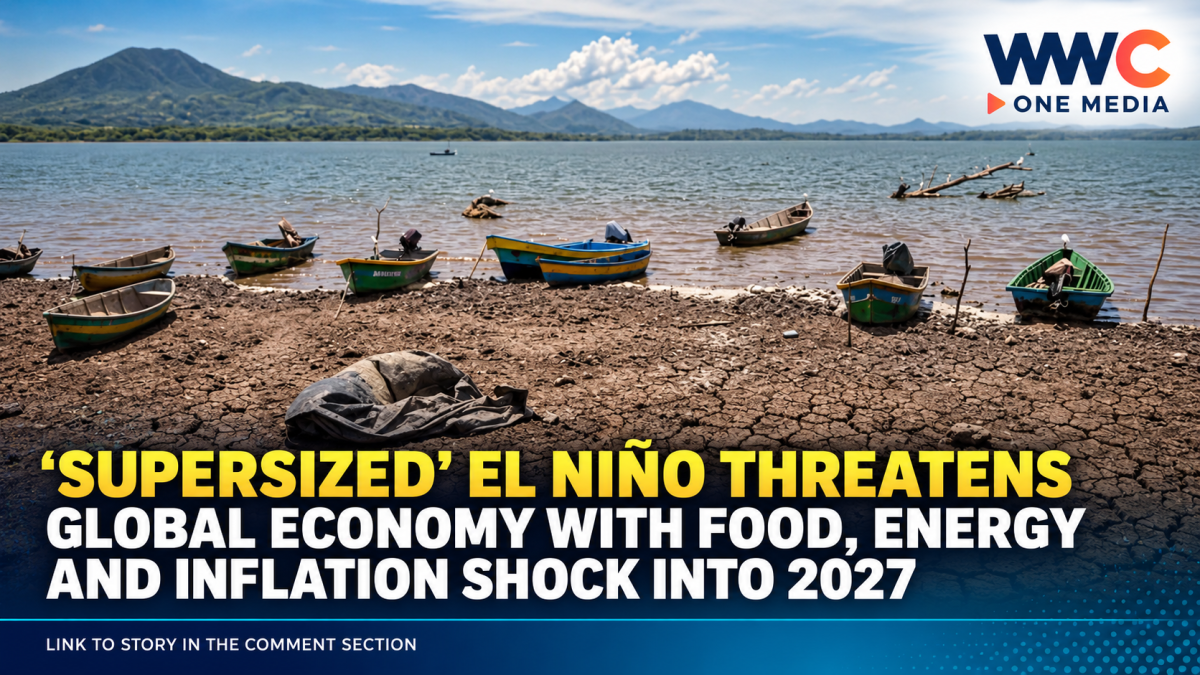
A rapidly strengthening El Niño could become one of the most powerful on record, putting crops, food prices, energy systems and vulnerable economies under pressure just as the world faces another period of economic uncertainty.
GENEVA — A powerful El Niño gathering strength across the tropical Pacific is no longer just a weather story. It is increasingly becoming an economic one.
The World Meteorological Organization warned on September 3 that El Niño is now firmly established and is expected to intensify into a very strong event before peaking toward the end of 2026.
WMO forecasts put the probability of El Niño continuing through February 2027 at nearly 100%, an unusually high level of confidence that reflects broad agreement among international climate models.
UN Secretary-General António Guterres described the phenomenon as being “supersized,” warning that unusually warm oceans are combining with a planet already heated by greenhouse-gas emissions.
For governments and investors, however, the immediate concern is what happens when extreme heat, drought and flooding begin hitting the systems that produce food, generate electricity and move commodities around the world.
The economic shock may already be starting
The effects are becoming visible across several major agricultural regions.
India, one of the world’s largest producers and consumers of food commodities, entered September with serious rainfall concerns. Reuters reported that rainfall was around 35% below normal in June, while August was also deficient, putting crops including rice, corn, soybeans and cotton under greater pressure.
A prolonged rainfall shortage could also affect India’s winter planting season and force the country to reconsider imports or exports of commodities including sugar, vegetable oils and pulses. Food inflation was already running at 5.52% in July, increasing the economic significance of further agricultural disruption.
Indonesia, meanwhile, is facing its most severe dry season in roughly a decade, with wildfires spreading in parts of Borneo, including areas around the country’s new capital, Nusantara. Officials have deployed aircraft, water bombing and cloud-seeding operations as authorities try to contain the fires. Reuters reported that the unusually dry conditions have been intensified by the strong El Niño pattern.
Sri Lanka is also suffering severe drought conditions, with water supplies and agricultural incomes under strain in farming communities where reservoirs and wells have fallen sharply.
Those localized shocks matter because major agricultural economies are connected through global commodity markets.
When production falls in one country, governments may restrict exports, increase imports or release emergency inventories. Buyers then compete for supplies elsewhere, potentially transmitting a local weather problem into higher international prices.
Food prices are already flashing a warning
The timing could hardly be more sensitive.
According to Reuters, citing the UN Food and Agriculture Organization, world food prices climbed in August 2026 to their highest level since late 2022.
The FAO Food Price Index rose to 133.3 points, from 130.8 in July, with increases across cereals, vegetable oils, sugar, meat and dairy.
Sugar recorded a particularly sharp monthly rise amid weather-related production problems in Brazil, Europe and Asia. FAO also lowered its forecast for 2026 global cereal production.
It would be inaccurate to blame the entire increase on El Niño. Geopolitical conflict, energy costs, Black Sea trade disruption and other weather events are also affecting supply.
But a strengthening El Niño creates another potential pressure point in a food system already dealing with multiple shocks.
There is also an important counterbalance: agricultural technology, larger inventories and a more diversified group of exporters mean the global food system may be more resilient than during earlier major El Niño episodes. Reuters reported in August that substantial rice, wheat and other crop inventories could cushion part of the impact.
That buffer, however, is not unlimited.
Why markets should care about more than agriculture
Agriculture may be the most visible economic channel, but it is not the only one.
Extreme rainfall can disrupt mines, roads, ports and oil facilities. Drought can reduce hydropower generation. Heat waves can push electricity consumption sharply higher just as water shortages constrain some forms of power production.
El Niño therefore has the potential to affect energy prices and industrial supply chains at the same time that it disrupts food production.
Historical IMF research has found that El Niño shocks can create short-term inflation pressure in many economies and affect both energy and non-fuel commodity prices, although the economic consequences vary widely between countries.
That distinction is important.
El Niño does not automatically mean a global recession. Some countries have historically experienced weaker economic activity during El Niño episodes, while others have occasionally benefited from different rainfall or temperature patterns.
The danger in 2026 is the scale of the event — and the fact that it is arriving alongside other inflationary and geopolitical risks.
The Philippines faces its own El Niño test
For the Philippines, the warning has particularly direct consequences.
PAGASA said in its latest monitoring update that a moderate to strong El Niño was already present in the tropical Pacific as of August 26 and could reach a very strong state before the end of 2026, with the phenomenon expected to continue into the first half of 2027.
El Niño generally raises the probability of below-normal rainfall across much of the country, increasing the danger of dry spells, drought and water shortages.
PAGASA has also warned that rainfed rice and corn areas can be especially vulnerable to moisture stress, potentially leading to lower yields or delayed crop development without adequate irrigation and drought-mitigation measures.
But the Philippine impact will not simply mean “less rain everywhere.”
Western parts of the country can still experience periods of above-normal rainfall during the southwest monsoon, particularly when tropical cyclones enhance the Habagat. That means authorities could be dealing with drought risks in some provinces and flooding risks in others.
For consumers, the chain of consequences could eventually become familiar: weaker harvests can tighten food supplies, tighter supplies can push prices higher, and higher food prices can complicate inflation management.
The IMF previously noted that the Philippines’ 2024 economic performance was affected in part by El Niño, while elevated rice and other food prices weighed on household consumption.
The real danger comes when several shocks collide
The biggest economic threat may therefore not be one failed harvest, one drought or one flood.
It is the possibility that several disruptions happen simultaneously.
A drought in one major producer can often be absorbed by supplies from another. A hydroelectric shortfall can sometimes be compensated for with other energy sources. A damaged crop can be replaced through imports.
But when extreme weather strikes several agricultural and energy-producing regions at roughly the same time, those alternatives become more expensive.
Commodity prices rise.
Insurance losses increase.
Governments spend more on disaster relief.
Food-importing countries face larger bills.
Central banks may then confront the uncomfortable combination of weaker growth and renewed inflation pressure.
That is why the WMO is urging governments to treat the current forecast as an opportunity for preparation rather than simply waiting for disasters to occur.
Early-warning systems, water management, strategic food reserves, changes to planting schedules and stronger energy planning can all reduce the eventual economic damage.
The world therefore has something previous generations confronting extreme El Niño episodes often lacked: unusually strong advance warning.
Whether governments, markets and businesses use that warning effectively may determine whether the 2026-2027 El Niño becomes primarily a severe climate event — or the next major shock to the global economy.
WWC ONE MEDIA M.J.E




Leave a Reply