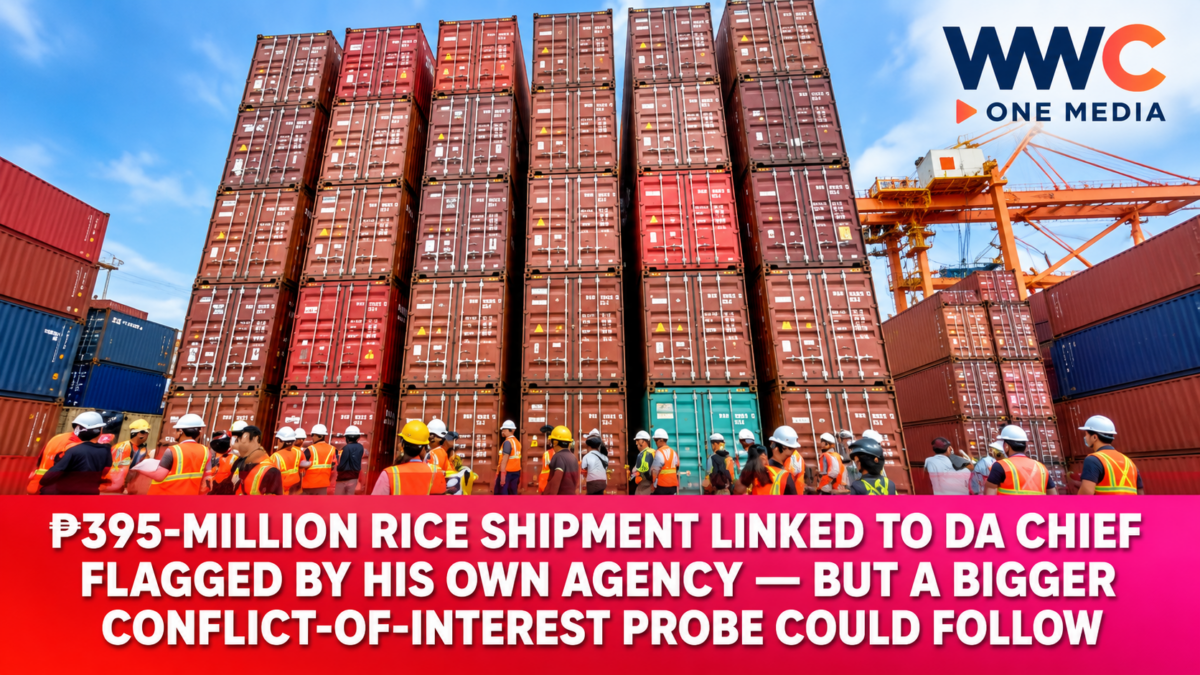
MANILA, Philippines — October 12, 2026 — A ₱395-million shipment of Vietnamese rice consigned to Planters Products Inc. (PPI) has become the center of a growing government controversy after the Department of Agriculture’s own Bureau of Plant Industry (BPI) canceled import clearances connected to the cargo, prompting customs enforcement action.
The case has attracted particular scrutiny because Agriculture Secretary Francisco Tiu Laurel Jr. exercises governance authority through a foundation with a controlling shareholding in PPI.
According to a Bilyonaryo investigation citing Bureau of Customs documents and corporate filings, BPI’s decision to revoke sanitary and phytosanitary import clearances set in motion enforcement proceedings involving the shipment aboard the Vietnamese vessel MV Tay Son 2.
The case raises questions about import compliance, corporate oversight and the relationship between a government regulator and a company connected to its own department.
However, the documents cited in the report do not establish that Tiu Laurel personally interfered with the shipment, directed its importation or influenced the customs investigation.
The bigger question is whether the ongoing scrutiny will reveal administrative violations alone — or expose weaknesses in how government-linked rice importers are regulated.
DA’s Own Bureau of Plant Industry Flags the Shipment
At the center of the case is a decision by the Bureau of Plant Industry, an agency under the Department of Agriculture.
Bilyonaryo reported that the BPI notified the Port of Davao on September 22 that it had canceled sanitary and phytosanitary import clearances issued to Planters Products Inc.
These clearances, commonly called SPSICs, are important regulatory documents used to ensure agricultural imports comply with the country’s plant health and quarantine requirements.
The cargo was being transported aboard MV Tay Son 2, which was carrying an estimated ₱395 million worth of Vietnamese rice.
On September 23, the BPI recommended that customs authorities withhold clearance, discharge and release of the cargo.
The following day-to-day developments placed the shipment under increasing regulatory scrutiny.
On September 25, the Bureau of Customs issued a Pre-Lodgement Control Order covering possible violations of the Customs Modernization and Tariff Act.
The order subjected the shipment to customs control while authorities pursued inspection and verification.
On September 28, the BPI recommended returning the shipment, subject to applicable agricultural and plant quarantine rules.
The sequence is significant because the regulatory action originated within the same government department that oversees the rice importer through its corporate governance arrangements.
What Happened to MV Tay Son 2?
The vessel was reportedly bound for the Santa Maria-Malita area of Davao Occidental in September.
Customs authorities questioned its movements after it had not completed the required customs procedures.
The Bilyonaryo investigation said the ship was observed heading south before authorities intercepted it.
The Bureau of Customs coordinated with the Philippine Navy in the enforcement operation.
Separate reporting by Abante TNT stated that the vessel was intercepted on September 17 and carried approximately 312,000 sacks of rice valued at ₱395 million.
The BOC also cited alleged failures to comply with Customs, Immigration and Quarantine boarding procedures.
According to the ship captain’s account described in Bilyonaryo, the vessel’s local agent had instructed the crew to drift and indicated that boarding formalities were unnecessary while the ship remained outside port limits.
That explanation forms part of the factual dispute and should not automatically be interpreted as proof of an attempt to evade customs.
Authorities must determine whether the ship’s movements and documentation violated applicable regulations.
Customs Inspection Faces Resistance
Abante TNT reported that customs personnel later attempted to implement the control order and inspect the cargo.
According to that account, the ship’s captain declined to open the cargo hatches, saying he was following instructions from the charterer.
A Vietnamese interpreter was reportedly used to communicate the requirements and legal basis of the inspection.
Customs authorities recommended continued control over the vessel and its cargo, along with further inspection.
They also proposed a maximum ₱300,000 penalty against the vessel over alleged unauthorized departure and failure to complete required formalities.
These details add another dimension to the investigation.
But proposed penalties and customs control measures are not equivalent to a final judicial finding of smuggling.
The outcome will depend on documentation, inspection findings and subsequent legal proceedings.
Why Planters Products’ Link to Tiu Laurel Matters
Planters Products Inc. has become central to the controversy because of its ownership and governance structure.
According to Securities and Exchange Commission filings examined by Bilyonaryo, Planters Foundation Inc. holds 79.24% of PPI shares in trust.
The agriculture secretary serves as chairman of the foundation and exercises certain governance powers, including voting rights and participation in board nominations.
That arrangement gives the office of the agriculture secretary a formal connection to a major rice importer.
At the same time, the Department of Agriculture regulates rice imports through agencies including the Bureau of Plant Industry.
This creates questions about how potential conflicts of interest are managed.
The relevant issues include whether decisions are made independently, whether officials with governance roles participate in regulatory matters and whether safeguards exist to prevent preferential treatment.
A governance connection, however, does not establish personal ownership of the shares by Tiu Laurel.
Nor does it prove that the secretary approved or directed the disputed shipment.
Any conclusion about misconduct would require evidence of actual decisions, actions or improper influence.
PPI Ranked Among the Philippines’ Largest Approved Rice Importers
The company’s scale has also attracted attention.
Bilyonaryo reported that BPI records showed Planters Products held 380 rice import clearances covering approximately 474,016.5 metric tons.
That placed PPI second among importers by approved volume.
The figures reflect quantities covered by import clearances, not necessarily rice already delivered to Philippine ports.
This distinction matters because approved import capacity may differ substantially from actual arrivals.
The company’s size means its activities could have implications for market competition and the distribution of import opportunities.
For regulators, the challenge is applying the same documentary and inspection standards regardless of an importer’s ownership structure or relationship with government institutions.
Senate Scrutiny Widens to Nearly ₱700 Million in Rice Shipments
The case is part of a broader controversy involving two Vietnamese rice shipments.
On October 8, Senator Francis Pangilinan announced plans to investigate suspected import irregularities involving cargoes totaling nearly 20,000 metric tons.
One shipment involved approximately 12,500 metric tons consigned to PPI aboard MV Tay Son 2.
The second involved around 7,400 metric tons consigned to Krystal San Pedro Rice Mill and detained at the Port of Limay in Bataan.
The Federation of Free Farmers and MAGSASAKA Party-List said the combined shipments were worth roughly ₱700 million.
The organizations have called for accountability and closer examination of the relevant import permits.
It is important not to confuse the figures.
The ₱395-million amount refers to the MV Tay Son 2 shipment involving PPI. The approximately ₱700-million amount covers two separate shipments under scrutiny.
The allegations remain subject to investigation and have not been established by a final legal determination.
Farmers’ Groups Demand Answers
The Federation of Free Farmers and MAGSASAKA Party-List have questioned the circumstances surrounding the rice shipments.
Their concerns include the validity of import clearances, vessel movements and the responsibilities of agencies involved in approving or inspecting imported rice.
In separate reporting by Bombo Radyo, Federation of Free Farmers chairman Leonardo Montemayor called for accountability over the cargoes.
Agricultural groups are particularly concerned that import practices must be transparent and consistent with rules intended to protect domestic producers.
For Philippine rice farmers, import policy has direct economic consequences.
Large imported supplies arriving during the local harvest can increase competition for domestically produced palay.
However, the existence of a large shipment does not automatically mean it violates the law.
The legal issue is whether the importer complied with applicable documentation, quarantine, customs and trade requirements.
Earlier Senate Questions Over PPI’s Rice Business
Scrutiny of Planters Products began before the latest shipment was detained.
In May 2026, Senator Imee Marcos sought a Senate inquiry into PPI’s rapid expansion in rice importation.
She questioned how the company had financed large import purchases given its reported financial position.
Senate Resolution No. 392 called for an examination of alleged irregularities involving the company.
BusinessMirror also published concerns raised by Montemayor about the distribution of rice import allocations and PPI’s growing share of the market.
These earlier questions provide background to the present controversy.
However, previous calls for investigation do not constitute findings that the company committed wrongdoing.
The October cargo case must be evaluated based on its own permits, transactions and customs records.
Rice Imports Remain a Sensitive Philippine Economic Issue
The controversy comes as the government tries to balance sufficient rice supplies with the need to protect Filipino farmers.
On October 5, Agriculture Secretary Tiu Laurel urged importers to voluntarily reduce shipments during the harvest season.
He said wet palay prices ranged from approximately ₱16.50 to ₱20 per kilogram.
The Department of Agriculture maintained that rice imports did not need to be suspended nationally but appealed for cooperation to avoid unnecessary pressure on farmgate prices.
The situation is complicated by concerns about future El Niño-related production losses.
Earlier DA projections indicated potential risks to domestic palay production if adverse weather conditions intensify.
The government therefore faces competing priorities: maintaining food security, keeping consumer prices affordable and supporting local producers.
Enforcement of import rules is especially important because uncertainty about compliance can undermine confidence in the broader policy.
The Bigger Question: Who Regulates a Government-Linked Rice Importer?
The most consequential aspect of the PPI case is the overlap between regulatory authority and corporate governance.
The Department of Agriculture oversees agencies responsible for rice import clearances.
The agriculture secretary simultaneously holds a governance role through a foundation with a controlling interest in PPI.
That arrangement deserves clear explanations about institutional independence and conflict-of-interest safeguards.
The Bureau of Plant Industry’s cancellation of the clearances demonstrates that enforcement action was taken against the shipment.
But it does not by itself resolve questions about the company’s import approvals, the circumstances surrounding the vessel’s movements or the responsibilities of individuals involved.
For customs authorities, the immediate task is determining whether the cargo violated import and customs requirements.
For lawmakers, the issue includes whether oversight arrangements provide sufficient transparency.
For farmers, the priority is ensuring that all importers follow the same rules.
And for the public, the central concern is whether government decisions are made fairly and without improper influence.
A ₱395-million rice shipment has been flagged by an agency under the department led by an official with governance ties to the importer — but the existence of that connection is not, by itself, proof of corruption or smuggling.
The outcome will depend on the results of regulatory investigations, any Senate proceedings and the evidence disclosed by the parties involved.
The bigger question is whether the case will lead to stronger safeguards for government-linked importers — or expose deeper weaknesses in the institutions responsible for protecting Philippine rice trade.