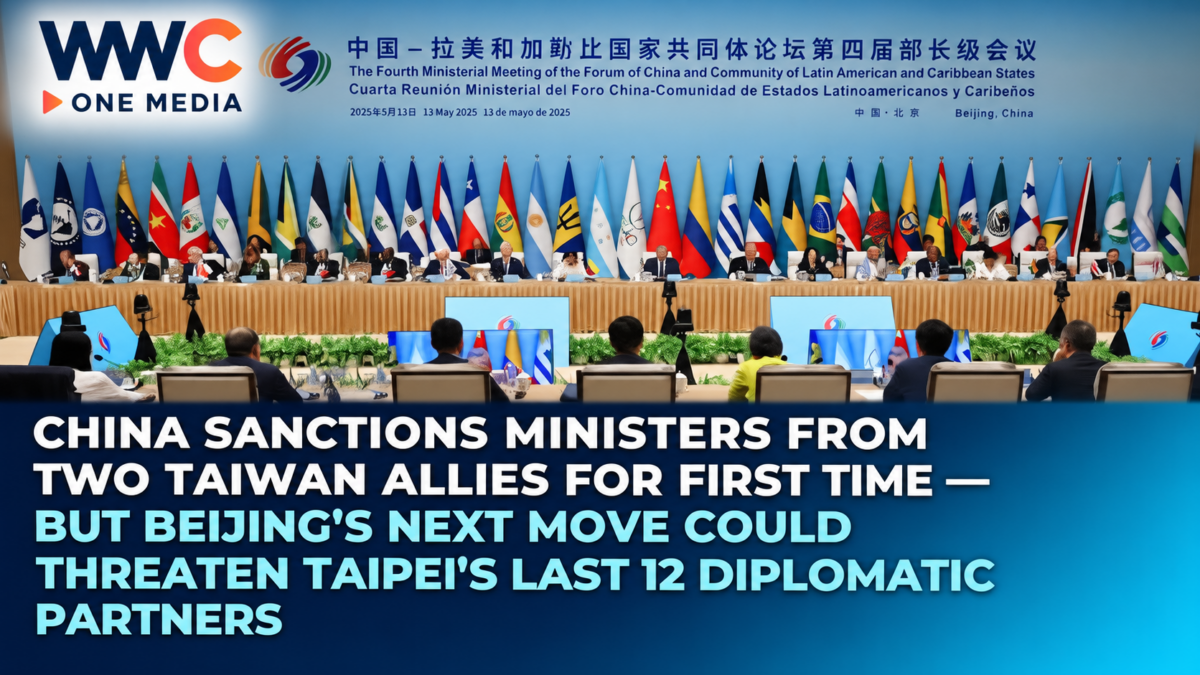
BEIJING, China — October 12, 2026 — China has imposed sanctions on senior government officials from Paraguay and Belize over their countries’ diplomatic relations with Taiwan, marking a significant escalation in Beijing’s campaign to isolate the self-governing island internationally.
The measures target Paraguay’s Minister of Information and Communication Technologies, Gustavo Villate, and Belize’s Foreign Minister, Francis Fonseca.
Announced by China’s Ministry of Foreign Affairs on Monday, October 12, the restrictions include freezing any assets the officials hold in China, barring their entry into mainland China, Hong Kong and Macau, and prohibiting Chinese organizations and individuals from conducting transactions or cooperating with them.
The decision is notable because China’s previous Taiwan-related sanctions have primarily targeted politicians from Western countries rather than serving officials of governments that formally recognize Taipei.
For Taiwan, the move highlights an increasingly aggressive diplomatic strategy aimed at its remaining international partners.
Only 12 countries continue to maintain formal diplomatic relations with Taiwan, following years of pressure from Beijing to persuade governments to switch recognition to the People’s Republic of China.
The immediate sanctions may be largely symbolic, but the bigger question is whether Beijing is preparing to impose greater costs on countries that refuse to abandon Taiwan.
Beijing Targets Two Senior Foreign Officials
China’s Foreign Ministry announced separate sanctions against Villate and Fonseca, accusing them of activities it considers harmful to Chinese national sovereignty and security.
Beijing said political figures in Paraguay and Belize had supported continued formal diplomatic relations with Taiwan and engaged in conduct that China considered hostile to its interests.
The ministry described the measures as necessary to defend national sovereignty and oppose activities associated with Taiwanese independence.
Under the restrictions, any relevant property or assets belonging to the sanctioned ministers within Chinese jurisdiction may be frozen.
The officials are also barred from entering mainland China, Hong Kong and Macau.
Chinese businesses, institutions and individuals are prohibited from engaging in transactions, cooperation or other dealings with them.
However, the actual financial effect is uncertain.
Reuters reported that the sanctions are largely symbolic because officials from Taiwan’s diplomatic allies rarely travel to mainland China.
No independently verified assessment of the ministers’ Chinese assets or financial losses was available when the sanctions were announced.
Who Are Gustavo Villate and Francis Fonseca?
Gustavo Villate serves as Paraguay’s Minister of Information and Communication Technologies.
His portfolio includes digital policy and technology development, making engagement with Taiwan especially relevant because of Taipei’s strength in semiconductors, computing and other technology industries.
In June 2026, Villate met Taiwan’s Deputy Foreign Minister Chen Ming-chi in Paraguay.
He also publicly commemorated Taiwan’s National Day on October 10, reaffirming Paraguay’s commitment to friendship, cooperation and shared democratic principles.
Francis Fonseca is Belize’s foreign minister.
In September, he met Taiwan’s Foreign Minister Lin Chia-lung during a visit to Belize.
The two governments discussed ways to deepen their diplomatic relationship and cooperation.
Belize also publicly marked the anniversary of its formal diplomatic relationship with Taiwan.
These high-level contacts demonstrate why Beijing may regard the ministers as important figures in Taiwan’s effort to maintain international recognition.
However, diplomatic engagement with Taiwan is not itself evidence of criminal wrongdoing.
The sanctions reflect China’s stated foreign-policy position rather than any independently established legal offense by the ministers.
Taiwan Has Only 12 Formal Diplomatic Allies Left
The sanctions come at a sensitive moment for Taiwan’s international position.
The island maintains its own democratically elected government, military, currency and institutions.
China claims Taiwan as part of its territory and has never ruled out using force to bring it under Beijing’s control.
Taiwan’s government rejects Beijing’s claim and maintains that its future should be determined by its own people.
Under China’s diplomatic policy, countries generally cannot maintain full diplomatic relations with both Beijing and Taipei.
Over the past several decades, most countries have established formal relations with the People’s Republic of China.
As a result, Taiwan’s remaining official diplomatic partners are relatively few.
Paraguay is particularly significant because it is Taiwan’s only remaining formal diplomatic ally in South America.
Belize is one of its remaining partners in Central America.
Taiwan also maintains diplomatic relations with countries in the Caribbean, Pacific and Africa, as well as the Holy See.
For Taipei, preserving these relationships is important because formal allies can advocate for its international participation and provide diplomatic support in global forums.
Beijing’s Sanctions Follow Taiwan’s National Day
The measures were announced just two days after Taiwan celebrated its National Day on October 10.
During the celebrations, Taiwanese President Lai Ching-te reaffirmed the island’s commitment to preserving peace and protecting its democratic system.
Lai emphasized that Taiwan would not give up its freedom despite increasing pressure from Beijing.
China strongly criticized the speech, accusing the Taiwanese leader of advancing a separatist political agenda.
Beijing considers Lai’s political position unacceptable because it views Taiwan’s future as an internal Chinese matter.
Taiwan, meanwhile, argues that its people have the right to determine their political future without coercion.
The timing of the sanctions suggests they are part of a broader diplomatic confrontation surrounding Taiwan’s status and international recognition.
However, Beijing did not announce a general suspension of relations with Paraguay or Belize because it does not maintain formal diplomatic relations with either country.
The sanctions apply specifically to the named officials.
Paraguay Defies Pressure to Abandon Taiwan
Paraguay remains one of Taiwan’s most important diplomatic partners.
President Santiago Peña has repeatedly expressed support for the relationship despite economic arguments favoring closer ties with Beijing.
In May 2026, Peña visited Taiwan and met President Lai Ching-te.
The two governments signed agreements involving judicial cooperation, cybersecurity and technology-related investment.
These agreements strengthened a relationship that extends beyond diplomatic symbolism.
For Paraguay, Taiwan provides opportunities involving technology, development assistance and international cooperation.
However, some business and agricultural interests have argued that diplomatic relations with Beijing could improve access to China’s enormous consumer market.
China is an important destination for South American agricultural products, including beef and soybeans.
Paraguay therefore faces an economic and political dilemma.
Maintaining recognition of Taiwan reflects the government’s diplomatic commitments, but critics question whether that position limits commercial opportunities with mainland China.
The new sanctions add another layer of pressure without directly altering Paraguay’s official diplomatic relationship with Taipei.
Belize Deepens Cooperation With Taiwan
Belize has also maintained a longstanding relationship with Taiwan.
The countries established diplomatic ties in 1989, building cooperation involving education, agriculture, healthcare, technology and development assistance.
In September 2026, Taiwan’s Foreign Minister Lin Chia-lung visited Belize for high-level discussions.
The visit was intended to strengthen bilateral relations and identify new areas for cooperation.
Belize has publicly expressed appreciation for Taiwan’s partnership and development support.
The government’s continued engagement with Taipei has placed it among the countries resisting Beijing’s effort to reduce Taiwan’s formal diplomatic recognition.
For Belize, the sanctions raise questions about whether maintaining that relationship could produce additional political or economic consequences.
However, there was no verified announcement on October 12 of broad Chinese trade sanctions against the Belizean economy.
The measures specifically target Foreign Minister Fonseca.
China Previously Persuaded Honduras and Nauru to Switch Sides
Beijing has successfully reduced the number of countries recognizing Taiwan over the past several years.
In March 2023, Honduras severed diplomatic relations with Taipei and established formal ties with Beijing.
The decision represented a significant diplomatic loss for Taiwan in Central America.
Another setback followed in January 2024 when the Pacific island nation of Nauru switched recognition from Taiwan to China.
Nauru’s decision came shortly after Taiwan’s presidential election.
Each diplomatic switch reduces the number of governments that formally recognize Taiwan.
It also allows Beijing to strengthen its argument that the People’s Republic of China is the sole internationally recognized government representing China.
Taipei has criticized Beijing’s use of diplomatic and economic pressure to persuade countries to change their relationships.
China, however, argues that recognition of Beijing is consistent with its interpretation of the one-China principle.
These competing positions are central to the dispute.
Why the New Sanctions Are Different
China has previously imposed sanctions on foreign politicians over support for Taiwan.
Those measures have often targeted lawmakers, former officials or organizations in Western countries.
The latest restrictions are different because they target sitting ministers from countries that formally recognize Taipei.
This broadens the potential audience for Beijing’s pressure.
Rather than focusing exclusively on influential Western supporters of Taiwan, China is now directly penalizing officials who help maintain Taiwan’s remaining diplomatic relationships.
The immediate consequences may be limited.
But diplomatic sanctions can carry a broader political message.
Other governments may interpret the move as a warning that their own officials could face restrictions if they deepen engagement with Taiwan.
The approach could also complicate future cooperation involving technology, investment and international travel.
However, the announcement does not establish that Beijing has adopted a permanent new sanctions policy against every Taiwanese ally.
Any broader escalation remains a possibility, not a confirmed decision.
Taiwan Faces Military Pressure Alongside Diplomatic Isolation
China’s sanctions were announced during a period of heightened military tension.
On October 12, Taiwan’s defense ministry said it was monitoring a series of live-fire military drills conducted by China along its coastline.
The exercises were taking place at several locations, including areas near Zhejiang province.
Taiwanese Defense Minister Wellington Koo said the drills did not surround Taiwan directly but required continued vigilance.
The exercises followed renewed exchanges between Beijing and Taipei after Taiwan’s National Day.
China has described military activity as a way to deter what it calls separatist actions and foreign interference.
Taiwan has characterized Beijing’s military presence and pressure as a threat to regional stability.
These developments highlight the multiple dimensions of the dispute.
China is applying diplomatic restrictions while continuing to demonstrate military capabilities.
Taiwan, meanwhile, is strengthening defense preparations and working to maintain international support.
United States Raises Concerns About Chinese Pressure
The United States remains Taiwan’s most important unofficial international security partner.
Washington does not maintain formal diplomatic relations with Taipei but provides defensive assistance under its domestic legal framework.
On October 10, the US State Department criticized Chinese maritime activities near Taiwan’s eastern coast as destabilizing.
American officials urged Beijing to stop pressuring Taiwan and pursue dialogue.
The United States has expressed particular concern about Chinese military and maritime activity around the island, including its implications for international shipping.
Beijing opposes foreign military support for Taiwan, arguing that such cooperation interferes in Chinese sovereignty.
The disagreement has become one of the most sensitive issues in US-China relations.
Although the new sanctions target Paraguay and Belize rather than Washington, they fit into a larger confrontation over Taiwan’s international space.
Why the Dispute Matters to Asia and the Philippines
The diplomatic confrontation also has implications for Southeast Asia.
Taiwan sits near major maritime routes that are important for regional trade and energy transportation.
Any escalation involving China and Taiwan could affect investor confidence, shipping costs and supply chains.
The Philippines has a particular interest in regional stability because of its geographic proximity to Taiwan.
The Bashi Channel between Taiwan and the northern Philippines is strategically important for maritime activity.
The Philippines also maintains close economic and people-to-people connections with Taiwan.
However, the October 12 sanctions do not directly target the Philippines.
They should not be interpreted as a new Chinese restriction against Philippine companies, travelers or officials.
The wider significance lies in Beijing’s expanding use of diplomatic pressure and its potential consequences for regional security.
For Southeast Asian governments, the challenge is maintaining economic relationships with China while responding to growing uncertainty over Taiwan and the broader Indo-Pacific.
Could China Target More of Taiwan’s Diplomatic Allies?
The immediate sanctions may have limited practical consequences.
Neither Paraguay nor Belize has announced a change to its diplomatic recognition of Taiwan as a result of the measures.
But Beijing’s decision creates uncertainty over whether similar restrictions could be directed at officials from other Taiwanese allies.
Such measures might include travel restrictions, asset freezes or prohibitions on business cooperation.
Whether China will introduce additional penalties remains unknown.
Beijing also has reasons to avoid measures that could produce diplomatic backlash or strengthen support for Taiwan.
Governments targeted by sanctions may resist further pressure rather than reconsider their existing partnerships.
The long-term effectiveness of the approach will therefore depend on how affected countries respond.
The Bigger Question: Is China Trying to Raise the Price of Supporting Taiwan?
The October 12 announcement represents another development in China’s effort to restrict Taiwan’s international diplomatic presence.
By sanctioning officials from Paraguay and Belize, Beijing is signaling that support for Taipei may carry consequences beyond diplomatic criticism.
For Taiwan, the challenge is preserving relationships with its remaining 12 formal allies while strengthening unofficial partnerships with major economies.
For Paraguay and Belize, the immediate issue is whether they can maintain their existing diplomatic commitments without experiencing additional economic or political pressure.
For China, the strategy is intended to reinforce its sovereignty claims and discourage further international engagement with Taipei.
But the ultimate outcome is uncertain.
Sanctions can communicate political displeasure, yet they do not necessarily convince governments to reverse their diplomatic decisions.
The larger confrontation involves competing views of sovereignty, democratic self-government and international recognition.
Taiwan’s remaining allies now find themselves under heightened scrutiny as Beijing considers how to increase pressure without generating greater resistance.
China has sanctioned officials from two of Taiwan’s few remaining diplomatic partners — but the bigger question is whether this unprecedented step will push more countries away from Taipei or strengthen their determination to stand by it.