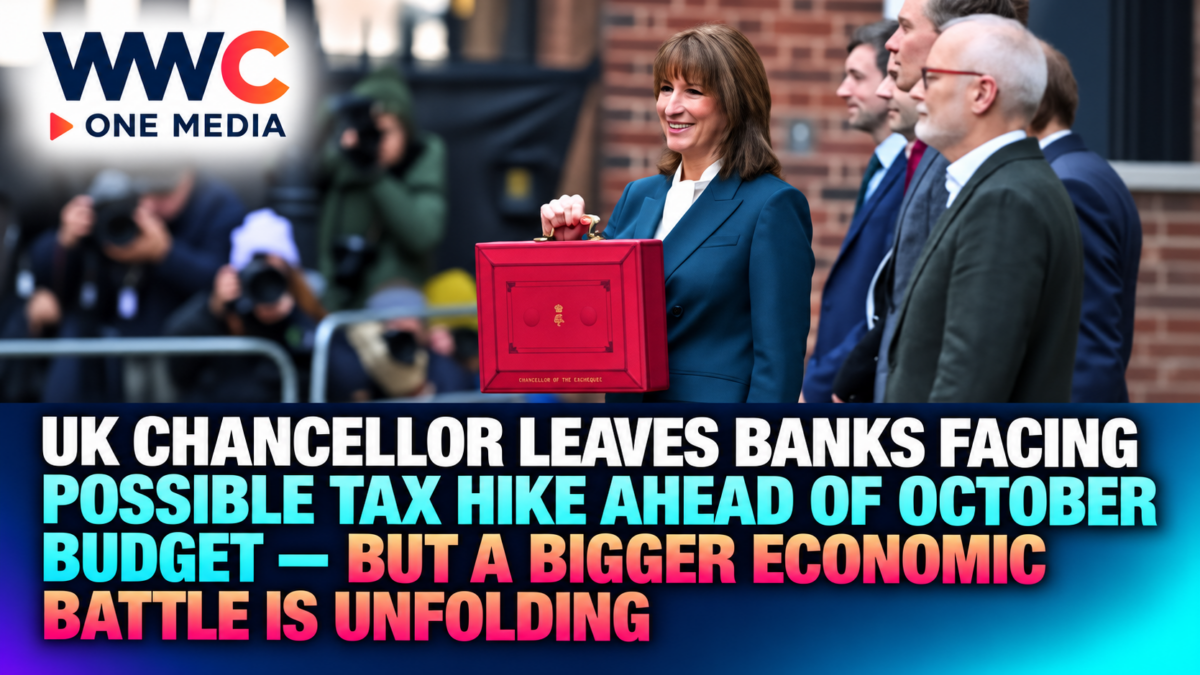
LONDON — Britain’s biggest banks have emerged from a high-stakes meeting with Chancellor John Healey without the assurance they wanted: that the government will spare them from another tax increase in its upcoming Budget.
The Chancellor told senior banking executives on October 6 that no decision had been made on whether to increase taxes on the financial sector.
But he also warned that Britain faces a challenging fiscal environment, with rising government borrowing costs and growing pressure to finance public services, defense and household support.
The meeting took place at 11 Downing Street, bringing together leaders from major financial institutions including HSBC, Barclays, Lloyds Banking Group, NatWest and other lenders.
The banks argued that additional taxation could discourage investment, weaken international competitiveness and make it harder to support economic growth.
Healey remained noncommittal.
With Britain’s October 28 Budget approaching, the banking industry now faces an uncomfortable question: Will the government ask lenders enjoying strong profits to contribute more to public finances—or conclude that higher taxes could damage the economic recovery it is trying to build?
Britain’s Biggest Bank Executives Delivered a Warning
The meeting included several of the most influential figures in British finance.
Among those involved were HSBC Chief Executive Georges Elhedery, Barclays CEO C.S. Venkatakrishnan, Lloyds Banking Group CEO Charlie Nunn and NatWest CEO Paul Thwaite.
Executives used the meeting to explain why they believe additional banking taxes could undermine the government’s economic priorities.
Their argument centers on a simple concern.
Banks operate in an internationally competitive industry.
Major financial institutions can choose where to deploy capital, expand operations and create jobs.
If the United Kingdom becomes significantly more expensive than competing financial centers, banks argue that future investment could increasingly move elsewhere.
The industry also says higher taxes may reduce resources available for lending to households and businesses.
But government officials face an entirely different pressure.
Britain needs additional revenue, and banks remain among its most profitable companies.
That makes them politically attractive potential taxpayers.
The October 28 Budget Is Becoming a Major Test
Healey is preparing to deliver his first major Budget since taking over as Chancellor in July 2026.
The financial statement is scheduled for October 28.
He has already pledged to prioritize fiscal discipline while supporting economic growth.
But achieving those goals is becoming increasingly difficult.
The government is facing rising borrowing costs, persistent inflation and additional spending demands.
Defense is one important pressure.
Britain has committed to increasing military expenditure over the coming years, creating substantial long-term funding requirements.
At the same time, households continue struggling with expensive energy and living costs.
That combination leaves the Chancellor with difficult choices.
He can raise taxes.
He can reduce spending.
He can borrow more.
Or he can attempt some combination of all three.
None offers an easy political solution.
Britain’s Banks Are Already Highly Taxed
The banking industry argues that it is starting from a comparatively expensive tax position.
According to UK Finance, the total tax rate for a representative corporate and investment bank operating in London is approximately 46.5%.
That compares with:
42.2% in Amsterdam,
39.1% in Frankfurt,
29% in Dublin,
and 27.9% in New York.
These comparisons include a broader range of taxes and employment-related costs, rather than representing only the statutory corporation tax rate.
UK Finance argues that London’s relatively high burden could weaken the country’s attractiveness for international banking investment.
The concern is especially important because Britain depends heavily on financial services as a source of employment, exports and tax revenue.
Banks Already Face Special Tax Rules
British banks are subject to additional taxes beyond ordinary corporation tax.
The UK’s main corporation tax rate is 25%.
Qualifying banking profits above the applicable threshold are also subject to a 3% bank corporation tax surcharge.
That surcharge was previously 8% before being reduced as part of changes introduced in 2023.
Banks also face a separate bank levy, calculated according to applicable balance-sheet liabilities and rules.
These industry-specific measures were introduced in the aftermath of the global financial crisis.
They reflected concerns that banks should contribute more toward public finances and the risks associated with the financial system.
The present debate is whether the sector should be asked to pay more again.
Britain’s Banking Sector Contributes More Than £40 Billion in Taxes
UK Finance estimates that Britain’s banking sector contributed approximately £43.3 billion in taxes during the financial year ending March 2025.
That represented about 4.3% of total UK government tax receipts.
The figure includes taxes borne directly by banking businesses and taxes collected through their activities.
Industry representatives use this contribution to argue that banking already provides substantial support to public finances.
But critics see the same numbers differently.
They argue that a highly profitable financial sector may be better placed than struggling households to absorb additional taxation.
That disagreement is now becoming central to the Budget debate.
Why the Government Is Considering Banks
The political argument for taxing banks has strengthened because of the industry’s recent financial performance.
Britain’s four largest banking groups generated approximately £29 billion in combined pretax profits during the first half of 2026, according to Financial Times reporting.
Those earnings have intensified calls for banks to contribute more toward public spending.
Higher interest rates have also supported parts of the banking industry.
When lending rates rise faster than deposit costs, banks can earn larger margins on some products.
That does not mean every bank automatically benefits from high interest rates.
Higher rates can also increase borrower defaults, funding expenses and economic risks.
Nevertheless, the industry’s strong overall profitability has made it a natural focus for politicians seeking additional revenue.
A Windfall Tax Is One Possibility
One proposal receiving attention is a windfall tax.
Such a measure would target profits considered unusually high or partly attributable to economic conditions beyond normal business activity.
Supporters argue that banks have benefited from higher interest rates while households and companies have faced increased borrowing costs.
They believe a temporary additional tax could help finance public services or cost-of-living relief.
The Trades Union Congress and Green Party politicians have supported proposals for increased taxation of banking profits.
Their broader argument is that extraordinary financial-sector earnings should contribute to addressing pressure on ordinary households.
But the government has not announced a specific new bank-tax policy.
A windfall tax remains a possibility—not a confirmed Budget measure.
Bank Executives Say Higher Taxes Could Backfire
The banking industry’s strongest argument concerns investment.
Banks say taxing profits more heavily could reduce the attractiveness of doing business in Britain.
International lenders compare the cost of operating in London with alternatives such as New York, Frankfurt and Dublin.
A bank deciding where to expand its trading operations, hire employees or allocate investment capital may consider differences in regulation and taxation.
Additional banking taxes could therefore affect international investment decisions.
Industry representatives also argue that reduced profitability could constrain the capital available for lending.
But that outcome is not automatic.
Whether a tax increase actually reduces lending depends on its design, scale, banks’ capital positions and the wider economic environment.
Critics Say Banks Can Afford to Pay More
Supporters of higher bank taxes reject the industry’s warnings as exaggerated.
They point to substantial profits and shareholder distributions.
British banks have continued paying dividends and conducting share buybacks, returning large amounts of capital to investors.
Critics argue that some of those distributions could instead be used to absorb additional taxes.
They also note that the financial sector benefited from substantial public support during the 2008 global financial crisis.
That history continues to influence the political debate over how much banks should contribute to the public finances.
For supporters of a windfall tax, the issue is one of fairness.
If households are paying higher energy bills and governments are struggling to finance essential services, they argue that profitable banks should share more of the burden.
The dispute therefore goes beyond tax policy.
It raises questions about who should finance Britain’s economic recovery.
Higher Government Bond Yields Are Making Everything Harder
The banking-tax debate comes during a difficult period for Britain’s bond market.
On October 1, long-term UK government borrowing costs surged as investors reacted to inflation and fiscal concerns.
The yield on 30-year British government bonds reached its highest level since 1998.
Bank stocks also fell sharply.
NatWest declined approximately 5.2%, HSBC lost 4.3%, Lloyds fell 4.4% and Barclays dropped nearly 4%.
The declines reflected broader pressure from rising bond yields and concern about the economic outlook.
Speculation about higher banking taxes added another potential risk for investors.
The connection is important.
Higher government borrowing costs increase the amount of money the Treasury must allocate to debt interest.
That reduces funds available for other priorities.
The Chancellor therefore faces growing pressure to demonstrate that government finances remain credible.
Britain’s Inflation Problem Has Not Disappeared
The economic challenge is complicated by persistent inflation.
Bank of England policymaker Catherine Mann warned on October 6 that elevated inflation risks becoming embedded in Britain’s economy.
She expressed concern that inflation could approach 4% around the end of the year.
Higher energy prices have added to the problem.
If inflation remains elevated, the Bank of England may need to maintain restrictive monetary policy or raise rates further.
That would increase borrowing costs for households and businesses.
It could also weigh on economic growth.
For the Treasury, this creates a difficult situation.
Higher inflation can increase government spending requirements.
Higher interest rates can increase debt-servicing costs.
And slower economic growth can weaken tax receipts.
That is one reason the October Budget is attracting such intense attention.
Energy Bills Are Creating Another Political Emergency
The Guardian reported on October 6 that Healey is also considering additional support for lower-income households facing rising energy bills.
One option under discussion involves a package worth approximately £1 billion to expand assistance through the Warm Home Discount.
The measure could increase support for eligible households.
But such assistance would also require funding.
That adds another dimension to the banking-tax debate.
Supporters of additional bank taxation could argue that stronger contributions from profitable lenders would help finance relief for households.
Opponents could argue that weakening the banking industry’s competitiveness would ultimately damage growth and reduce future tax revenue.
Both arguments are likely to become more prominent as the Budget approaches.
The Chancellor Also Wants Banks to Lend More
The meeting was not exclusively about taxes.
Bank executives also discussed the regulatory environment and how financial institutions could support economic growth.
The government wants stronger investment and greater access to credit for businesses and households.
Banks have argued that reducing some capital requirements and regulatory burdens could free up resources for lending.
The Bank of England has already moved to reduce certain capital expectations.
But proposals for further easing remain controversial.
Critics warn that excessive deregulation could undermine the resilience established after the global financial crisis.
That leaves policymakers balancing three competing goals:
Make banks financially resilient.
Encourage them to lend more.
And raise sufficient tax revenue.
Achieving all three simultaneously is not straightforward.
The International Competition Is Real
London remains one of the world’s leading financial centers.
Its strengths include deep capital markets, a large concentration of financial expertise, established legal infrastructure and extensive international connections.
But those advantages do not eliminate competition.
New York continues attracting substantial banking and investment activity.
European financial centers are competing for businesses that want access to the European Union.
Asian hubs such as Singapore and Hong Kong are also expanding their roles in global capital markets.
A sustained increase in Britain’s banking-tax burden could become one factor influencing future investment decisions.
However, taxation is only one consideration.
Regulatory stability, market access, available talent and customer relationships also matter.
That makes it difficult to calculate exactly how much economic activity would move abroad in response to any particular tax increase.
Bank Shareholders Are Watching Closely
For investors, the uncertainty matters because bank valuations depend heavily on expected future profits.
A permanent increase in the bank surcharge could reduce earnings available to shareholders.
A temporary windfall tax would have a different impact.
Changes to the bank levy would create yet another set of consequences.
That is why the precise structure of any tax measure matters as much as the headline announcement.
Investors will want to know whether a new tax is temporary or permanent.
They will also examine which institutions are affected and whether the measures apply equally to domestic and international banks.
An announcement perceived as particularly damaging to UK-focused lenders could cause renewed volatility in banking shares.
The Government Has Not Committed to a Bank Tax Increase
This is the most important distinction in Bloomberg’s report.
Despite the intense speculation, Healey has not announced a new banking tax.
He told executives that no decision had been made.
The October 6 meeting was an opportunity for the government to hear industry concerns ahead of the Budget.
That means several outcomes remain possible.
The Chancellor could introduce a windfall tax.
He could increase an existing banking tax.
He could adopt a narrower measure.
Or he could decide against additional taxation of the sector altogether.
Until the October 28 Budget, those possibilities remain speculative.
October 28 Could Determine the Next Direction for British Banks
The financial sector now faces three weeks of uncertainty.
Banks will continue arguing that higher taxes could undermine growth and international competitiveness.
Unions and other supporters of additional taxation will argue that the industry should contribute more.
Investors will monitor government signals for clues about the eventual decision.
And the Chancellor will have to weigh all of those pressures against Britain’s increasingly difficult public-finance position.
The stakes go beyond banking profits.
The Budget will help determine how Britain distributes the cost of rising public debt, expensive energy and greater government spending requirements.
It will also signal whether the government believes strengthening the financial sector and raising more revenue from it are compatible objectives.
Britain’s Banking Industry Has Won No Guarantees
For now, the banks have avoided an immediate announcement of additional taxes.
But they have not secured an exemption either.
Healey listened to their concerns.
He acknowledged the challenging fiscal situation.
And he left the decision open.
That uncertainty may itself weigh on banking stocks as investors prepare for the Budget.
Britain’s biggest lenders are warning that more taxes could weaken investment and lending just when the economy needs both.
The government, meanwhile, is confronting soaring borrowing costs and growing demands for public spending.
The bigger question is whether Chancellor John Healey can raise the revenue Britain needs without undermining the financial industry he is counting on to help deliver economic growth.