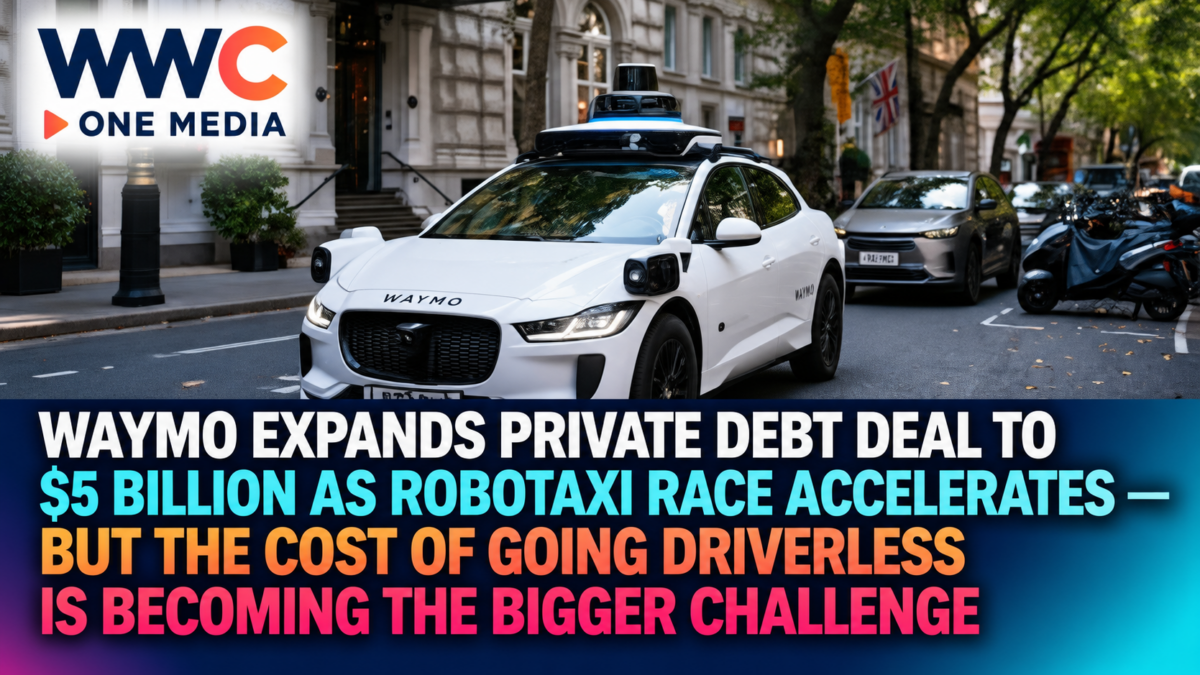
NEW YORK — Alphabet’s self-driving company Waymo is reportedly preparing to borrow $5 billion from some of Wall Street’s biggest private-credit investors, signaling that the global robotaxi race is entering a much more expensive phase.
The company has increased the size of its inaugural private-debt financing package from an initial target exceeding $3 billion to approximately $5 billion, according to Bloomberg’s October 6 report.
The transaction reportedly includes investment commitments from Pacific Investment Management Co. (Pimco), Blackstone and Sixth Street Partners, with Goldman Sachs assisting in arranging the financing.
The loan is reportedly priced at 5.25 percentage points above a benchmark interest rate.
That figure is particularly important because it represents a borrowing spread—not an all-in interest rate of 5.25%.
The total financing cost would also depend on the applicable benchmark and other contractual terms.
The deal comes as Waymo accelerates the expansion of its autonomous ride-hailing service across the United States while preparing to enter international markets.
But the bigger story is not simply that another artificial-intelligence company is raising billions of dollars.
Waymo is testing whether autonomous transportation can become a scalable business without the enormous costs of acquiring, operating and maintaining driverless fleets overwhelming its long-term profits.
Why Waymo Needs Another $5 Billion
Waymo has already demonstrated that robotaxis can operate commercially in multiple American cities.
The next challenge is scaling those services.
Unlike a software company that can serve additional customers through existing cloud infrastructure, Waymo must put more vehicles on the road as demand expands.
Every new city requires significant investment.
The company needs vehicles equipped with advanced autonomous-driving technology, charging infrastructure, maintenance operations and systems for monitoring fleet performance.
Vehicles must be cleaned, serviced and repaired.
Parking and charging facilities must be established.
Regulatory approvals must be secured.
And autonomous-driving systems must operate safely in different traffic conditions.
That makes robotaxi expansion a capital-intensive business.
The reported $5 billion borrowing package could provide additional financial flexibility as Waymo increases its operating footprint.
Waymo Already Raised $16 Billion Earlier This Year
The new debt financing follows one of the largest private technology funding rounds of 2026.
On February 2, Waymo announced that it had raised $16 billion in equity financing, valuing the company at $126 billion after the investment.
The financing was led by Dragoneer Investment Group, DST Global and Sequoia Capital.
Other investors included Andreessen Horowitz, Mubadala Capital, Silver Lake, Tiger Global and T. Rowe Price.
Alphabet remained Waymo’s majority investor.
Waymo said the capital would help finance global expansion and the development of its autonomous-driving technology.
The company also disclosed that it had completed more than 20 million fully autonomous rides since launching commercial operations.
The latest reported debt financing therefore represents a significant change in how Waymo is funding its growth.
Instead of relying exclusively on capital from shareholders, the company is increasingly turning to lenders.
Why Private Credit Is Becoming Important to the Robotaxi Industry
Private credit has become a major financing source for companies pursuing expensive infrastructure projects.
Unlike traditional publicly traded corporate bonds, private-credit arrangements are negotiated directly between borrowers and lenders.
These transactions can offer customized repayment terms, financing structures and commitments designed around the company’s investment requirements.
For Waymo, private credit could provide access to billions of dollars without requiring another immediate sale of equity.
That could help existing shareholders avoid additional dilution.
However, debt also creates obligations.
Borrowed money must generally be repaid, and interest expenses continue even if revenue grows more slowly than expected.
The reported borrowing spread suggests lenders are demanding compensation for the risks involved in financing a rapidly expanding autonomous-vehicle company.
That makes the transaction a financial test of Waymo’s business model.
Wall Street Sees Robotaxis as the Next Major AI Investment Opportunity
Artificial intelligence investment has traditionally focused on semiconductors, data centers and cloud computing.
Autonomous transportation represents a different opportunity.
Instead of using AI primarily to generate digital content or process information, Waymo uses it to operate vehicles in the physical world.
Its technology must recognize pedestrians, cyclists, traffic signals, road hazards and unpredictable driving situations.
That requires complex software supported by cameras, lidar, radar and advanced computing systems.
Waymo’s growing commercial operations suggest that autonomous driving is moving beyond research and development.
But investors are now being asked to finance the infrastructure required for mass adoption.
That explains why private-credit firms are becoming more interested.
The opportunity is potentially enormous.
So are the capital requirements.
Waymo Is Now Operating in 14 U.S. Cities
Waymo’s commercial expansion accelerated in September.
The company began welcoming paying riders in Denver, San Diego and Tampa, bringing its fully autonomous passenger-service network to 14 American cities.
The rollout is being conducted gradually.
Instead of immediately opening access to every potential customer, Waymo typically invites selected riders before expanding availability.
That allows the company to monitor operations and increase fleet capacity as demand develops.
Its recent expansion demonstrates that robotaxi services are becoming increasingly accessible to ordinary customers.
But operating in 14 cities also means managing a much more complicated business than a single-city pilot.
The Fleet Has Surpassed 4,000 Vehicles
Waymo’s expansion has been accompanied by significant growth in its physical fleet.
TechCrunch reported in September that the company was operating more than 4,000 autonomous vehicles.
The fleet includes Jaguar I-Pace electric vehicles and the newer Ojai autonomous vehicle platform.
Each vehicle represents a substantial investment.
Unlike conventional ride-hailing services, where drivers generally provide their own vehicles, Waymo must secure the cars and specialized systems that make driverless operation possible.
That creates a different financial structure from traditional ride-hailing platforms.
Waymo may eventually benefit from lower human-driver costs.
But it also faces much greater direct responsibility for vehicle-related capital and operating expenses.
One Million Paid Rides Per Week Is the Target
Waymo’s expansion strategy is built around an ambitious operational goal.
Co-Chief Executive Officer Tekedra Mawakana has said the company expects to exceed one million paid robotaxi rides per week by the end of 2026.
Earlier this year, the company reported more than 400,000 weekly rides across six major U.S. metropolitan areas.
Achieving the one-million milestone would demonstrate a substantial increase in commercial adoption.
However, ride volume alone is not the same as profitability.
A robotaxi service could generate millions of rides while still requiring significant additional investment in vehicles, technology and operational infrastructure.
Investors will eventually want to know how much profit each ride contributes after costs.
That may become the most important financial measure of Waymo’s long-term success.
Singapore Is Part of Waymo’s Global Expansion
Waymo is also preparing for its first major Southeast Asian commercial deployment.
On September 17, the company announced plans to introduce its fully autonomous electric ride-hailing service in Singapore in 2028.
The initiative is being developed in cooperation with Singapore’s Ministry of Transport and Land Transport Authority.
The planned launch represents a significant step beyond Waymo’s U.S. operations.
Singapore offers a highly developed transport system, strong digital infrastructure and an established regulatory environment.
But operating in the city-state will also require Waymo to demonstrate that its technology can handle local traffic conditions, road layouts and operational requirements.
The expansion could become a major test of the company’s ability to adapt its autonomous-driving system to Asian markets.
Japan Is Another Strategic Market
Waymo has also identified Tokyo as part of its international expansion ambitions.
The company previously announced work with Japanese partners to introduce and test autonomous-driving technology in Japan.
Tokyo presents a different operating environment from many American cities.
Its dense urban roads, complex intersections and highly developed public-transport network create unique challenges.
Successfully entering Japan would strengthen Waymo’s position as a global autonomous-mobility provider.
However, international expansion requires additional investment before commercial operations can produce meaningful revenue.
That is another reason access to financing matters.
Robotaxis Require More Than Self-Driving Software
One of the industry’s biggest misconceptions is that autonomous transportation becomes inexpensive once the human driver disappears.
In reality, the technology introduces additional costs.
Autonomous vehicles require specialized sensors, computing hardware, software development and fleet-management infrastructure.
Vehicles also need charging, cleaning, repairs and maintenance.
Waymo’s expansion in Nashville illustrates the operational challenge.
Lyft has established an approximately 80,000-square-foot facility in Tennessee to support autonomous vehicles.
The depot is designed to accommodate charging, maintenance, repairs and other fleet operations.
This demonstrates that robotaxi services still need substantial physical infrastructure.
Driverless transportation may reduce some traditional labor expenses.
It does not eliminate the cost of operating a commercial transportation network.
Competition From Tesla Is Intensifying
Waymo is also facing competition from Tesla.
Elon Musk’s electric-vehicle company has been expanding its robotaxi operations across several American cities.
Tesla is pursuing a different technological approach centered heavily on camera-based vision systems.
Waymo uses a combination of sensors, including lidar and radar, to support its autonomous-driving system.
The companies also differ in their operating and commercial strategies.
Waymo has established substantial experience providing fully autonomous paid rides across multiple markets.
Tesla is attempting to capitalize on its vehicle-manufacturing capabilities and existing technology infrastructure.
The competition could accelerate innovation.
But it could also increase financial pressure.
Companies may need to invest heavily to expand service areas, improve technology and attract customers before the industry settles into a sustainable economic model.
Amazon’s Zoox Is Another Competitor
Amazon-backed Zoox is also developing autonomous ride-hailing services.
Unlike Waymo’s approach of integrating its technology into existing vehicle platforms, Zoox has developed a purpose-built robotaxi designed specifically for passenger transportation.
That introduces another possible business model.
Waymo emphasizes scaling its autonomous-driving technology across supported vehicles and operating environments.
Zoox is attempting to develop a vehicle designed from the beginning for autonomous mobility.
Both approaches require significant capital.
The industry’s eventual winners may be determined not only by technological sophistication but also by the cost of producing and operating each vehicle.
Safety Remains the Most Important Requirement
Waymo has published research indicating that its autonomous vehicles experience lower rates of certain injury-causing crashes than human drivers in comparable operating environments.
The company reported in September that it had completed more than 300 million fully autonomous kilometers.
However, autonomous-vehicle safety remains under regulatory scrutiny.
U.S. authorities have investigated incidents involving Waymo vehicles, including their behavior around school buses and a collision involving a child.
Those investigations demonstrate why rapid expansion must be accompanied by rigorous oversight.
The company cannot afford to treat safety as merely another financial variable.
A serious incident could affect regulatory approvals, customer confidence and the pace of future expansion.
Safety therefore remains both a public-interest obligation and a major business risk.
Why Lenders Are Willing to Finance Waymo
The reported participation of Pimco, Blackstone and Sixth Street is notable.
These institutions manage substantial pools of private and institutional capital.
Their interest suggests that major financial investors increasingly view autonomous mobility as a sector capable of supporting significant financing.
Waymo’s connection to Alphabet is also relevant.
Alphabet provides financial backing, technological expertise and a relationship with one of the world’s largest technology companies.
However, Waymo’s financing obligations should not automatically be treated as equivalent to direct borrowing by Alphabet.
The specific legal borrower, guarantees, collateral and repayment terms matter.
Those details have not all been publicly disclosed.
Investors therefore should not assume the reported loan carries the same risk profile as Alphabet’s own corporate debt.
The Reported Interest Spread Is Significant
Bloomberg-derived reporting indicates that the financing carries a spread of approximately 5.25 percentage points above the applicable benchmark rate.
That is a substantial premium.
For example, if the relevant benchmark were 4%, adding a 5.25-percentage-point spread would produce a starting interest rate of approximately 9.25%, before other applicable costs.
That is an illustration—not a confirmed rate on Waymo’s loan.
Actual financing costs will depend on the contract, benchmark and other terms.
The distinction matters because the price of borrowing directly affects how much revenue Waymo must eventually generate to support its financing.
Rapid growth can be attractive.
But financing expensive infrastructure with costly debt raises the financial threshold for success.
Private Debt Could Help Waymo Expand Without Selling More Shares
The company’s earlier $16 billion funding round involved equity.
Investors contributed capital in exchange for ownership interests.
Debt works differently.
Lenders generally receive interest and repayment rights rather than ownership.
That allows Waymo to finance expansion while potentially preserving the ownership positions of Alphabet and other investors.
However, the tradeoff is greater financial leverage.
If Waymo’s commercial rollout proceeds as expected, the additional capital could accelerate growth.
If expansion is delayed or operating costs remain high, debt servicing could become a more significant burden.
That is why the financing structure deserves as much attention as the headline amount.
The Robotaxi Business Is Entering Its Most Expensive Phase
The autonomous-driving industry has spent years attempting to prove that vehicles can operate safely without human drivers.
Waymo has made substantial progress toward commercializing that technology.
But the next stage is fundamentally different.
The company must scale manufacturing partnerships, deploy fleets, establish local infrastructure and maintain vehicles across a growing number of cities.
It must also continue investing in software and hardware.
Those requirements create enormous upfront costs.
A successful robotaxi company may eventually produce recurring revenue from millions of rides.
But getting there requires sustained financial investment.
That is the challenge reflected in Waymo’s reported $5 billion debt package.
Growth Alone Will Not Be Enough
Waymo’s scale and investor backing give it a strong position in autonomous transportation.
Its $126 billion valuation earlier this year demonstrated considerable investor confidence.
Its fleet continues expanding.
Its U.S. service network has reached 14 cities.
And the company is preparing for international operations.
But public disclosures still do not provide enough detail to independently establish whether Waymo’s overall robotaxi operations are profitable.
That leaves major questions unanswered.
How much does a vehicle cost to deploy?
How many paid rides can it generate each day?
What are its charging and maintenance expenses?
How quickly must vehicles be replaced?
And how much revenue remains after financing and operating costs?
Those figures will become increasingly important as the industry matures.
Wall Street Is Now Financing the Physical AI Economy
Waymo’s reported borrowing also reflects a larger financial trend.
Artificial intelligence is moving beyond software applications into physical infrastructure.
Investors are financing data centers, semiconductor equipment, power systems and increasingly autonomous vehicles.
The capital requirements are substantial.
Companies must often spend billions before the underlying assets generate their expected returns.
Private-credit firms see opportunities to provide financing for that expansion.
But the financing must ultimately be supported by viable businesses.
Waymo’s loan would therefore represent another example of Wall Street betting that AI-powered infrastructure can eventually generate cash flows large enough to justify its enormous construction and operating costs.
The Real Test Is Turning Driverless Rides Into Sustainable Profits
Waymo has already achieved something that once seemed extraordinarily difficult.
It has brought fully autonomous vehicles into commercial service across multiple American cities.
Passengers are paying for rides.
Fleet sizes are increasing.
International expansion is taking shape.
And institutional investors are willing to finance further growth.
But the company is now entering a phase in which financial performance may matter as much as technological performance.
Borrowing $5 billion could accelerate the deployment of more vehicles.
It could help establish infrastructure in additional cities.
And it could support Waymo’s ambition to deliver more than one million paid rides per week.
But debt must eventually be repaid.
Waymo has already proved that robotaxis can operate without human drivers.
Now, with a reported $5 billion private-debt deal and billions more already raised from investors, the bigger challenge is proving that driverless transportation can generate enough profit to pay for its own expansion.