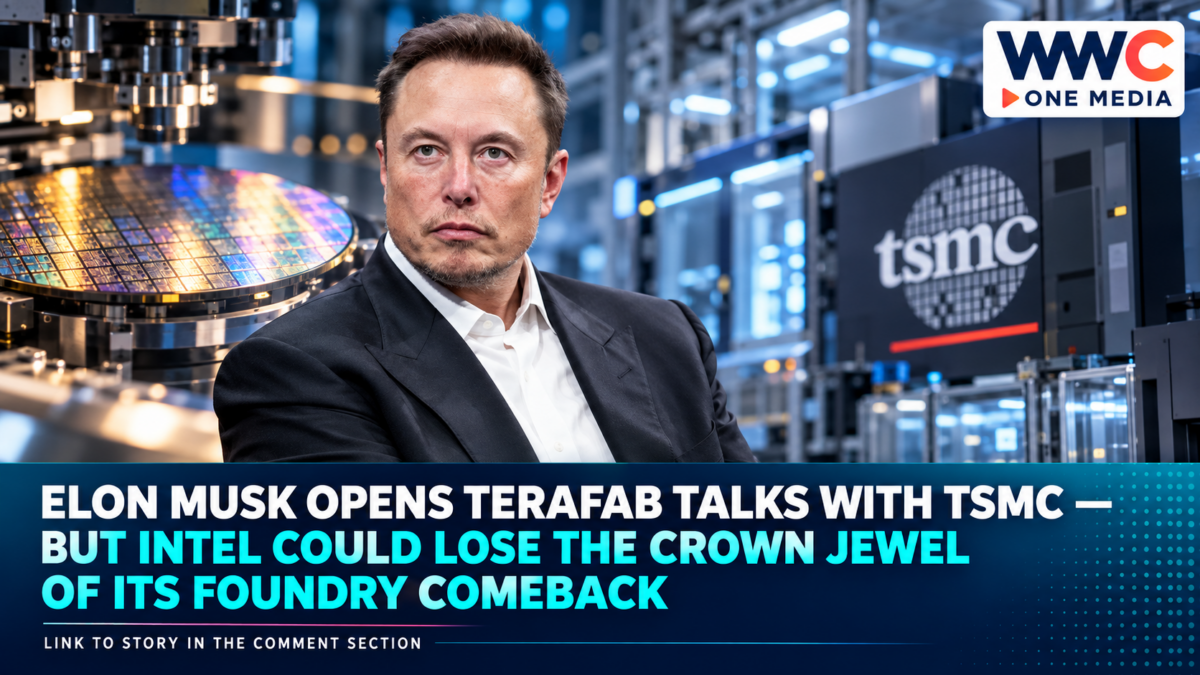
AUSTIN, Texas — Elon Musk’s enormous Terafab semiconductor project was supposed to become one of Intel’s biggest opportunities to prove that its struggling contract-chip business could finally challenge TSMC.
Now the world’s largest chip manufacturer may be entering the picture itself.
Musk confirmed that his companies are holding discussions with Taiwan Semiconductor Manufacturing Co., raising questions over how large a role Intel will ultimately play in Terafab — the ambitious Texas semiconductor complex being developed to supply chips for Tesla, SpaceX and xAI.
The talks immediately caught Wall Street’s attention.
Intel shares fell roughly 3% on Monday and another 3% during Tuesday trading, according to CNBC, while investors debated whether TSMC could take part of a manufacturing opportunity previously viewed as an important validation of Intel’s next-generation 14A process technology.
TSMC, meanwhile, reached a record closing high Monday as investors contemplated another potentially enormous source of advanced-chip demand.
But Musk has emphasized that nothing has been finalized.
Responding to reports about discussions with TSMC, Musk said they were:
“Just discussions, but something may come of it.”
He later agreed with a characterization suggesting TSMC could complement rather than eliminate Intel’s role.
That distinction is crucial.
Intel has not lost Terafab.
But for a company whose foundry comeback depends heavily on convincing major outside customers to trust its factories, simply having TSMC enter the conversation is enough to raise the stakes dramatically.
What Is Elon Musk’s Terafab?
Terafab is one of Musk’s most ambitious industrial projects yet.
SpaceX describes the initiative as a collaboration with Tesla designed to build manufacturing capacity capable of producing approximately 1 terawatt of computing hardware every year.
The goal is to vertically integrate several stages of semiconductor production, including:
chip design,
lithography masks,
logic-chip fabrication,
memory-chip production,
advanced packaging,
and rapid testing and redesign.
SpaceX said the project is intended to reduce future chip shortages, improve performance and potentially lower the enormous computing costs associated with artificial intelligence.
Intel joined Terafab in April 2026.
SpaceX said Intel would contribute its ability to design, fabricate and package high-performance semiconductors at scale.
Musk subsequently said Tesla planned to use Intel’s next-generation 14A manufacturing process as part of the project.
That immediately made Terafab much more important to Intel investors.
Because Intel doesn’t simply need another customer.
It needs proof that advanced customers genuinely want its factories.
Intel’s Bigger Problem Is TSMC
For decades, Intel dominated semiconductor manufacturing.
But it lost technological ground while TSMC built the world’s most successful independent chip foundry.
Today, TSMC manufactures advanced processors for companies including:
Nvidia,
Apple,
AMD,
Broadcom,
and numerous other semiconductor designers.
Intel is trying to challenge that model through Intel Foundry, opening its factories to outside customers instead of manufacturing primarily for its own processor businesses.
That strategy is one of CEO Lip-Bu Tan’s most important turnaround projects.
Terafab appeared to offer Intel exactly what it needed:
A high-profile customer.
Huge potential volume.
A demanding application involving AI, autonomous vehicles and aerospace.
And public validation for Intel 14A.
If TSMC becomes a major Terafab partner, Intel may suddenly have to share that spotlight with the very company it is trying to catch.
Wall Street Sees Several Possible TSMC Deals
Analysts do not yet agree on what Musk and TSMC are discussing.
One possibility is relatively modest.
Bank of America analyst Haas Liu believes the cooperation is more likely to involve increased chip purchases for Tesla and SpaceX than TSMC handing over its manufacturing secrets.
Liu estimated Tesla and SpaceX could eventually represent around 2% to 3% of TSMC sales, directly through automotive, robotics and AI ASICs and indirectly through purchases of GPUs and networking chips.
He said the probability of TSMC licensing its manufacturing technology or operating a factory in which Terafab owns a meaningful stake appears relatively low.
That would be the less threatening scenario for Intel.
TSMC could simply supply Musk’s companies alongside Intel without fundamentally changing Terafab’s manufacturing structure.
But other analysts see a much broader possibility.
Could TSMC Actually Help Run Musk’s Factory?
D.A. Davidson technology research chief Gil Luria told CNBC there could be commercial structures in which TSMC shares limited manufacturing intellectual property.
TSMC could carefully restrict what technology it provides while still earning highly attractive economics from licensing.
Semiconductor historian and American Enterprise Institute expert Chris Miller also noted that licensing and joint-development arrangements are not unprecedented in the semiconductor industry.
Sharing technology can allow companies to divide research costs, manufacture products in different geographical locations and expand capacity more quickly.
That possibility is exactly what Intel investors fear.
If Musk can gain access to TSMC manufacturing expertise — rather than merely buy finished chips — Terafab could become far less dependent on Intel technology.
TSMC Was Already Looking at Texas
The timing makes the speculation particularly interesting.
Reuters reported on September 30 that TSMC is evaluating a potential semiconductor investment in Texas.
The plans have not been finalized.
But a Texas facility would come on top of TSMC’s extraordinary U.S. expansion.
The Taiwanese company has already committed around $265 billion to Arizona, including fabrication plants, advanced-packaging facilities and a research-and-development center.
TSMC CEO C.C. Wei has said the company expects to build additional facilities as demand continues growing.
That means the Musk discussions are occurring just as TSMC is already considering a much larger American manufacturing footprint.
Wall Street quickly connected the dots.
Mizuho analyst Jordan Klein suggested that a Texas facility being considered by TSMC could potentially become connected to Terafab.
One possible structure would have TSMC own and operate the factory while Musk-linked companies invest capital, guarantee purchases — or do both.
TSMC Could Be Good for Terafab — And Bad for Intel
From Musk’s perspective, using more than one supplier makes considerable sense.
Tesla, SpaceX and xAI consume rapidly growing quantities of advanced semiconductors.
Musk’s companies need chips for:
AI training,
robotics,
autonomous vehicles,
satellites,
data centers,
and potentially enormous orbital computing systems.
Relying entirely on a single manufacturing technology could create another bottleneck.
Having Intel and TSMC involved could therefore give Musk:
more capacity,
supply-chain redundancy,
stronger negotiating leverage,
and access to two different semiconductor manufacturing ecosystems.
For Terafab, that could be positive.
For Intel shareholders, it is more complicated.
Mizuho’s Klein described potential TSMC participation as positive for TSMC but a modest negative for investors betting on Intel.
The concern is not necessarily that Intel disappears from Terafab.
It is that Intel may no longer be indispensable.
Intel 14A Is Bigger Than Terafab
This is where the story becomes strategically important.
Intel 14A is the company’s planned manufacturing technology beyond Intel 18A.
Intel says development has made substantial progress and that several potential major customers are evaluating the process.
But the company has also acknowledged something important:
How aggressively it expands 14A manufacturing will depend on how much committed customer demand it can secure.
In its second-quarter regulatory filing, Intel said it would scale manufacturing investment based partly on design wins from significant external customers.
That makes every major outside commitment important.
Terafab was therefore valuable not merely because Musk’s companies might buy enormous numbers of chips.
It could have served as a public endorsement telling the rest of Silicon Valley:
Intel 14A works.
If TSMC becomes a major manufacturing partner instead, that endorsement becomes much less exclusive.
Intel Foundry Is Still Losing Billions
Intel’s foundry business is improving, but the financial numbers show why outside customers matter so much.
Intel Foundry generated about $5.77 billion in second-quarter 2026 revenue.
But substantially all of Intel Foundry’s business still supports Intel’s own products.
The segment posted an operating loss of approximately:
$2.09 billion in Q2 alone.
Across the first half of 2026, Intel Foundry lost approximately:
$4.53 billion.
Intel explicitly says its goal is to build a much larger external foundry operation.
That requires convincing companies that normally manufacture at TSMC or Samsung to move important designs into Intel factories.
Terafab appeared capable of becoming one of the most visible examples.
Outside Foundry Revenue Remains Tiny
The gap becomes even clearer when looking at outside customers.
Intel Foundry generated roughly $293 million from external customers during the second quarter, according to reporting based on its latest results.
But around $181 million came from Altera, which used to be controlled by Intel before the company sold a majority stake.
Excluding Altera, other outside customers accounted for only about $112 million.
Against Intel Foundry’s $5.8 billion quarterly revenue base, that remains tiny.
So Intel’s challenge is straightforward:
It needs major external semiconductor companies to put real, high-volume products into Intel factories.
Not evaluations.
Not discussions.
Actual production.
Google Has Given Intel Some Momentum
The outlook is not entirely negative.
Reuters reported in June that Alphabet had contracted Intel to manufacture more than three million of Google’s internally designed Tensor Processing Units for 2028, according to The Information.
Nvidia was also reportedly evaluating Intel for certain advanced manufacturing work.
Intel shares surged after those reports because they provided evidence that major technology companies may finally be willing to use Intel’s foundry capabilities.
That gives Intel more than one potential path to success.
Terafab matters.
But it is not the entire turnaround.
Intel Investors May Already Be Pricing In a Comeback
The concern on Wall Street is that Intel’s stock has already risen enormously.
The shares have more than tripled in 2026.
That means expectations are dramatically higher than they were at the beginning of the year.
D.A. Davidson’s Luria has warned that some Intel investors may currently be looking through “rose-colored glasses.”
His argument is essentially about expectations.
If investors already assume Intel will win major 14A customers, then every sign that a customer could use TSMC instead becomes disproportionately important.
That may explain why the Terafab headlines caused such an immediate selloff even though no Intel contract has actually been cancelled.
Intel’s Role Was Never Guaranteed
There is another detail investors should not overlook.
SpaceX’s own filing says the Terafab framework remains flexible.
Specific projects under the initiative require separate negotiations covering:
development schedules,
milestones,
capital expenditure,
and other commercial arrangements.
SpaceX also indicated that participation by Tesla or Intel in future specific projects is not necessarily guaranteed.
In other words, Intel joining Terafab in April did not mean every future Terafab chip automatically belonged to Intel.
The project’s structure was deliberately left open.
That makes today’s TSMC discussions less surprising — but potentially no less consequential.
Musk May Want Competition
There is also a negotiating dimension.
Equity Armor Investments CEO Luke Rahbari suggested that bringing TSMC into the conversation could give Musk leverage with Intel.
Two world-class semiconductor manufacturers competing for business would give Terafab much greater negotiating power over:
pricing,
manufacturing capacity,
technology,
and investment commitments.
Musk has repeatedly pursued aggressive vertical integration where he believes existing suppliers create bottlenecks.
But vertical integration does not necessarily mean doing everything alone.
It can also mean controlling the relationship among multiple suppliers.
Why TSMC Has the Stronger Foundry Record
Intel may possess enormous manufacturing expertise, but TSMC has something Intel Foundry is still trying to build:
decades of experience producing advanced chips for outside customers.
TSMC’s entire corporate model revolves around manufacturing semiconductors designed by other companies.
That means it has built vast infrastructure around:
customer confidentiality,
design tools,
process portability,
production yields,
capacity planning,
and high-volume manufacturing.
Intel historically designed and manufactured most of its own processors.
Transforming that culture into an independent foundry competing directly for external customers is a massive strategic change.
That is why every Intel 14A customer matters so much.
AI Is Creating an Unprecedented Chip Shortage Risk
The broader backdrop is exploding semiconductor demand.
AMD CEO Lisa Su said this week that her company intends to significantly increase chip supply in 2027 and is already planning capacity requirements three to five years ahead.
AMD is meeting suppliers including TSMC, Foxconn, Samsung and SK Hynix as it attempts to secure enough advanced wafers and memory to satisfy AI demand.
Nvidia, AMD, Google, Amazon, Microsoft, Meta, OpenAI and Musk’s companies are all competing for similar manufacturing resources.
That pressure is exactly why Musk created Terafab.
He does not want Tesla, SpaceX and xAI’s growth constrained because another company controls semiconductor capacity.
This Could Become Much Bigger Than Intel Versus TSMC
Terafab’s stated objective — one terawatt of compute hardware annually — is extraordinary.
If Musk comes anywhere close to that target, the project could require an industrial semiconductor ecosystem rather than a single foundry.
That could include:
Intel,
TSMC,
memory manufacturers,
advanced-packaging companies,
lithography suppliers,
networking-chip companies,
and other specialist semiconductor businesses.
Under that scenario, TSMC joining Terafab would not necessarily mean Intel loses.
Both companies could receive substantial work.
But investors care about relative importance.
If Intel goes from the manufacturing partner to merely one manufacturing partner among several, the value of Terafab as proof of Intel’s foundry comeback changes considerably.
The Real Test for Intel Is Still Ahead
The market’s reaction may therefore be less about Musk and more about Intel itself.
Intel has spent billions attempting to restore manufacturing leadership.
It has improved its technology roadmap.
It has expanded U.S. factories.
Potential outside customers are evaluating 14A.
And investors have rewarded those developments with one of the semiconductor sector’s biggest stock rallies of 2026.
Now Intel has to deliver actual customer wins.
TSMC’s discussions with Musk provide a reminder that Intel’s biggest competitor is not standing still.
TSMC is expanding in America.
AI demand is pushing its factories toward capacity limits.
Its largest customers are spending hundreds of billions of dollars.
And now it may have an opportunity to participate in one of the world’s most ambitious semiconductor manufacturing projects.
For Elon Musk, having Intel and TSMC competing for Terafab could be exactly what he wants.
For TSMC, it could open another huge source of U.S. demand.
For Intel, the situation is much more uncomfortable.
Terafab was supposed to show that Intel could finally win back advanced manufacturing business from TSMC.
Now Intel may have to prove that case while TSMC is standing inside the same factory negotiations.