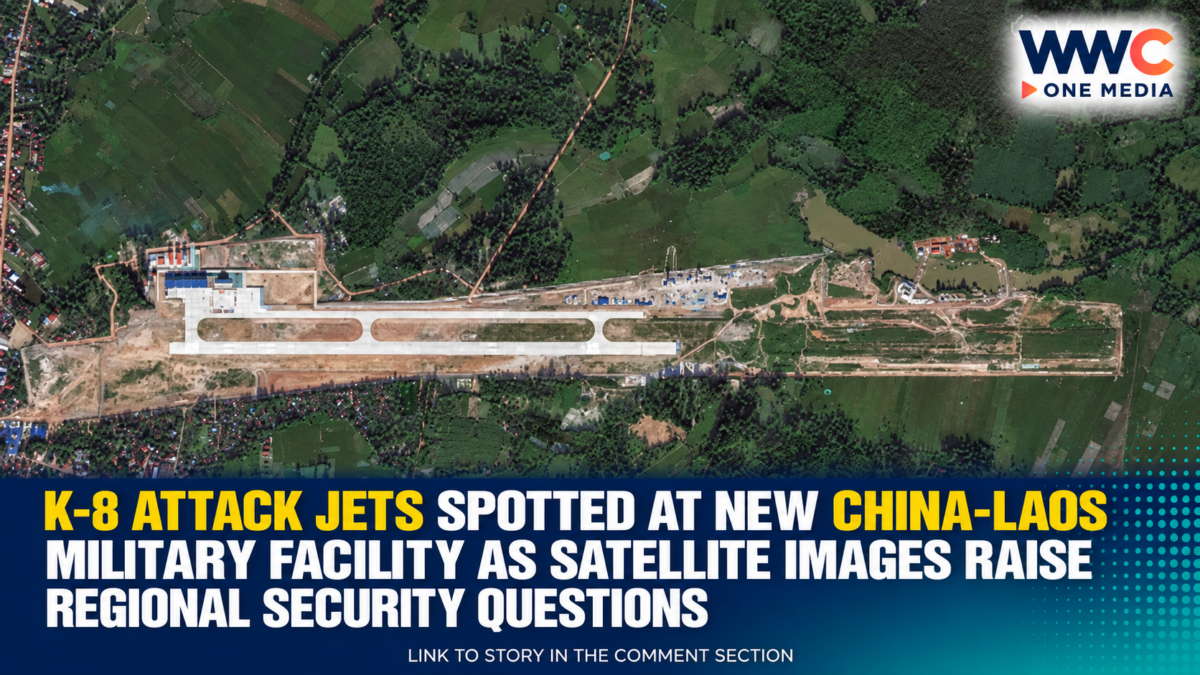
At least eight K-8 light attack and training aircraft and more than two dozen military support vehicles have been spotted at a newly established China-Laos joint facility in Laos, according to satellite imagery reviewed by Reuters.
The images, captured on Sept. 30, show aircraft and vehicles positioned on a runway that is still under construction at Ban Keun, about 50km north of the Lao capital, Vientiane.
The development comes only a day after China’s Defence Ministry announced the establishment of the China-Laos Joint Support and Training Center and the China-Laos Friendship Aviation Academy at the site.
The rapid construction and arrival of military aircraft have drawn attention from regional security analysts, some of whom believe the facility could eventually become a more substantial Chinese military foothold in Southeast Asia.
Satellite Images Show Aircraft and Support Vehicles
Commercial satellite images provided by Vantor show eight aircraft that analysts identified as Hongdu JL-8s, commonly known as K-8s.
The two-seat aircraft is used primarily for pilot training but can also carry out light-attack missions.
The aircraft are operated by both China and Laos, meaning the imagery alone does not establish which country owns or operates the aircraft currently positioned at Ban Keun.
More than 20 military and support vehicles were also visible around the developing airfield.
The imagery provides an early look at activity at a facility that has only recently been publicly acknowledged by Beijing.
Construction around the runway was still continuing when the images were taken, suggesting the site is not yet complete.
China Says Facility Is for Training
China’s Defence Ministry has described the new facility as a joint training and support centre rather than a conventional overseas combat base.
The China-Laos Friendship Aviation Academy is intended to support air-force pilot training, while the joint support and training centre will facilitate broader military cooperation between the two countries.
Beijing has stressed that the facility is not directed against any third party.
China and Laos have maintained close political and military ties for years, including joint exercises and high-level military exchanges.
The two countries also conducted a joint exercise focused on humanitarian response in September, shortly before the new facility was announced.
Why Ban Keun Matters
The location of the facility has attracted particular attention.
Ban Keun is relatively close to Vientiane and lies within reach of major infrastructure connecting Laos with China, including the China-Laos railway.
Rachel Vandenbrink, a senior analyst at the Australian Strategic Policy Institute, said the location could give China’s People’s Liberation Army persistent access to a logistics hub capable of supporting forces operating in Laos.
However, she also cautioned that it remains unclear what unique military advantage the location provides China compared with facilities in China’s neighbouring Yunnan province.
The more immediate significance, she said, may be Beijing’s ability to establish a continuing military presence and deepen its institutional relationship with the Lao armed forces.
Could It Become a Larger Military Base?
The current facility appears relatively modest, but analysts are watching its construction for signs that its military role could expand.
Security specialists are particularly interested in whether the site eventually receives air-defence systems, ammunition and fuel storage, surveillance equipment or other permanent military infrastructure.
Alexander Neill, an adjunct fellow at the Pacific Forum, said the runway appears to have been engineered in a way that could potentially allow it to be extended.
Such an expansion could eventually make the airfield suitable for larger aircraft, including surveillance or signals-intelligence platforms.
That possibility remains speculative, however.
There is currently no confirmation that China intends to deploy larger aircraft or establish permanent combat forces at Ban Keun.
China’s Expanding Overseas Military Footprint
The development is significant because China has historically maintained a relatively small network of overseas military facilities compared with the United States.
China’s known overseas military presence includes its Djibouti base, which opened in 2017, and its growing presence at Ream Naval Base in Cambodia.
China has also constructed military-grade facilities on several disputed features in the South China Sea, including Fiery Cross, Mischief and Subi reefs.
The Ban Keun facility could therefore represent another step in Beijing’s effort to expand access and logistical options beyond mainland China.
Some defence analysts have described the Laos facility as potentially China’s first full-fledged overseas military base in Southeast Asia, although the exact classification remains debated because Beijing and Vientiane have presented it as a joint training and support facility.
The Diplomat has similarly described the facility as giving China a new security foothold in mainland Southeast Asia, while noting its focus on logistics and training.
A Site With a Cold War History
The location also has an unusual military history.
During the Vietnam War era, the Ban Keun airfield was reportedly used by Air America, an airline secretly controlled by the US Central Intelligence Agency, to support US-backed forces in Laos.
The site was known as Lima Site 44.
Air America operated aircraft and helicopters from numerous locations in Laos during the conflict, transporting personnel and supplies and supporting Hmong forces allied with the United States.
The development of a Chinese-backed military facility at the same location decades later adds another layer of historical significance to the site.
Laos Deepens Defence Ties With China
Laos has long maintained close relations with China, while also having historic defence ties with Vietnam and other partners.
Its air force is relatively small and operates a limited number of Chinese- and Russian-designed aircraft.
Before the Ban Keun facility became operational, Lao personnel often travelled abroad for more advanced military training.
The new aviation academy could allow more of that training to take place inside Laos.
China’s growing involvement also comes as Beijing has expanded economic and infrastructure ties with Laos, with the China-Laos railway becoming a major component of the relationship.
For Beijing, closer defence cooperation could complement those existing economic links.
Regional Governments Watching Closely
The facility is likely to attract attention from countries elsewhere in Southeast Asia, particularly those concerned about China’s growing military presence.
Thailand, which shares a long border with Laos and maintains close relations with both Laos and China, has said it recognises Laos’ sovereign right to decide whether to host such a facility.
At the same time, Thai defence officials have indicated that Bangkok will continue monitoring developments and their implications for regional trust and security.
The United States is also closely watching China’s expansion of its overseas military infrastructure.
China has repeatedly said its defence cooperation with other countries is based on mutual respect and does not target third parties.
What Happens Next
The most important question now may be what happens as construction at Ban Keun continues.
Analysts will be looking for evidence of additional aircraft, permanent personnel, weapons storage, fuel facilities, radar or surveillance equipment and other infrastructure that could indicate a role beyond pilot training.
For now, the K-8 aircraft and support vehicles provide the clearest indication yet that the new facility is already becoming operational.
But satellite imagery alone cannot establish whether the aircraft are permanently stationed there, whether they belong to China or Laos, or how the facility will ultimately be used.
What is clear is that China has established a new military-linked presence in mainland Southeast Asia — at a site where construction has progressed rapidly and where the potential for a broader role is already being closely watched by regional security analysts.