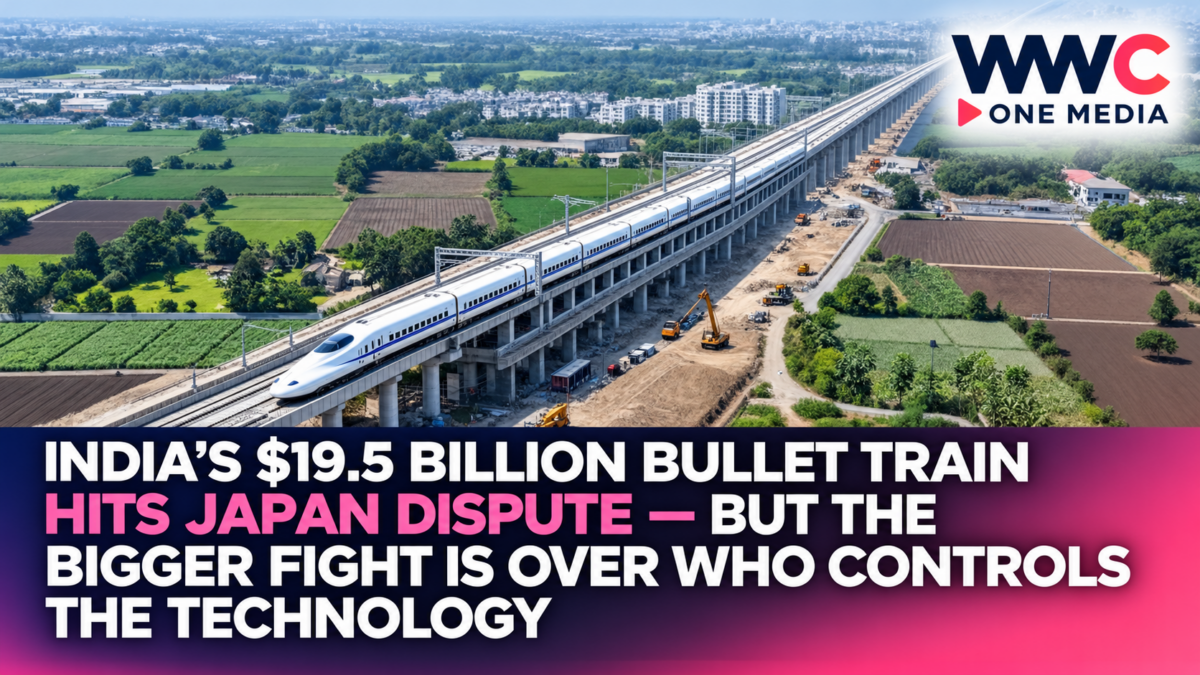
NEW DELHI/TOKYO — India’s first bullet train was supposed to become one of the clearest symbols of its strategic partnership with Japan. Instead, the $19.5 billion Mumbai–Ahmedabad high-speed rail project is exposing a growing disagreement over cost, delays, technology and how much control India should have over the railway it is building.
The 508-kilometer corridor linking Mumbai with Ahmedabad was conceived around Japan’s highly regarded Shinkansen system, backed by exceptionally long-term Japanese financing and technology transfer.
But more than a decade after the two governments agreed on the project, India is preparing to launch the first operating section using a domestically developed high-speed train rather than a Japanese Shinkansen.
It has also awarded the signaling contract to a consortium led by Indian construction group Dineshchandra R. Agrawal and Germany’s Siemens, which will install the European Train Control System, or ETCS Level 2.
Those decisions have become the center of a much deeper disagreement.
Japan wants the railway to preserve the integrated technology philosophy that helped make its Shinkansen network one of the safest and most reliable high-speed rail systems in the world.
India increasingly wants flexibility, localization and control over the technology used on what it hopes will eventually become a nationwide bullet-train network.
The result is an unusual situation:
Japan is still financing and helping build India’s first high-speed railway, while India is simultaneously developing alternatives to some of the Japanese systems that originally defined it.
The project was once supposed to open years ago
India and Japan agreed in 2015 to build the Mumbai–Ahmedabad High-Speed Rail corridor.
The original estimated cost was around ₹980 billion, while the project was expected to enter service much earlier in the 2020s.
The Financial Times now estimates the cost at roughly ₹1.87 trillion, or about $19.5 billion, reflecting delays, inflation and other cost pressures.
The corridor itself stretches approximately 508 kilometers through Maharashtra, Gujarat and Dadra and Nagar Haveli.
It will have 12 stations and is designed for trains operating at up to 320 kilometers per hour, cutting travel between Mumbai and Ahmedabad to roughly two hours.
Japan agreed to provide the majority of the financing through the Japan International Cooperation Agency, or JICA.
JICA records show multiple massive loan packages have already been approved, including ¥400 billion in 2023 alone for one stage of construction, on highly concessional terms.
That financing made Japan much more than an ordinary equipment supplier.
The project became a flagship of the strategic relationship between Prime Minister Narendra Modi’s India and Japan.
Then the delays started
One of the biggest early problems was land acquisition.
The Indian government has acknowledged that difficulties acquiring land in Maharashtra affected progress through 2021.
By February 2026, however, the government said all 1,389.5 hectares required for the corridor had finally been acquired, all statutory clearances obtained and all identified utilities shifted.
Construction has since accelerated.
Viaducts, bridges, stations, tunnels, tracks and electrification are advancing rapidly in Gujarat and Maharashtra.
On October 4, authorities announced completion of the massive Sabarmati River bridge, with 18 of Gujarat’s 21 river bridges then finished.
The physical railway is therefore increasingly real.
But while concrete and steel are moving forward, the technological architecture of the railway has become much more contentious.
The biggest disagreement is over the trains themselves
The original concept was straightforward:
India would build a high-speed railway based on Japan’s Shinkansen technology.
But the Japanese E5 series, which had initially been expected to play a role in the project, is being phased out.
Japan is now developing a next-generation E10 Shinkansen.
That created a timing problem.
Indian railway officials said Japan could not provide the E10 to India quickly enough for the first section to begin commercial service in 2027.
One senior Indian official said the Japanese train may not be available for delivery to India until around 2034, although India’s Foreign Ministry has more generally described the timetable as the “early 2030s.”
India did not want its newly built railway sitting unused for years while waiting for the Japanese train.
So it chose another solution.
India is building its own bullet train
India is developing a domestically manufactured high-speed train known as the B28.
The train is being produced by state-owned BEML at its new Aditya manufacturing complex in Bengaluru.
India says the B28 will have a design speed of around 280 km/h and an operating speed of roughly 250 km/h.
The first prototype is expected around early 2027.
The government plans to use the Indian train on the initial Surat–Vapi section, approximately 97 kilometers long, with commercial operations targeted for August 2027.
That makes the B28 much more than a temporary substitute.
It could become the foundation of India’s own high-speed train manufacturing industry.
And that is exactly where Japan’s concerns become strategically important.
India does not want to depend forever on imported Shinkansen trains
For Modi’s government, the bullet-train program fits into the broader Make in India strategy.
India does not merely want to operate high-speed trains.
It wants to learn how to:
design them;
manufacture them;
maintain them;
build tracks for them;
develop signaling;
and eventually export the technology.
The government says around 1,000 Indian engineers and skilled workers have already been trained in Japanese high-speed rail methods.
Indian companies are also increasingly producing track components and specialized construction machinery domestically.
That localization is strategically valuable because Mumbai–Ahmedabad is not intended to be India’s only bullet-train corridor.
The government says the experience is being used to build a standardized template for thousands of kilometers of future high-speed rail lines.
If India permanently depended on Japanese rolling stock and proprietary systems, every future corridor could potentially require large foreign technology purchases.
Building domestic capability changes that equation.
Signaling has become an even bigger flashpoint
The disagreement is not limited to trains.
India has also moved away from Japan’s proprietary high-speed signaling architecture.
In 2025, NHSRCL awarded a roughly ₹41.4 billion contract to a consortium involving Dineshchandra R. Agrawal Infracon, Siemens Limited and Siemens Mobility.
Siemens will provide ETCS Level 2-based signaling and train-control technology.
The company says the contract covers design, installation and long-term maintenance of signaling and telecommunications systems across the Mumbai–Ahmedabad corridor.
ETCS is widely used internationally.
India argues that an open international standard provides greater flexibility and compatibility with domestic rolling stock.
But Japanese critics see the decision very differently.
Japan argues that Shinkansen safety comes from the entire system
Japan’s Shinkansen is not simply a train.
It is an integrated ecosystem.
Rolling stock.
Signaling.
Control centers.
Tracks.
Maintenance procedures.
Operating rules.
Emergency systems.
Training.
Japanese officials and experts argue that the network’s legendary safety and reliability partly come from designing all those elements to work together.
That is why some Japanese critics are uncomfortable with India mixing Japanese infrastructure principles, Indian trains and European signaling.
Former Japanese Justice Minister Hideki Makihara, who had been involved with the project, publicly attacked India’s decisions in July and blamed the Indian side for the project’s difficulties.
He specifically criticized India’s decision not to use the Japanese signaling system.
India responded unusually strongly.
New Delhi rejected Japan’s criticism
India’s Ministry of External Affairs said Makihara’s remarks represented a personal opinion and were at considerable variance with the facts.
Indian officials argued that discussions with Japan remained positive and that Japan itself had been unable to provide commercial offers for some systems quickly enough.
A senior railway official said Japanese suppliers had not been able to provide firm offers for:
the E10 trains;
the signaling system;
and the operations control center
because the E10 was still under development.
India therefore argues that it did not suddenly abandon Japanese technology.
It says it adapted the project because waiting for Japan could have delayed commercial operations for years.
That is a fundamentally different interpretation from the Japanese criticism.
Siemens’ contract crystallized the disagreement
The ETCS contract is particularly significant because signaling systems are difficult to replace after a railway begins operation.
Once India builds future trains and corridors around ETCS, the system could become the national standard for high-speed rail.
That could reduce Japan’s commercial role in future Indian bullet-train projects.
This is why what looks like a technical procurement decision could have enormous strategic consequences.
Mumbai–Ahmedabad is effectively becoming the laboratory where India decides what its future high-speed railway ecosystem will look like.
Japan wants the answer to remain largely Shinkansen-based.
India appears to want a hybrid system increasingly under domestic control.
The Financial Times says tensions extend beyond technology
According to the FT, disagreements have also involved project management, contract awards and the way decisions are made.
Japanese participants tend to favor careful integration and long planning cycles.
India wants faster execution, more domestic participation and greater flexibility.
Those differences reflect very different industrial cultures.
Japan’s Shinkansen system developed over more than six decades around rigorous standardization.
India is attempting to create an entirely new high-speed rail industry while simultaneously constructing its first operational corridor.
The two countries therefore do not always share the same definition of the fastest or safest path forward.
The cost has become harder to ignore
The original project estimate was roughly ₹980 billion.
The FT now puts the expected bill at around ₹1.87 trillion.
That is almost double the original rupee estimate.
Not every increase reflects construction overruns.
Exchange rates, inflation, revised specifications and delays can all change headline project costs.
Japan’s financing is also highly concessional, with long repayment periods and extremely low interest rates on major JICA tranches.
Still, a project approaching ₹2 trillion naturally creates pressure to localize manufacturing and lower future costs.
India’s argument is essentially that the country cannot build an entire national bullet-train network if every new corridor depends on expensive imported proprietary technology.
Japan’s argument is that reliability is worth paying for
Japan has an equally powerful counterargument.
Shinkansen trains have carried billions of passengers while maintaining an extraordinary safety record.
That reliability comes partly from highly controlled engineering and operations.
Japanese officials therefore worry that breaking the system into pieces—one country supplying engineering expertise, another supplying signaling and India supplying trains—could increase integration risks.
This does not mean the Indian-European combination is unsafe.
ETCS is a proven system.
Siemens has extensive global railway experience.
India’s B28 will undergo testing before commercial operation.
But Japan’s concern is that a mixed architecture introduces engineering complexity that the original integrated Shinkansen design was intended to avoid.
India says international standards are an advantage
Indian officials view interoperability differently.
They argue ETCS allows trains from different manufacturers to operate under a common signaling framework.
That can lower costs.
It can increase supplier competition.
And it can reduce reliance on one foreign vendor.
The same strategic thinking is visible across India’s infrastructure and defense industries.
New Delhi increasingly wants foreign technology partnerships that eventually develop domestic capability rather than permanent import dependence.
High-speed rail is now becoming another example.
The first commercial section could open in 2027
Despite all the disagreement, both sides continue saying the project itself is moving forward.
India plans to begin initial service on the Surat–Vapi section in 2027.
The government talks about a section close to 100 kilometers.
The FT reports Japanese diplomats privately believe a smaller section—possibly closer to 50 kilometers—may actually be ready initially.
That gap illustrates the broader tension over timelines.
India is publicly pushing for speed.
Japanese participants remain more conservative.
The full corridor is now expected around 2029, although schedules for megaprojects of this complexity can still change.
Even a Japanese high-speed rail expert says the delay needs context
Not everyone in Japan is blaming India.
Masafumi Shukuri, chairman of the International High-Speed Rail Association and Japan Transport and Tourism Research Institute, said this week that describing the project simply as delayed is unfair.
He argued that even Japan, despite more than six decades of Shinkansen experience, would struggle to construct a completely new 500-kilometer high-speed line in less than a decade.
He pointed to COVID-19, land acquisition and the inherent difficulty of introducing high-speed rail technology into a country for the first time.
That provides important context.
The project is undeniably later and more expensive than originally planned.
But it is also one of India’s most complicated infrastructure projects ever attempted.
The corridor includes extraordinary engineering
The railway includes elevated viaducts across hundreds of kilometers.
It crosses major rivers.
It requires advanced slab tracks.
It incorporates a 21-kilometer tunnel section near Mumbai, including an undersea portion.
Electrification is being built around a sophisticated 2×25 kV overhead traction system designed to support operations at up to 320 km/h.
Mumbai’s Bandra Kurla Complex station is being constructed deep underground.
The project therefore cannot be compared with simply laying conventional railway tracks.
India is building an entirely new technological system.
The project has already transferred substantial Japanese knowledge
The disagreement can also obscure how much Japan has already contributed.
Japanese engineering methods are deeply embedded in the project.
Indian workers have received training in Japan.
Japanese experts have participated in design reviews and construction methodology.
The slab-track system draws heavily from Shinkansen practice.
JICA remains the central financier.
India itself still officially describes the project as being implemented with Japanese technical and financial assistance.
So portraying the project as India abandoning Japan would be misleading.
The more accurate description is that India is trying to absorb Japanese knowledge while reducing its dependence on Japanese suppliers.
The E10 could eventually run alongside Indian trains
India still says Japan’s E10 Shinkansen will eventually come.
The Foreign Ministry said the next-generation train is expected in the early 2030s.
That could create an unusual future network.
Indian-built B28 trains might operate first.
Japanese E10 trains could arrive later.
Both could potentially use infrastructure designed around international signaling.
If successfully integrated, India could argue that it created a flexible high-speed system capable of using multiple types of rolling stock.
If integration becomes problematic, Japanese critics will argue their warnings were justified.
That makes the first years of operation especially important.
The real prize is not Mumbai–Ahmedabad
This is where the disagreement becomes much larger than one railway.
India has discussed thousands of kilometers of potential future high-speed corridors.
Routes under consideration have included connections involving:
Delhi;
Varanasi;
Mumbai;
Hyderabad;
Chennai;
Bengaluru;
and other major cities.
The government says experience from Mumbai–Ahmedabad is being standardized for future projects, with more than 4,000 kilometers of potential high-speed lines discussed in industry planning.
Whoever supplies the technology standard for the first line therefore has an advantage in competing for the next several thousand kilometers.
Japan understands this.
India understands it too.
Japan had hoped India would become a global Shinkansen showcase
Mumbai–Ahmedabad was strategically valuable to Tokyo for another reason.
Japan has struggled to export its complete Shinkansen model internationally.
The Indian corridor was supposed to become a flagship demonstration that Japan’s high-speed rail system could succeed outside Japan.
JICA itself has described the project as Japan’s first Shinkansen project outside Japan funded through ODA.
A successful Indian system could have helped Japanese companies compete for other major global rail contracts.
If India instead develops its own train and uses European signaling, Japan’s commercial benefit becomes smaller.
That helps explain why the technological disagreement matters so much in Tokyo.
India sees the same project as a launchpad for its own industry
For India, however, being a showcase for another country’s technology is not the ultimate objective.
The country wants to become a high-speed rail producer itself.
The B28 is part of that ambition.
So are domestically produced track components and local engineering.
If India can successfully operate its own high-speed train, it could eventually produce cheaper systems for domestic corridors—and perhaps export them to emerging markets.
That would transform the bullet-train project from an infrastructure purchase into industrial policy.
This is the fundamental tension:
Japan hoped India would prove Shinkansen could be exported.
India hopes the Shinkansen partnership will teach it how to stop importing bullet trains.
The dispute has not broken the broader India-Japan alliance
Despite the friction, neither government appears interested in allowing the railway dispute to damage the wider relationship.
India and Japan share important strategic concerns, particularly regarding China’s growing influence in Asia.
Japan remains one of India’s largest development-finance partners.
The two countries cooperate on:
defense;
semiconductors;
critical technologies;
infrastructure;
supply chains;
and Indo-Pacific security.
Japan Times reported that the countries signed nearly 120 business agreements over the past year, supporting more than $10 billion in potential Japanese investment.
That helps explain why official statements remain much calmer than some of the public criticism.
Neither side wants a train dispute to derail a strategic partnership.
But the railway is exposing an uncomfortable truth about technology partnerships
Countries often say they want technology transfer.
What they usually mean is that they want to eventually master the technology themselves.
That can create tension with the country supplying it.
The supplier wants to protect:
intellectual property;
commercial contracts;
standards;
and long-term market share.
The buyer wants:
local jobs;
domestic production;
supplier competition;
and technological independence.
Mumbai–Ahmedabad is becoming a textbook example.
Japan’s success in teaching India high-speed rail may ultimately create a future competitor.
India is taking a calculated risk
India’s approach could prove visionary.
If the B28 performs reliably and ETCS integration works smoothly, New Delhi will have demonstrated that it can combine Japanese engineering knowledge, European signaling and domestic manufacturing into its own high-speed rail ecosystem.
That could dramatically lower the cost of future projects.
But the risk is equally clear.
India has never operated commercial bullet trains.
Japan has more than 60 years of experience.
Moving too quickly toward localization could create expensive technical or operational problems that only become apparent after service begins.
That is why testing and certification will be critical before the first passengers board.
Japan is also taking a risk by moving too slowly
Tokyo is not blameless in the technology standoff.
If E10 trains cannot arrive until the early 2030s, India cannot reasonably be expected to leave a completed high-speed railway idle.
That delay creates an opening for domestic manufacturing.
The transition from E5 to E10 also appears to have complicated Japan’s ability to provide firm equipment offers when India needed them.
That suggests the disagreement is partly the consequence of two national timetables that no longer match.
India wants trains in 2027.
Japan’s next-generation model will arrive years later.
Something had to fill the gap.
The bullet train is now about something bigger than speed
When the project was announced, the headline was simple:
India would finally get a bullet train.
Today, the story is much bigger.
It is about whether India can become a high-speed rail manufacturer.
Whether Japan can preserve its influence over a flagship export project.
Whether different rail technologies can safely and efficiently operate together.
Whether a project originally estimated around ₹980 billion can justify a cost approaching ₹1.9 trillion.
And whether two of Asia’s most important strategic partners can manage industrial competition without damaging their broader relationship.
The Mumbai–Ahmedabad line will eventually carry passengers at hundreds of kilometers per hour.
But the most important race may already be underway.
It is the race between Japan’s desire to preserve the Shinkansen system it created—
and India’s determination to build a bullet-train industry it can eventually call its own.