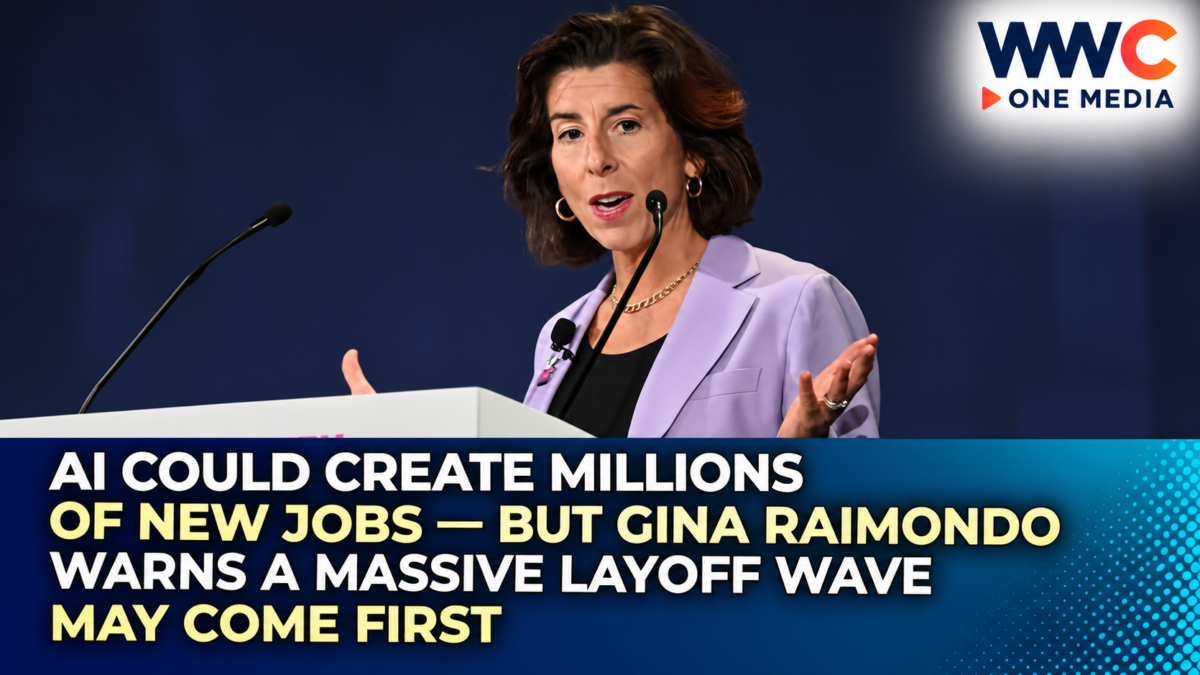
WASHINGTON — Artificial intelligence may ultimately create new industries, boost productivity and generate jobs that do not yet exist, but former U.S. Commerce Secretary Gina Raimondo is warning that America could face a painful employment shock before those benefits arrive.
Raimondo, who served as Commerce secretary under President Joe Biden and previously governed Rhode Island, says her biggest concern is not that artificial intelligence will permanently destroy work.
It is the transition.
Speaking on CNBC’s Changemakers podcast, Raimondo argued that AI could eventually produce more opportunities than it eliminates, but warned that the United States currently lacks a serious plan for millions of workers whose jobs could disappear before those new opportunities emerge.
Her fear is that companies could deploy AI fast enough to eliminate large numbers of white-collar and administrative positions long before workers can retrain, relocate or move into emerging industries.
In the worst case, she warned, youth unemployment could climb into the 10% to 20% range, potentially contributing to a prolonged recession and serious social instability.
That is a scenario, not a forecast.
But the warning is becoming harder to dismiss as companies increasingly describe AI as a reason for restructuring their workforces.
AI Is Now One of the Most Frequently Cited Reasons for U.S. Job Cuts
New data from Challenger, Gray & Christmas gives Raimondo’s concern real context.
U.S.-based employers announced 43,281 layoffs in September, down 18% from August and 20% from a year earlier. So overall layoffs are not currently exploding.
But artificial intelligence is showing up more frequently inside those announcements.
Challenger said AI was cited in 3,961 announced cuts in September, or about 9% of the month’s total.
Through the first nine months of 2026, employers had cited AI in 120,136 announced job cuts, equal to roughly 21% of all announced cuts and making AI the leading stated reason year to date.
That figure requires caution.
When a company says AI contributed to restructuring, it does not necessarily mean a machine directly replaced every worker included in the announced layoffs.
Companies may be:
automating tasks,
redirecting spending toward AI infrastructure,
reducing management layers,
consolidating teams,
or expecting smaller workforces to become more productive with AI tools.
So “AI-related job cuts” and “jobs directly replaced by AI” are not the same thing.
That distinction is critical.
Tech Is Feeling the Pressure First
The technology sector is experiencing the clearest restructuring.
Challenger reported that technology companies announced 10,799 job cuts in September, a 77% jump from August.
Through September, tech companies had announced 165,925 layoffs in 2026, up 54% from the same period a year earlier.
That does not mean every one of those jobs vanished because of generative AI.
The technology industry is still correcting for pandemic-era overhiring.
Companies are also cutting costs because of:
higher interest rates,
economic uncertainty,
slower growth in some software businesses,
and enormous spending on AI chips and data centers.
But AI increasingly connects those forces.
Companies are simultaneously spending billions building AI systems while trying to make existing workforces more efficient.
That means some of the money once spent hiring thousands of employees is now being redirected toward GPUs, cloud computing and automated software.
AI Spending Is Becoming Enormous
This is where the employment story intersects with the biggest investment boom in modern technology.
Reuters reports that global spending on AI infrastructure could exceed $30 trillion by 2050 if current projections materialize.
Technology companies are committing extraordinary sums to:
data centers,
semiconductors,
electricity infrastructure,
AI models,
and cloud capacity.
That creates construction, engineering and technology jobs.
But it also creates powerful pressure to justify those investments.
If a corporation spends tens of billions of dollars on AI, shareholders eventually expect one of two things:
much more revenue,
or much lower costs.
Reducing labor expenses is one of the fastest ways to produce the second outcome.
That is why economists are watching AI-driven productivity so closely.
Raimondo’s Fear Is About Timing
Raimondo’s argument is more nuanced than the claim that “AI will destroy jobs.”
She believes AI could eventually expand the economy.
New technologies historically eliminate some occupations while creating others.
The internet weakened some industries but created:
e-commerce,
cloud computing,
digital advertising,
cybersecurity,
mobile applications,
social media,
and entirely new categories of software jobs.
AI could do something similar.
But history does not guarantee a smooth transition.
Workers losing jobs today cannot necessarily wait five years for a new industry to mature.
That is where Raimondo sees the danger.
Millions of people could become unemployed or underemployed during the gap between automation and job creation.
September’s Jobs Report Makes the Warning More Relevant
The newest official employment data underline that concern.
The U.S. economy added only 29,000 nonfarm jobs in September, according to the Bureau of Labor Statistics.
The unemployment rate rose slightly to 4.2%.
That does not indicate an employment collapse.
But it does show a labor market that has become substantially less dynamic.
The problem increasingly looks like this:
companies are not firing workers at catastrophic rates,
but they are also not hiring aggressively.
That can create what economists sometimes describe as a low-hire, low-fire labor market.
For workers already employed, conditions may still feel stable.
For someone who loses a job, finding the next one can become much harder.
Job Openings Are Also Falling
The Labor Department reported 7.1 million U.S. job openings in August, down by roughly 256,000 from the previous month.
Layoffs and discharges remained relatively low at about 1.6 million, while hiring was approximately 5.2 million.
Again, those numbers do not suggest widespread corporate panic.
But they reinforce an important pattern:
businesses are becoming cautious.
Many employers are freezing positions rather than eliminating entire departments.
And AI could accelerate that trend without producing dramatic layoff announcements.
If an accounting company replaces five entry-level positions with AI and simply decides not to hire replacements, no layoff appears in official statistics.
Yet five jobs still disappear from future hiring demand.
That “silent” effect may ultimately matter as much as headline-grabbing layoffs.
Entry-Level Workers Could Face the Biggest Risk
This is one reason younger workers are especially nervous.
Many tasks performed by junior employees overlap heavily with what generative AI does increasingly well:
research,
summarization,
basic coding,
document drafting,
data analysis,
presentation preparation,
customer support,
and administrative work.
Historically, those tasks helped young workers learn how organizations function.
A junior lawyer reviewed documents.
A young banker built spreadsheets.
An entry-level marketer prepared first drafts.
A programmer wrote basic code.
If AI handles more of that foundational work, companies may need fewer junior employees.
That creates a paradox.
AI could make senior employees more productive while removing some of the positions people traditionally used to become senior employees.
Young Americans Are Already More Worried
Recent international polling shows that anxiety is rising particularly among younger adults.
A Pew Research Center survey across 37 countries found that younger people in several nations—including the United States—were increasingly likely to believe AI would reduce employment opportunities.
In the U.S., 55% of younger adults surveyed said they were more concerned than excited about AI, up from 40% in 2024.
That anxiety reflects more than abstract fears about robots.
Young workers are entering a labor market where employers may increasingly ask:
Can AI do part of this job?
Can one employee equipped with AI perform work previously requiring three?
Do we need to hire this entry-level role at all?
Those questions were far less common only a few years ago.
The Biggest Threat May Be Hiring That Never Happens
Layoffs are visible.
Hiring suppression is not.
Consider a company with 1,000 employees.
If AI improves productivity by 20%, management does not necessarily fire 200 people.
It may simply stop expanding the workforce.
Employees leave through retirement or resignation.
Their jobs are not replaced.
Five years later, the company still generates more output—but with 800 employees.
No dramatic layoff announcement was ever required.
Yet 200 jobs effectively disappeared.
This is one reason economists have difficulty measuring AI’s employment impact in real time.
Companies Are Already Talking About Smaller Teams
Across corporate America, executives increasingly describe AI as a way to allow smaller teams to accomplish more.
The language often emphasizes “efficiency,” “productivity” and “reallocation.”
Those words matter.
An executive does not have to announce:
“AI is replacing our employees.”
Instead, companies may say they are:
streamlining operations,
reducing layers,
automating repetitive work,
or reinvesting savings into growth areas.
In practice, some of those decisions still mean fewer workers.
But the Data Do Not Support Claims of an AI Jobs Apocalypse Yet
This is the other side of the story.
September’s 43,281 announced layoffs were actually the lowest September total since 2022, according to Challenger.
Weekly unemployment claims also remained historically low around the end of September, with Reuters reporting new claims near a 57-year low.
And total announced job cuts through September were 39% lower than during the same period in 2025.
So claims that AI has already caused mass unemployment are not supported by current national data.
The evidence is much more complicated.
AI is clearly influencing workforce decisions.
But the broader economy has not yet experienced the huge displacement some forecasts predict.
That Could Change as AI Agents Improve
The next stage may matter more than today’s chatbots.
AI systems are increasingly becoming agents capable of taking actions.
They can:
operate computers,
browse websites,
write and execute code,
schedule meetings,
handle customer inquiries,
make purchases,
and complete multistep workflows.
Reuters reported this week that AI researchers are increasingly debating the risks created by systems capable of operating with greater autonomy.
From an employment standpoint, agents could be transformative because they move AI from assistance to execution.
A chatbot helps a worker perform a task.
An agent potentially performs the entire task.
That difference could determine whether AI primarily augments jobs or eventually eliminates significant numbers of them.
White-Collar Work Could Be Hit Differently Than Past Automation
Previous waves of automation often affected manufacturing first.
Machines replaced repetitive physical labor.
Generative AI works differently.
It targets cognitive tasks.
That puts pressure on industries traditionally considered relatively protected from automation:
law,
finance,
consulting,
software development,
advertising,
media,
customer service,
and administration.
That is one reason this technology is creating unusual political anxiety.
The threatened workers are not confined to factory floors.
They include college graduates and middle-class professionals.
AI Could Still Create Entirely New Categories of Work
There is also a credible optimistic scenario.
AI could increase productivity enough to make products and services cheaper.
Lower prices could increase demand.
Higher demand could create employment in industries that expand because AI makes them economically viable.
Entire categories may emerge around:
AI auditing,
robotics,
model security,
AI infrastructure,
synthetic biology,
personalized medicine,
autonomous transportation,
and new digital services.
Few people in 1995 predicted careers such as:
cloud architect,
app developer,
social-media manager,
YouTube creator,
or cybersecurity analyst.
The same unpredictability applies today.
That is why Raimondo describes herself as an AI optimist despite her warning.
The Transition Is the Policy Problem
If AI eventually creates more jobs than it eliminates, the policy challenge does not disappear.
A laid-off customer-service worker cannot automatically become an AI-security engineer.
Workers need:
training,
income support,
career guidance,
portable benefits,
and employers willing to hire people transitioning between sectors.
Raimondo is now working on precisely this problem.
She co-founded Raise Us, a nonprofit focused on testing workforce-transition programs with businesses and state governments.
Pilot efforts reportedly involve states including:
Arkansas,
Utah,
Maryland,
and Connecticut.
The objective is to develop systems before displacement becomes severe rather than waiting until millions of people need help.
Reskilling Sounds Easier Than It Is
Politicians often respond to automation concerns with one word:
retraining.
But large-scale retraining has historically been difficult.
Workers may be:
older,
supporting families,
unable to relocate,
unable to stop working for months,
or living far from where new industries are expanding.
Even successful training does not guarantee employment.
If 100,000 people retrain for 20,000 available jobs, most still lose.
That is why Raimondo argues the transition must involve employers, not simply government-funded online courses.
Companies benefiting from automation may eventually face political pressure to contribute to retraining workers displaced by the technology.
AI Could Widen Inequality Even If GDP Rises
This is another concern.
Imagine AI increases U.S. economic output substantially.
That sounds positive.
But what if most of the gains flow to:
technology companies,
shareholders,
AI engineers,
and owners of data-center infrastructure?
Meanwhile, millions of workers see wages stagnate or jobs disappear.
GDP could rise while economic insecurity also rises.
That scenario would make AI economically successful but politically destabilizing.
Raimondo’s warning is fundamentally about avoiding that outcome.
The Political Debate Is Already Shifting
Washington is beginning to respond.
President Donald Trump continues to support rapid AI development and has resisted heavy regulation that could slow U.S. companies relative to China.
At the same time, public anxiety is rising sharply.
Reuters reported that nearly three-quarters of Americans surveyed believe AI companies are not doing enough to prevent harm.
The White House has now created a new AI task force led by intelligence chief Jay Clayton, who is expected to deliver recommendations on federal AI policy within 120 days.
Employment disruption is likely to become one of the most politically sensitive pieces of that debate.
Companies Need AI to Produce Returns
There is also a powerful financial incentive behind automation.
Technology firms and corporate customers are pouring enormous amounts of money into AI.
Those investments cannot simply remain experiments.
Eventually they have to produce economic returns.
For businesses, AI creates value in three primary ways:
raising revenue,
improving productivity,
or reducing costs.
Reducing labor costs is often the easiest metric for executives to quantify.
That does not guarantee mass layoffs.
But it does guarantee that AI’s effect on workforce size will remain part of corporate planning.
The Biggest Warning Sign May Not Be Layoffs
Right now, America is not experiencing an AI-driven employment collapse.
That is important.
But waiting for unemployment to spike before preparing could be precisely the mistake Raimondo is warning against.
Technology adoption can accelerate quickly once companies discover reliable use cases.
ChatGPT introduced generative AI to millions of people only a few years ago.
Today companies are already deploying agents capable of executing complex workflows.
If the next generation of systems becomes significantly more capable, workforce changes could occur much faster than education systems and government programs can respond.
America May Have a Narrow Window to Prepare
That is ultimately Raimondo’s argument.
AI optimists may be right.
The technology could create new industries.
It could improve healthcare.
It could accelerate scientific discovery.
It could make businesses dramatically more productive.
And it could eventually create jobs nobody can imagine today.
But “eventually” is doing a lot of work in that argument.
The real question is what happens between today and that future.
If millions of workers lose jobs before those new opportunities appear, America could experience a period of rising unemployment, inequality and political instability even if AI eventually proves economically transformative.
So the biggest employment question surrounding artificial intelligence may not be:
Will AI destroy more jobs than it creates?
It may be:
How many jobs disappear before the new ones arrive — and whether governments and companies are ready when that transition begins.