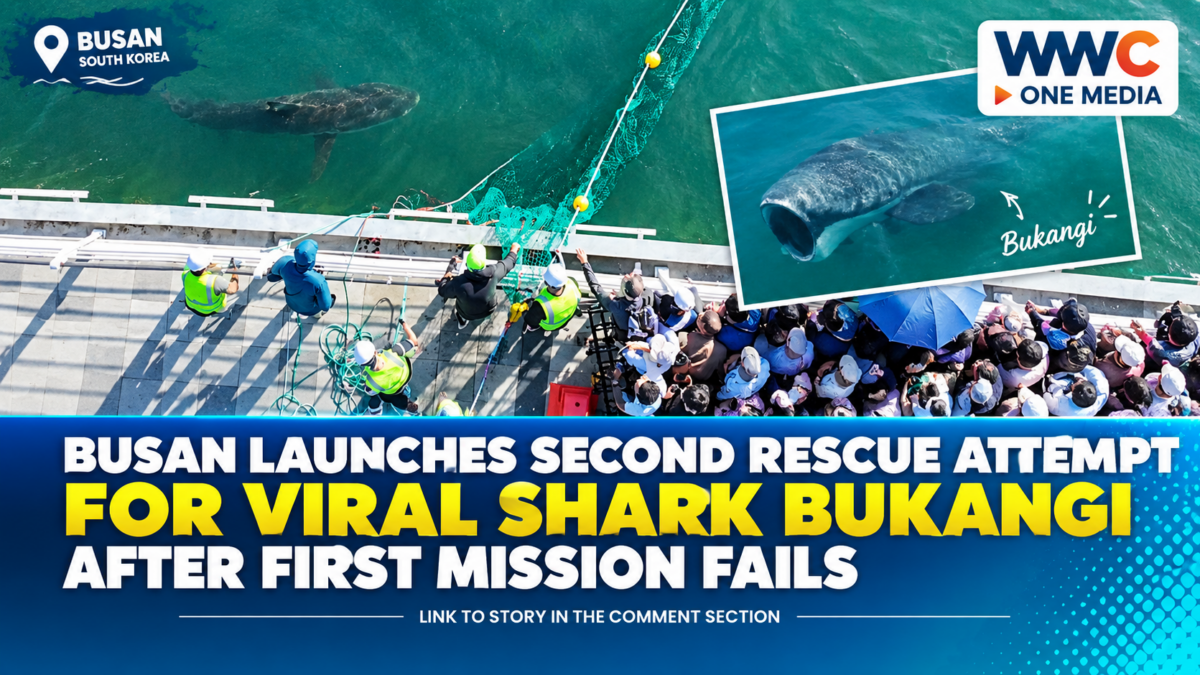
BUSAN — The clock is ticking for Bukangi. After spending about two weeks trapped inside an artificial waterway at Busan’s North Port Waterfront Park, the 3.5-meter shark is facing a second rescue attempt aimed at guiding it back to the open sea.
The operation is scheduled for 3:30 p.m. Friday, Oct. 2, after the first attempt on Sept. 29 failed to lead Bukangi out of the canal. This time, authorities are changing tactics — replacing the water-jet-only approach with a massive barrier net designed to gradually guide the shark toward the sea.
A 50-Meter Net Will Lead the Way
The rescue team plans to deploy a 50-meter-long, 6.8-meter-high net, with weights attached to its bottom to reduce gaps beneath it.
Two vessels and 10 personnel will participate. One vessel will tow the center of the net while workers positioned along both sides of the waterway help control its movement.
A second vessel equipped with pumps may use water streams behind the net to encourage Bukangi to continue toward the canal’s exit. Officials say the operation will be adjusted according to the shark’s movements and condition.
The First Rescue Failed
Authorities previously spent about five hours trying to guide Bukangi toward the sea using boats and water streams.
But the shark repeatedly avoided the vessels, moving away or swimming behind them instead of continuing toward the exit. The operation was eventually halted.
Experts say the artificial waterway’s layout may be part of the problem. Bukangi appears unable to navigate the curved, man-made channel back to the sea, while the noise and movement generated during the first rescue may have caused it to retreat.
Why Authorities Want Bukangi Out
Bukangi first appeared in the waterway on Sept. 18 and quickly became one of Busan’s biggest attractions.
More than 600,000 people had visited the area by the end of September, transforming the North Port waterfront into an unexpected tourist hotspot. The shark was even named an honorary promotional ambassador by Busan after its sudden popularity.
But officials say the unusual attention cannot change the fact that the artificial canal is not a suitable long-term habitat.
The National Institute of Fisheries Science has monitored Bukangi’s condition. Although the shark has remained active and its breathing has been stable, experts have reported signs that its movements have slowed compared with earlier observations.
Authorities have also said no feeding has been observed since Bukangi entered the canal, raising concerns about what could happen if it remains trapped for too long.
A Delicate Race Against Time
The second operation is designed to be more controlled than the first.
Instead of chasing Bukangi with boats, the net will gradually limit its ability to turn back while creating a route toward the open sea. Experts will monitor the shark throughout the process and adjust the speed or method if it shows signs of excessive stress.
The goal is simple: get Bukangi back to the ocean without causing unnecessary harm.
For a shark that unexpectedly became a Busan celebrity, its next swim could determine whether its remarkable stay in the city ends with a return to the sea.
WWC ONE MEDIA G,A