
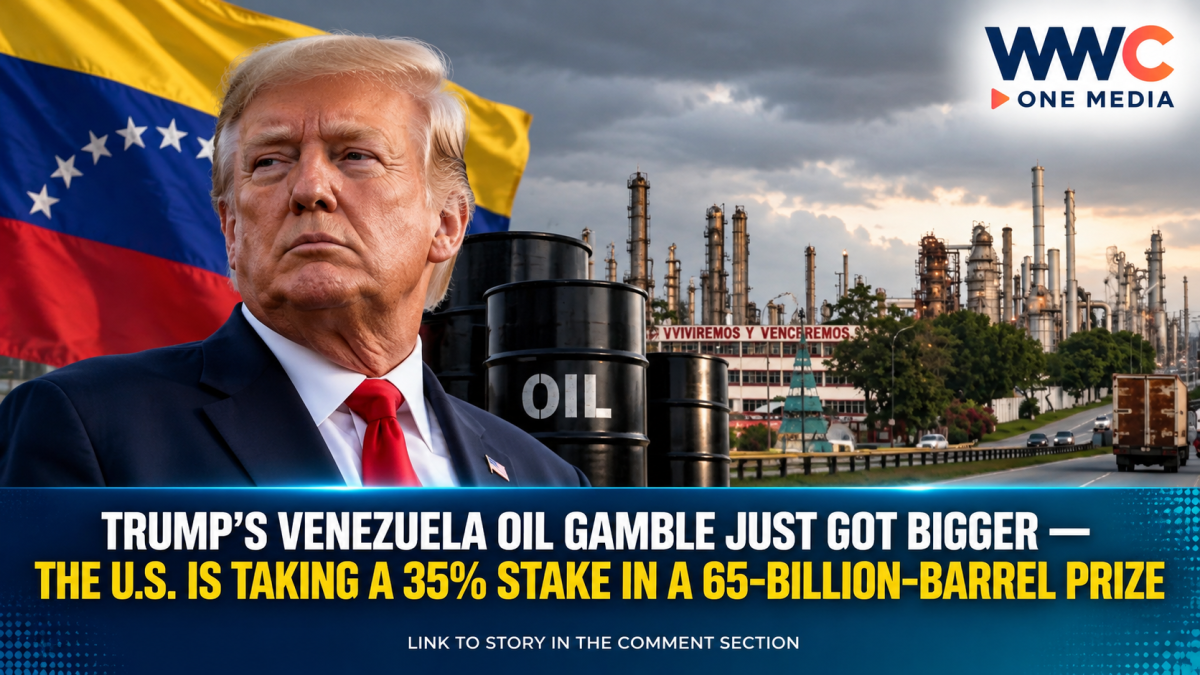
Trump’s Venezuela oil deal gives Washington a huge stake — but the real battle may be just beginning
President Donald Trump’s sweeping Venezuela oil agreement is turning into one of the most consequential energy deals in the Western Hemisphere, giving the U.S. government a 35% stake in a major Venezuelan oil venture while opening Washington’s path to preferential access to billions of barrels of crude.
At the center of the agreement is North American Blue Energy Partners (NABEP), a Venezuelan private oil producer controlled by businessman Alejandro Betancourt.
Under terms released by the White House, Venezuelan interim authorities granted NABEP 100-year rights covering 17 oil fields with approximately 65 billion barrels of proven reserves. The White House describes the arrangement as a way to revive Venezuela’s battered oil industry while strengthening U.S. energy security.
But the deal is already generating questions over its legal structure, political durability and whether it can actually deliver cheaper energy to Americans.
Washington gets a 35% position — and more than just oil
The U.S. government’s involvement goes well beyond simply buying Venezuelan crude.
The Pentagon’s Office of Strategic Capital is set to receive a 35% equity interest in NABEP’s corporate parent, while the U.S. government receives preferential purchasing rights over the company’s production.
Washington is guaranteed the right to purchase 20% of NABEP’s output at production cost. It also has a right of first refusal over the remaining 80%. The agreement gives the U.S. government veto power over board appointments, while a majority of NABEP’s directors must be U.S. citizens.
Reuters reported that the U.S. structured its 35% interest through “penny warrants,” designed to protect Washington’s stake from being diluted if the venture later raises additional capital.
That structure makes the agreement far more significant than a conventional oil-production partnership.
NABEP wants to dramatically increase Venezuela’s production
NABEP says it plans to invest nearly $100 billion in Venezuela’s oil infrastructure and raise production above 1 million barrels per day.
S&P Global reported that the company has already increased output from roughly 18,000 barrels per day to more than 200,000 barrels per day over the past two years, according to NABEP, and is targeting further expansion in the Lake Maracaibo region and the Orinoco Oil Belt.
The White House estimates that NABEP could generate roughly $200 billion in royalties and tax payments during the first 25 years, although those projections depend heavily on the company’s ability to attract investment, restore infrastructure and dramatically expand production.
Trump says the deal could transform U.S. energy security
The Trump administration is presenting the agreement as a strategic energy move.
The White House says the arrangement could provide a stable source of relatively low-cost Venezuelan crude and help replenish the U.S. Strategic Petroleum Reserve.
But there is an important complication: much of Venezuela’s oil is heavy and sour, meaning it is more difficult and expensive to process than lighter crude.
Energy Secretary Chris Wright has acknowledged that Venezuelan heavy crude cannot necessarily be placed directly into the U.S. Strategic Petroleum Reserve. One option being considered is an oil swap, in which Venezuelan heavy crude could be sent to refineries while lighter or medium-grade U.S. barrels are placed into the reserve.
That means Trump’s promise of rapidly refilling America’s emergency oil reserves with Venezuelan crude is considerably more complicated than the headline suggests.
Don’t expect cheaper gasoline overnight
The biggest question for American consumers is whether the agreement will actually bring down gasoline prices.
Analysts quoted by The Washington Post have warned that rebuilding Venezuela’s devastated oil infrastructure could take years, meaning any major increase in production would not immediately translate into cheaper gasoline at U.S. pumps.
Venezuela has enormous oil reserves, but reserves are not the same as immediately available production.
Pipelines, wells, refineries, electricity infrastructure, drilling equipment, financing and skilled labor all need to be restored or expanded before the country can dramatically increase output.
S&P Global also noted that NABEP’s production target is ambitious and that political stability remains a major factor in determining whether the investment can reach its full potential.
Big Oil is watching — but not everyone is convinced
The agreement has also created an unusual problem for Washington: convincing major international oil companies to invest alongside a U.S.-backed venture whose structure gives the U.S. government a substantial role.
Reuters reported that some major producers have expressed hesitation, with companies such as ExxonMobil and ConocoPhillips continuing to emphasize the importance of legal certainty, contract protections and political stability before committing major capital to Venezuela.
At the same time, Chevron is moving in the opposite direction.
Chevron has announced plans to invest more than $7 billion in Venezuela and aims to significantly increase its production there, according to multiple reports.
Other companies, including Eni, ONGC, GeoPark and GE Vernova, are also pursuing projects in Venezuela as Caracas attempts to attract foreign capital and technology.
The controversy surrounding NABEP
The deal’s biggest political vulnerability may be the identity of the company at its center.
NABEP is controlled by Alejandro Betancourt, a Venezuelan businessman whose past business dealings have attracted scrutiny from U.S. and European authorities. Reuters reported that he was investigated in connection with allegations but was not charged, while Betancourt has denied wrongdoing.
U.S. officials have defended the partnership, portraying Betancourt as an experienced Venezuelan oil operator capable of rapidly increasing production.
Critics, however, question whether such a politically sensitive oil venture should be built around a private company controlled by one Venezuelan businessman.
A legal battle could become the next major obstacle
Beyond the politics, legal questions could prove even more important.
The Center for Strategic and International Studies noted that Venezuela’s January 2026 hydrocarbons reforms allow certain private-sector production agreements but questioned whether the interim authorities have the legal power to grant the 100-year concessions described by the White House.
That distinction matters.
If a future Venezuelan government challenges the structure of the agreement, investors could face uncertainty over whether the rights granted today will remain enforceable decades from now.
And that could undermine precisely what Washington says it wants most: billions of dollars in long-term private investment.
More than an oil deal, it’s a geopolitical gamble
The agreement is therefore much bigger than the number of barrels involved.
For Washington, it represents an attempt to reshape Venezuela’s oil industry, reduce the influence of foreign competitors and establish a powerful U.S.-aligned energy position in the Western Hemisphere.
For Venezuela, it promises potentially enormous investment in an oil industry that has suffered from years of underinvestment and declining production.
For the global oil market, the question is whether Venezuela can actually turn its enormous reserves into millions of additional barrels of reliable production.
And for Trump, the ultimate test will be whether the agreement produces the economic and energy benefits he is promising before the political and legal risks catch up with it.
The oil is there. The money is being promised. The U.S. has secured a major stake.
Now comes the hardest part: turning a historic agreement on paper into millions of barrels flowing from Venezuela’s aging oil fields — without the entire deal collapsing under political, legal and investment pressure.
WWC ONE MEDIA M.J.E




Leave a Reply