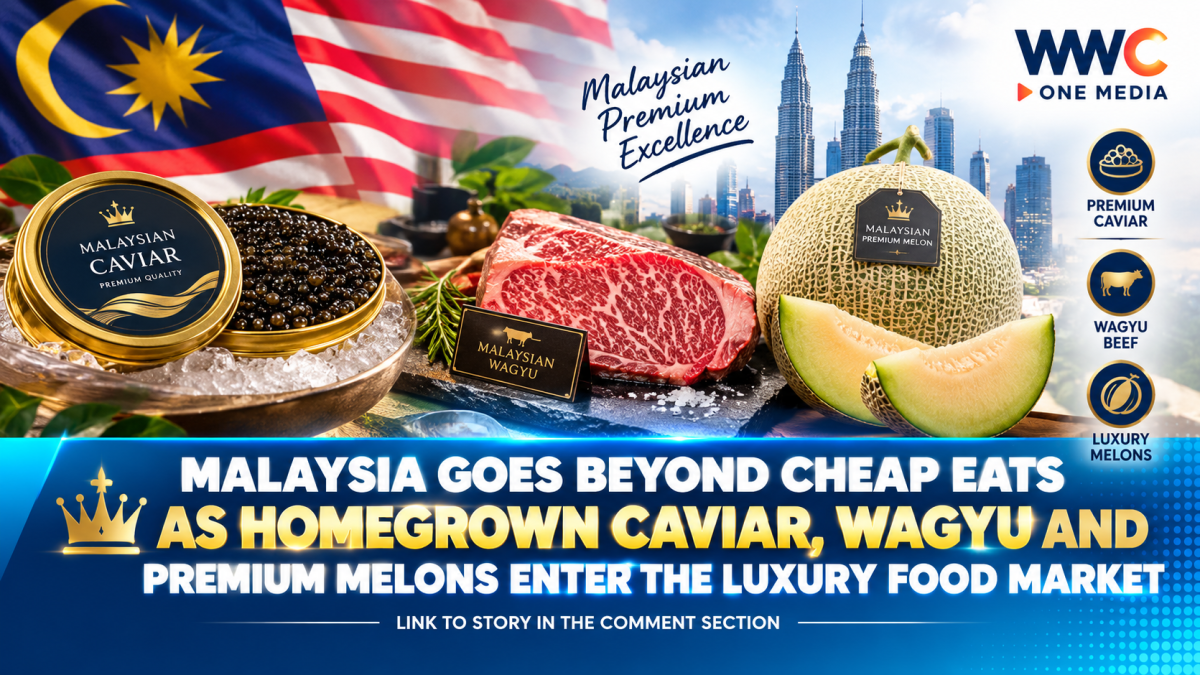
KUALA LUMPUR — Malaysia is increasingly moving beyond its reputation for affordable street food, with local producers developing homegrown caviar, Wagyu-cross beef and premium melons aimed at consumers seeking higher-end food experiences.
The shift is taking place as Malaysian farmers and entrepreneurs use selective breeding, technology and locally adapted production methods to overcome challenges posed by the country’s tropical climate. The result is a growing collection of premium products that traditionally relied heavily on imports.
Malaysia’s Tropical Climate Is No Longer the Only Barrier
Producing luxury foods associated with colder climates is far from straightforward in Malaysia.
Sturgeon, the fish used to produce caviar, generally thrive in cooler environments. Wagyu cattle originate from Japan, while premium Japanese melons are associated with carefully controlled growing conditions.
Yet Malaysian producers are adapting these products rather than simply trying to replicate overseas production.
At T’lur Caviar in Tanjung Malim, producers have developed methods to gradually acclimatise sturgeon to warmer water. The farm began producing caviar commercially after finding roe in 2016 and now fulfils orders of roughly 40kg to 80kg a month, according to The Straits Times.
Its caviar sells for around RM1,000 per 100g, placing it within the price range of some imported varieties.
Malaysian-Bred Wagyu Offers a Local Alternative
In Kuala Selangor, Colla Cattle Farm has spent years developing a Malaysian premium beef using Wagyu genetics.
Because Japan stopped exporting Wagyu genetic material and live cattle in the 1990s, the farm used artificial insemination involving Angus cows and Wagyu semen from Australian bloodlines descended from Japanese cattle.
After several generations of crossbreeding, the farm produced what it calls F3 MyGyu, with 87.5% Wagyu genetics. The beef is reported to reach M7 to M9 on the Australian marbling scale.
The locally produced meat also comes at a lower price than imported Wagyu. While imported Wagyu can sell for roughly RM210 per 100g, MyGyu is priced at about half that level, according to the report.
The farm currently has eight bulls and around 40 MyGyu cattle, with demand reportedly exceeding available supply.
Terengganu Melons Take Aim at the Premium Fruit Market
The luxury-food push is not limited to meat and seafood.
In Marang, Terengganu, Murai Estates is producing a premium local melon that is being positioned as a distinctive alternative to imported Japanese musk melons.
The Terengganu melon has a crisp, crunchy texture and salmon-orange flesh, rather than the softer texture commonly associated with Japanese musk melons.
The fruit also has geographical-indication protection, with cultivation restricted through state regulations governing seed distribution.
Murai Estates produces more than 30 tonnes every 65 days from about 8,000 plants across four greenhouses.
The price difference is striking: Murai melons sell for around RM21 per kilogram, while Japanese imports can cost RM300 or more per kilogram.
AI and IoT Are Helping Transform Malaysian Farming
Technology is becoming another important part of the premium-food story.
Murai Estates co-founder James Alexander, who had no previous farming background, used technology and AI to learn about cultivation. The farm now incorporates Internet of Things (IoT) technology and agricultural techniques adapted from the Netherlands.
The broader Malaysian agriculture sector is also pushing toward higher-value production.
At MAHA 2026, Malaysia’s Agriculture and Food Security Ministry promoted smart farming and modern agricultural technology while connecting local agrofood businesses with international buyers. The event featured a dedicated programme aimed at helping export-ready Malaysian products reach overseas markets.
A Growing Premium Food Market
Malaysia’s changing food landscape is also reflected in its restaurant industry.
The country now has nine Michelin-starred restaurants, more than twice the number recorded when the Michelin Guide first arrived in Malaysia three years ago, according to The Straits Times.
Meanwhile, beef and buffalo meat imports reached about 200,000 tonnes in 2024, compared with 140,000 tonnes a decade earlier, according to Trade Data Monitor figures cited by the newspaper.
That combination of expanding consumer demand, premium restaurants and agricultural innovation is creating space for Malaysian producers to develop higher-value domestic products.
The Big Test: Can Local Luxury Compete?
Malaysia’s homegrown luxury-food experiment is still relatively niche.
Local producers must demonstrate that their products can consistently deliver quality while maintaining prices that consumers are willing to pay. They also face the challenge of convincing diners that locally produced alternatives can stand alongside established imported luxury brands.
But the early results are attracting interest.
From tropical-adapted sturgeon and Wagyu-cross cattle to technologically grown Terengganu melons, Malaysia is showing that premium food production does not necessarily have to depend on importing the finished product.
The bigger question now is whether these unusual homegrown products can move from niche luxury items into a sustainable Malaysian premium-food industry — and eventually find customers beyond the country’s borders.
WWC ONE MEDIA G,A