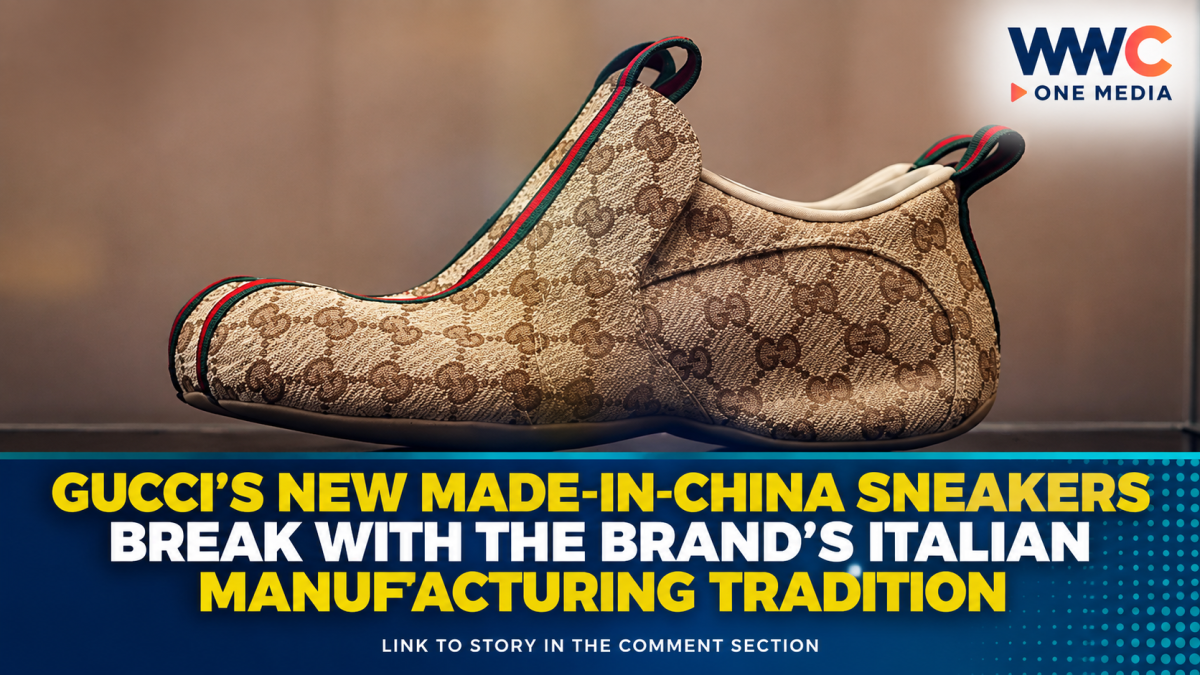
Gucci has begun selling new luxury sneaker models labelled “Made in China,” marking a notable departure from the Italian manufacturing tradition that has long been closely associated with the luxury house.
The move comes as Gucci attempts to refresh its product lineup under creative director Demna while managing costs and trying to reconnect with more price-conscious luxury shoppers.
One of the most prominent new designs is the Drip, described by Gucci as Demna’s first sneaker for the brand. The futuristic, laceless shoe was introduced as part of the Primavera collection and is priced at about €800 in Europe and $1,000 in the United States.
The Drip has a dramatically different appearance from Gucci’s more traditional Ace sneaker. Its sock-like silhouette and chunky proportions also reflect design elements associated with Demna’s previous work at Balenciaga.
A second leather slip-on sneaker from the same collection is also labelled “Made in China.” The brand said both models were manufactured there because of specific technical requirements connected to their designs.
Gucci has stressed that the decision does not represent a broader move away from Italian production. The company said Italy would remain central to its manufacturing model and identity, while explaining that the Chinese supplier was selected for its technical expertise and ability to meet the required performance and quality standards.
The distinction is significant because Gucci’s country of origin has traditionally been an important part of its luxury positioning. According to current product information, other Gucci shoes carrying a country-of-origin label on the website remain made in Italy.
China is also one of the world’s major footwear manufacturing hubs, with factories producing sneakers for mass-market, premium and international brands. The controversy surrounding Gucci is therefore less about whether China can manufacture high-quality footwear and more about how the change fits with a luxury brand whose identity has been strongly associated with Italian craftsmanship.
The timing adds another layer to the decision. Gucci’s sales have fallen sharply over the past three years, while parent company Kering has been pursuing a turnaround strategy. The brand has also introduced price reductions on selected products as it seeks to regain market share.
Some luxury-industry analysts have raised concerns that Chinese manufacturing could create tension between Gucci’s product origins and its efforts to reinforce its luxury image. Those are industry assessments rather than an indication that Gucci plans to relocate its wider manufacturing operation.
For Gucci, the new sneakers therefore represent more than another footwear launch. They highlight the difficult balance between maintaining a heritage built around Italian production, adopting specialized manufacturing capabilities elsewhere and keeping luxury products commercially competitive.
As Demna prepares to unveil his latest Gucci collection in Milan, the Made-in-China sneakers are already putting a much bigger issue under the spotlight: how far can one of the world’s best-known Italian luxury brands modernize its production without changing what consumers believe Gucci stands for?