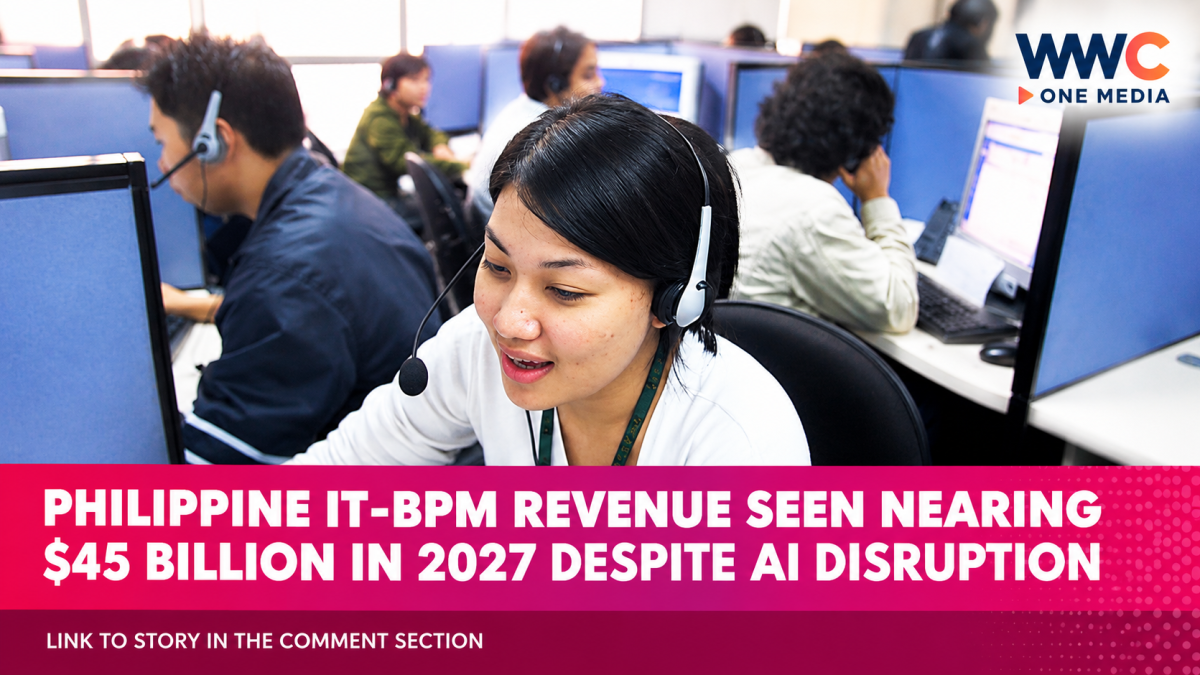
The Philippine information technology and business process management (IT-BPM) industry is expected to generate nearly $45 billion in revenue next year as companies increasingly use artificial intelligence to raise productivity and shift toward higher-value services.
The Information Technology and Business Process Association of the Philippines (IBPAP) projects industry revenue to reach $42.3 billion in 2026 and about $44.9 billion in 2027. Employment is expected to increase more slowly, reaching nearly 2 million full-time workers next year.
The widening gap between revenue and headcount reflects the growing role of AI and automation in the sector. IBPAP President and CEO Jack Madrid said technology can allow companies to handle the same amount of work, or potentially more, with fewer employees while increasing the value of services delivered.
The industry’s projected workforce is expected to rise to about 1.99 million full-time employees in 2027, compared with roughly 1.94 million this year. That represents a much slower increase than the projected growth in revenue.
Rather than signaling a simple reduction in jobs, industry officials say the shift is increasing demand for workers with stronger technical and domain-specific capabilities. AI fluency, continuous learning and specialized expertise are becoming increasingly important as companies move toward more complex services.
IBPAP has also revised its longer-term outlook. For 2028, the industry now sees revenue ranging from $43.3 billion under a downside scenario to $50.5 billion under a stronger-growth scenario, with employment estimated between 1.85 million and 2.14 million workers. The new projections are below the more ambitious targets set in the sector’s 2022 roadmap.
AI is not the only factor reshaping the industry. Philippine IT-BPM companies are facing stronger competition from emerging outsourcing locations, including South Africa, Egypt, Poland, Colombia, Costa Rica and Vietnam. Geopolitical and macroeconomic uncertainty has also made some investors slower to decide where to locate new operations.
At the same time, the Philippines is seeking to capture more high-value work, including global capability center operations involving finance, human resources, information technology and other specialized business functions. This could allow the sector to generate more revenue without requiring workforce growth at the same pace.
Infrastructure and the ease of doing business remain important factors. Industry officials have pointed to the expansion of IT-BPM operations beyond Metro Manila and Cebu as evidence of improving infrastructure, while also stressing the need to continue developing digital connectivity and business environments in emerging locations.
The Bangko Sentral ng Pilipinas has similarly noted that generative AI is expected to augment rather than immediately displace jobs in the Philippine IT-BPM industry, while emphasizing the need for reskilling and upskilling as AI-driven work evolves.
The industry’s next challenge is therefore not simply how many jobs AI may replace, but whether the Philippine workforce can develop the skills needed for a more technology-intensive outsourcing market. With revenue projected to approach $45 billion in 2027, the pace of growth will increasingly depend on talent, AI adoption, infrastructure and the country’s ability to compete for higher-value international work.