
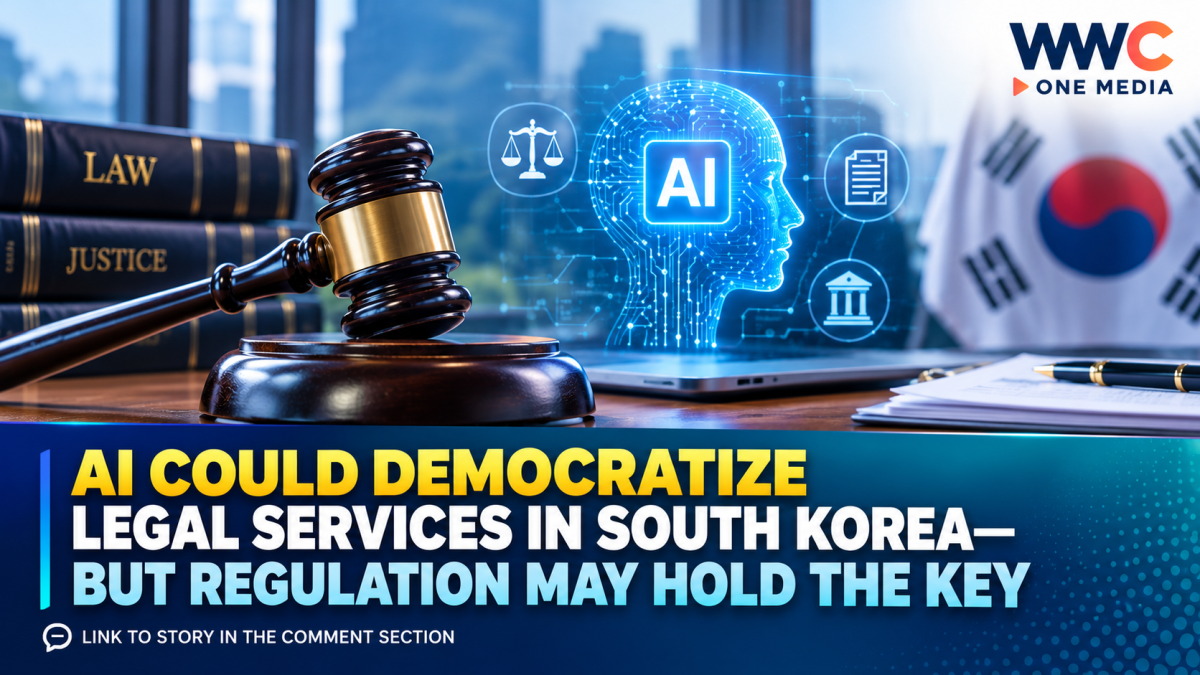
SEOUL, South Korea — Artificial intelligence is rapidly changing how lawyers work around the world, and South Korea is facing a difficult question: Can AI make legal help more accessible without weakening the safeguards surrounding professional legal services?
The debate was highlighted in a Sept. 6 Korea Times opinion column by Hong Dae-soon, a Kwangwoon University professor, who argues that South Korea should reconsider how its legal-services regulations apply to artificial intelligence.
His central argument is that legal AI should be viewed not simply as a threat to lawyers, but as a potential tool for expanding access to legal information and assistance.
That is an opinion—not a change in Korean law—but it comes as the country’s legal sector is already beginning to adopt AI at a much faster pace.
Korea’s legal industry is already entering the AI era
The debate is no longer theoretical.
In July, Korean law firm Bae, Kim & Lee (BKL) announced the firm-wide adoption of Harvey, a specialized legal AI platform.
BKL said the system would be used across the organization for areas including legal research, document drafting and multilingual analysis after a pilot program demonstrated its usefulness. The firm described the rollout as the first firm-wide implementation of a global legal AI platform among Korean law firms.
The development reflects a much broader international trend.
Law firms in the United States and United Kingdom are increasingly deploying AI for tasks such as contract review, legal research, document analysis and drafting.
Google has also expanded its AI offerings specifically for legal professionals, while specialist platforms such as Harvey continue to sign agreements with major law firms.
The technology is therefore moving from experimentation toward everyday legal work.
But South Korea faces a particular regulatory question.
What Article 109 means for legal AI
At the center of the discussion is Article 109 of South Korea’s Attorney-at-Law Act.
The provision establishes criminal penalties for non-attorneys who receive compensation for providing or arranging certain legal services, including legal consultation and preparation of legal documents in connection with legal cases.
That rule exists for an important reason: protecting consumers from unauthorized legal practice.
But AI complicates the traditional distinction between legal information and legal advice.
An AI system can explain a legal concept, summarize legislation or help a user identify relevant information.
But what happens when the same system analyzes an individual’s specific dispute and tells that person exactly what legal action to take?
That is where the regulatory questions become much more complicated.
A recent analysis published by Seoul Economic Daily noted that Article 109 can prohibit non-attorneys from handling legal affairs for profit and argued that AI services providing specific legal measures or response plans for an individual’s case could potentially cross the line from general information into regulated legal services.
The argument for opening the door
Hong argues that the debate should be reframed.
Instead of asking only who is legally permitted to provide legal services, he suggests asking how easily ordinary citizens can obtain useful legal assistance.
That distinction matters because many everyday legal problems do not initially require complex courtroom representation.
People encounter questions involving:
- housing leases;
- employment disputes;
- inheritance;
- consumer rights;
- contracts;
- small claims; and
- other routine legal issues.
For people who cannot easily afford a lawyer, even understanding what their rights are can be difficult.
The argument presented in the Korea Times column is that AI could lower the barrier to obtaining basic legal information and help people determine when professional legal assistance is necessary.
In that model, AI would not replace attorneys.
Instead, it would act as a first layer of assistance.
AI does not eliminate the need for lawyers
This distinction is increasingly important as legal AI becomes more capable.
Lawyers remain responsible for professional judgment, strategy, client representation and accountability.
Even BKL, while adopting Harvey throughout the firm, emphasized safeguards around sensitive information and human review of AI-generated results. Seoul Economic Daily reported that the firm planned cross-review procedures and maintained that final legal judgment and responsibility remain with lawyers.
That approach reflects a growing philosophy in the legal industry:
AI handles more of the repetitive work; lawyers handle the judgment.
The division is not unlike what has happened in other professional fields, where software automates portions of a workflow without eliminating the underlying profession.
But legal AI carries serious risks
The case for wider access does not mean unrestricted AI-generated legal advice is automatically safe.
Legal AI systems can produce inaccurate information, misunderstand statutes or generate convincing but incorrect answers.
That problem becomes particularly serious when a person relies on an AI response in a real legal dispute.
There are also questions about:
Privacy. Legal matters can involve highly sensitive personal and financial information.
Accountability. If an AI gives incorrect advice, determining responsibility can be complicated.
Bias. AI systems can reproduce weaknesses or biases contained in the information used to develop them.
Confidentiality. Lawyers have professional obligations that ordinary consumer AI systems may not share.
Unauthorized practice. A system that moves from explaining law to providing individualized legal services could create regulatory problems.
These concerns mean that “democratizing law” cannot simply mean removing every restriction.
The challenge is designing rules that allow useful innovation while protecting people who depend on legal services.
South Korea is already trying to balance innovation and regulation
The legal-AI debate is unfolding alongside a much broader national effort to regulate artificial intelligence.
South Korea’s AI Basic Law, formally known as the Framework Act on the Development of Artificial Intelligence and Establishment of Trust, entered into force on Jan. 22, 2026.
The framework establishes national institutions and requirements concerning AI development, safety, ethics and high-impact systems.
That creates an interesting tension.
South Korea wants to become a global AI powerhouse while simultaneously building safeguards around potentially high-risk uses of the technology.
Legal AI sits directly inside that tension.
Too much regulation could discourage innovation and allow overseas companies to gain an advantage.
Too little regulation could expose consumers to serious harm.
The global legal industry is moving quickly
South Korea is not debating this issue in isolation.
In the United States and Europe, major law firms are rapidly increasing their use of AI.
Harvey has expanded across numerous international firms, while Google has launched legal-specific AI capabilities designed to help lawyers perform research and other professional tasks.
The global legal-technology market is therefore becoming increasingly competitive.
For Korean law firms, the question is no longer simply whether AI will enter the profession.
It already has.
The question is how deeply it will be integrated—and what legal boundaries will govern its use.
The bigger issue: who gets access to justice?
That may ultimately be the most important part of the debate.
Legal systems are built around the principle that people have rights.
But knowing that a right exists and being able to enforce it are not necessarily the same thing.
If AI can help an ordinary person understand a lease, identify a potentially unlawful employment practice, organize documents or determine what questions to ask a lawyer, it could reduce one of the barriers between citizens and the legal system.
But that benefit will depend on accuracy, transparency, privacy protections and human oversight.
The goal should therefore not be “AI instead of lawyers.”
It may be “AI plus lawyers, with better access for everyone.”
Korea faces a choice
South Korea has already demonstrated that it can move quickly in artificial intelligence.
Its semiconductor industry, digital infrastructure and technology companies have made the country one of Asia’s leading technology economies.
Legal services are now becoming another test.
The country can maintain a cautious regulatory approach designed primarily around preventing unauthorized legal practice.
Or it can develop a framework that allows carefully controlled legal AI to provide broader access to information while preserving professional responsibility for lawyers.
The answer may ultimately determine more than the future of a handful of legal-tech companies.
It could determine whether artificial intelligence becomes a tool that widens the gap between people who can afford legal expertise and those who cannot—or a technology that helps narrow it.
And that leaves South Korea facing a question that is becoming increasingly difficult to avoid:
If AI can make legal knowledge dramatically easier to access, should the law keep it behind professional walls—or build a safer door for everyone to enter?



Leave a Reply