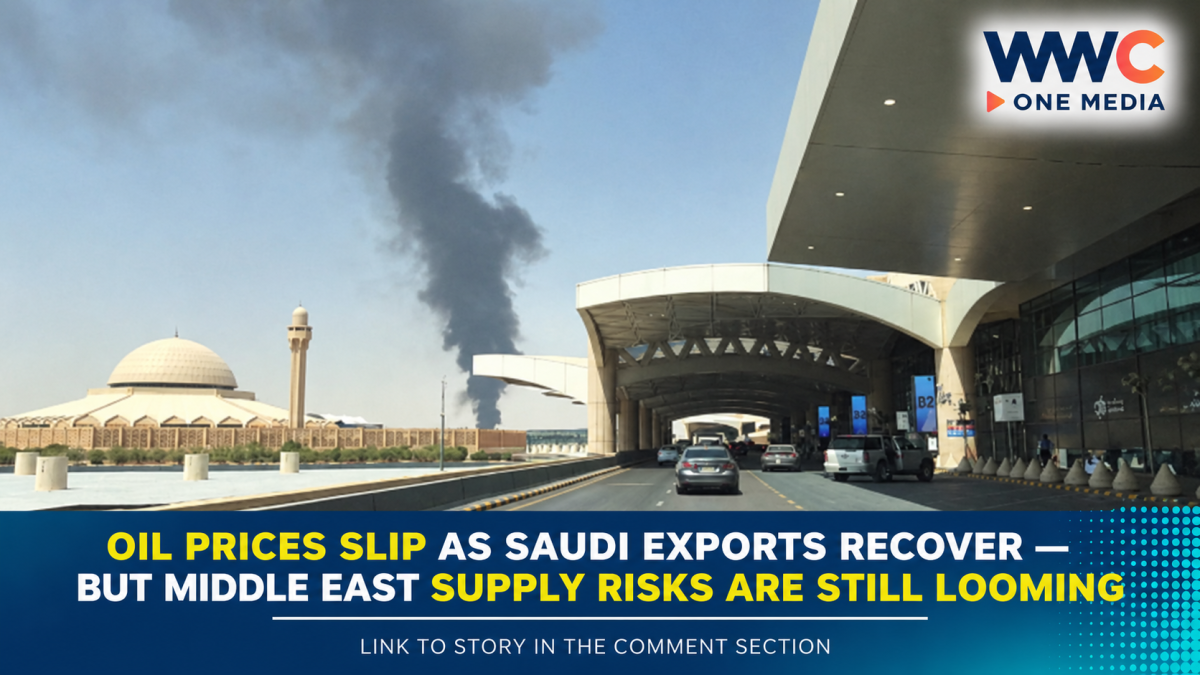
Oil prices fell on Sept. 21 as investors weighed signs that Saudi Arabia is restoring some crude exports against continuing attacks and uncertainty surrounding the Middle East conflict.
Brent crude fell 81 US cents, or 0.78 per cent, to US$103.06 a barrel, while West Texas Intermediate dropped 89 US cents, or 0.89 per cent, to US$99.41 during early trading. The decline came as traders assessed improving Saudi shipments and the possibility of diplomatic developments involving the United States and Iran.
Saudi Arabia’s oil exports have begun recovering after attacks disrupted its East-West pipeline, an important route for moving crude to the Red Sea. With that route affected, Saudi Aramco has increased shipments through the Strait of Hormuz.
Provisional data from Kpler showed Saudi exports had recovered to just over 4 million barrels per day in September, compared with about 2.4 million barrels per day in August — the lowest level recorded by the data set since at least 2013. Satellite data also indicated Saudi oil flows through the Strait of Hormuz averaged about 2.9 million barrels per day over the six days before Sept. 21, sharply higher than the roughly 700,000 barrels per day recorded in August.
Saudi Aramco was also reported to have loaded about 14 million barrels of crude onto seven very large crude carriers inside the Middle East Gulf on Sept. 20, another indication that export activity is picking up.
The recovery is important for global oil markets because the attacks have disrupted one of Saudi Arabia’s alternative export routes. However, relying more heavily on the Strait of Hormuz also leaves shipments exposed to the wider security situation in the region.
The market is simultaneously watching developments between Washington and Tehran. US President Donald Trump has said he is open to meeting Iranian President Masoud Pezeshkian during the United Nations General Assembly, while Iran and the United States have continued exchanging threats. Iran has also reportedly communicated conditions for returning to negotiations through intermediaries.
Those diplomatic signals have become another major factor for oil traders. Any progress toward negotiations could reduce fears of further supply disruptions, while renewed military escalation could put additional pressure on crude supplies and prices.
The broader supply picture remains fragile. The US Energy Information Administration said Middle Eastern crude production disruptions averaged an estimated 6.7 million barrels per day in August, up from 5 million barrels per day in July, and expects significant disruptions to continue into the fourth quarter of 2026.
Oil prices have since shown how quickly sentiment can change. On Sept. 22, Brent rose again after four consecutive sessions of declines as traders focused on possible US-Iran talks, with the November contract reaching about US$102.06 a barrel in early trading.
For consumers and businesses, the direction of crude prices could eventually feed into fuel and transportation costs, although pump prices do not necessarily move in lockstep with daily changes in crude.
Saudi Arabia’s recovering exports have eased some immediate supply concerns, but the reliance on vulnerable shipping routes and continuing military tensions mean the oil market remains highly sensitive to every new development.
The bigger question now is whether Saudi Arabia can keep restoring exports without another disruption — or whether the next escalation in the Middle East could send oil prices climbing again.