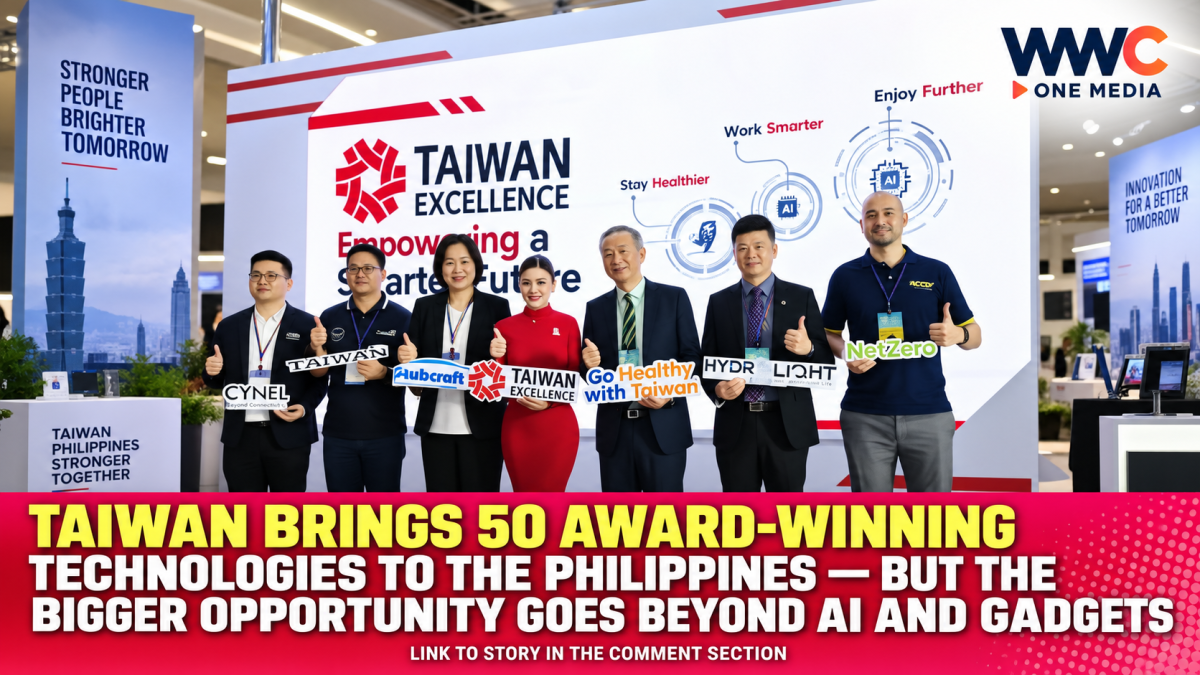
MANILA, Philippines — Taiwan is stepping up its technology push in the Philippine market, showcasing 50 award-winning products from 24 Taiwanese brands as it seeks new business partnerships in artificial intelligence, healthcare, cloud networking and sustainable technology.
At the recently concluded Taiwan Expo 2026 in Pasay City, Taiwanese companies demonstrated how emerging technologies could help Philippine businesses improve efficiency, modernize operations and address everyday challenges.
The Taiwan Excellence Pavilion, one of the exhibition’s major showcases, brought together products ranging from edge AI computing hardware and cloud networking solutions to healthcare equipment and air purification systems. Six companies were highlighted for their technologies and potential applications in the Philippine market.
The three-day exhibition, held from September 17 to 19 at the SMX Convention Center Manila, featured 125 Taiwanese companies across multiple industries, reflecting Taiwan’s efforts to expand commercial cooperation with the Philippines.
The initiative comes as Philippine companies face increasing pressure to modernize their operations while managing energy costs, digital infrastructure requirements and growing demand for accessible healthcare.
For Taiwan’s technology industry, the opportunity extends beyond selling sophisticated equipment. Companies are seeking Philippine partners that can help bring practical solutions to businesses, hospitals, households and communities.
Six Taiwanese companies showcase technology for everyday needs
The Taiwan Excellence Pavilion featured four categories: intelligent technology, smart life, consumer electronics and smart healthcare.
During the event’s product presentations, six Taiwanese companies highlighted solutions aimed at addressing different operational and consumer needs.
1. Aetina: Bringing AI closer to Philippine businesses
Aetina Corporation introduced edge AI hardware that allows organizations to run artificial intelligence applications on-site, closer to where information is generated.
Unlike systems that rely primarily on remote cloud servers, edge AI can process information locally, potentially reducing delays and allowing businesses greater control over how they manage their data.
The technology may be relevant to Philippine manufacturers, retailers, logistics providers and other companies seeking to automate specific operations.
Possible applications include visual inspection, equipment monitoring and real-time data analysis.
However, the actual benefits depend on the software, infrastructure and implementation costs involved. The expo demonstration does not establish that these systems have already been deployed commercially by Philippine customers.
2. Team Group: Computing performance meets sustainability
Team Group Inc., a Taiwanese technology company known for memory and storage products, highlighted the importance of balancing computing performance with sustainability.
As businesses invest in digital infrastructure, demand for reliable computing and data storage continues to grow.
Team Group’s presentation focused on meeting performance requirements while considering the longer-term sustainability of technology investments.
For Philippine companies, these considerations may become increasingly relevant when upgrading office computers, industrial systems and other digital infrastructure.
The showcase emphasized the company’s approach to performance and sustainability rather than establishing specific energy savings for Philippine users.
3. Zyxel Networks: Securing businesses moving to the cloud
Zyxel Networks showcased cloud networking solutions designed to support secure and reliable business connectivity.
As companies rely more heavily on cloud-based applications, uninterrupted network access and the protection of business information become increasingly important.
The company’s technologies are positioned to help organizations manage their network infrastructure while supporting digital operations.
Such solutions could be relevant to businesses operating multiple offices, retail branches and other connected facilities.
However, Philippine businesses would still need to evaluate equipment costs, technical support, cybersecurity requirements and compatibility with their existing systems before adopting the technology.
4. Jian Ling Technology: Healthcare and wellness innovation
Jian Ling Technology Co. Ltd. presented its Hydrolight High Penetration Detox Capsule as part of the pavilion’s healthcare and wellness showcase.
The presentation reflected Taiwan’s interest in expanding its healthcare-related products and technologies into overseas markets.
However, the product’s name and promotional positioning should not be interpreted as proof of medical effectiveness. Its specific health benefits, clinical evidence and Philippine regulatory status would need to be independently verified before any treatment claims could be made.
5. KUANG YU Metal Working: Technology for everyday wellness
KUANG YU Metal Working Co. Ltd. presented iEnjoy, a product positioned around everyday health and wellness.
Its participation illustrated how Taiwan’s manufacturing and technology sectors are exploring consumer-oriented products alongside industrial and enterprise solutions.
The presentation provided an opportunity for potential Philippine distributors and business partners to examine the product and assess its suitability for the local market.
The available reporting does not establish that the product has received Philippine regulatory approval for any specific medical use.
6. Sauber Technology: Air purification for homes and commercial spaces
Sauber Technology Co. Ltd. highlighted air purification technology designed for integration into residential and commercial environments.
Its presentation explored how air-cleaning equipment could become a less intrusive part of everyday living and working spaces.
Air purification systems may be relevant to offices, hospitality establishments and households seeking better indoor air quality.
Nevertheless, actual performance depends on factors such as filtration efficiency, room size, airflow and maintenance. The exhibition itself does not establish the effectiveness of a particular model in Philippine conditions.
Beyond the pavilion: Taiwan targets Philippine energy, healthcare and agriculture
The wider Taiwan Expo 2026 showcased technologies across several industries beyond the six companies featured in the Taiwan Excellence presentations.
According to Interaksyon and Context.ph, exhibitors presented renewable energy equipment, agricultural automation, industrial monitoring systems, smart security technologies and healthcare solutions.
Energy solutions included sodium-ion batteries, energy management systems, transformers and decentralized power technologies.
These technologies could be relevant to Philippine communities facing electricity reliability challenges, particularly in areas where extending conventional power infrastructure is difficult.
Context.ph reported that approximately 1.55 million Philippine households remained without electricity in 2024, underscoring the potential need for alternative power technologies.
The expo also featured agricultural technologies designed to support automation, more efficient production and food-processing operations.
In healthcare, Taiwanese exhibitors presented medical devices, telemedicine systems and other technologies aimed at improving healthcare delivery.
These additional sectors demonstrate the range of industries Taiwan is targeting as it seeks a larger presence in the Philippine market.
However, the technologies would need to be evaluated against local requirements, affordability and infrastructure limitations before their potential benefits could be realized.
Taiwan targets $100 million in business opportunities
Beyond displaying products, Taiwan Expo 2026 was intended to connect Taiwanese manufacturers with Philippine buyers, distributors and business partners.
In a September 17 report by the Philippine News Agency, Taiwan External Trade Development Council (TAITRA) chairman James Huang said organizers expected the exhibition to facilitate around $100 million in business deals.
The target followed the performance of the 2025 edition, which generated approximately $53.4 million in business opportunities and attracted more than 10,000 visitors and buyers.
The $100-million figure was an expectation announced during the 2026 exhibition, not a verified total of completed transactions.
It also remains important to distinguish business opportunities announced at trade exhibitions from signed contracts, investments already disbursed and revenue actually generated.
The results will depend on whether negotiations between Taiwanese companies and Philippine businesses translate into commercial agreements.
Why the Philippines is attracting greater Taiwanese investment
Taiwan’s interest in the Philippine market extends beyond the recent trade exhibition.
A June 3 report by the Taipei Times, citing the Chung-Hua Institution for Economic Research, said Taiwanese investment in the Philippines reached approximately $257 million in 2025 as manufacturers explored opportunities to diversify their production networks.
The report identified several factors attracting Taiwanese companies, including the Philippines’ young workforce, English-language capabilities, established economic zones and proximity to Taiwan.
Electronics manufacturing and semiconductor assembly, testing and packaging remain important areas of cooperation.
However, the report also identified challenges involving advanced technical skills, electricity costs and dependence on imported raw materials.
These factors could influence how quickly Taiwanese technology companies expand their Philippine operations and develop deeper local partnerships.
What happens after Taiwan Expo 2026?
The conclusion of Taiwan Expo 2026 on September 19 marks the beginning of a new phase for participating companies as they pursue potential customers, distributors and commercial partners.
The exhibition provided Philippine businesses with opportunities to evaluate emerging technologies and connect directly with Taiwanese manufacturers.
But technology demonstrations alone cannot determine whether new products will succeed in the local market.
For Philippine businesses, the next considerations include affordability, product availability, technical support, after-sales service and the ability to integrate new systems into existing operations.
For Taiwanese companies, developing long-term commercial relationships will require understanding Philippine market conditions and demonstrating that their technologies can solve practical problems.
With 50 award-winning products showcased at the Taiwan Excellence Pavilion and a broader exhibition involving 125 Taiwanese companies, Taiwan has highlighted the potential for greater technological cooperation with the Philippines.
The next question is whether these demonstrations will lead to sustained partnerships, wider technology adoption and measurable benefits for Philippine businesses and consumers.