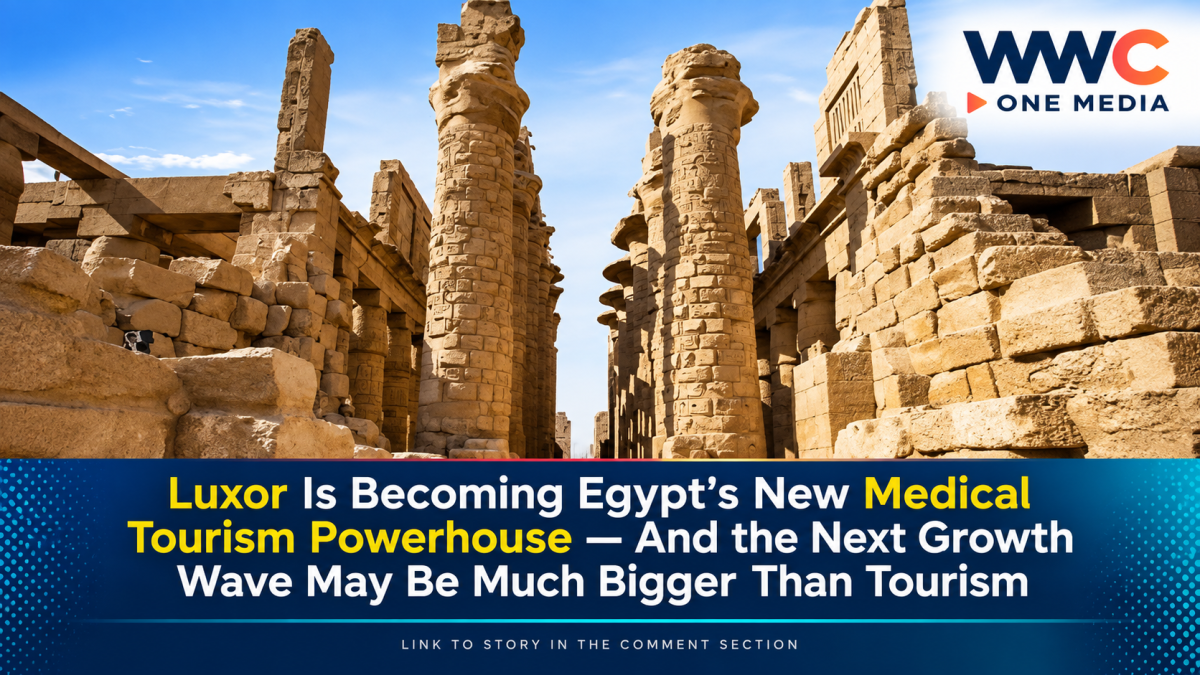
LUXOR, EGYPT — Egypt is betting that the same city that draws travelers to the temples of Karnak and the Valley of the Kings can also attract a new kind of visitor: international patients seeking advanced medical treatment.
At the center of that strategy is Luxor, where Egypt has been expanding hospitals, specialist services, international-patient facilities and digital systems designed to make medical travel easier.
The push comes as Egypt seeks a larger share of a rapidly expanding global medical-tourism market. Grand View Research estimates the worldwide market at about $34 billion in 2025, with its forecast rising to $38.6 billion in 2026 and potentially reaching $126.2 billion by 2035.
For Egypt, the opportunity is not simply about treating foreign patients. It is about combining healthcare with the country’s established tourism infrastructure — and Luxor may be one of the clearest examples of that strategy.
Why Luxor Is At the Center of the Plan
Luxor already has one of Egypt’s strongest tourism brands.
The city is home to major archaeological attractions including Karnak Temple, Luxor Temple and the Valley of the Kings, giving it an advantage that conventional medical destinations cannot easily replicate: patients and accompanying family members can combine treatment with accommodation, sightseeing and recovery in a major tourist destination.
Egyptian authorities have increasingly identified healthcare as another pillar of Luxor’s economy.
The Egypt Healthcare Authority describes Karnak International Hospital as a cornerstone of the medical-tourism system in Upper Egypt. The facility has 149 inpatient beds, 39 intensive-care beds, 44 dialysis machines, 10 neonatal incubators and seven operating rooms. Its services have also expanded to include oncology and other advanced procedures.
The government is simultaneously developing the Luxor International Medical Complex, which is designed to serve as a referral center for complex cases across Upper Egypt.
The complex has 373 inpatient beds, 57 intensive-care beds, 26 neonatal incubators, 13 operating rooms and 22 dialysis beds, along with advanced imaging capabilities. Authorities say it has already delivered more than 1.6 million medical services and nearly 33,000 surgeries.
That makes the Luxor strategy broader than simply adding a few services for tourists. The investment is also expanding the region’s underlying healthcare infrastructure for the local population.
From Ancient Healing Reputation to Modern Healthcare
Luxor’s medical-tourism ambitions also draw on a much older association with health and recovery.
The city became popular among European travelers seeking warmer, drier conditions in the 19th century, when Luxor’s climate was promoted as beneficial for certain illnesses. That history is now being reframed around modern hospitals, specialist medicine and international patient services.
The difference today is technology.
Instead of relying on climate and wellness alone, Egypt is attempting to build a complete medical-travel ecosystem covering diagnosis, treatment, accommodation, transportation and follow-up care.
That is becoming increasingly important as countries compete for international patients.
Egypt Is Building a National Medical Tourism Machine
Luxor is only one part of the country’s wider plan.
In August, Egypt launched a National Platform for Health Tourism, designed to organize the medical tourist’s journey from treatment planning and healthcare-provider selection to visa procedures, medical services and follow-up care.
Egypt also launched Tour4Cure, a digital platform intended to allow overseas patients to manage much of the treatment journey through one system, including provider selection, travel arrangements, accommodation, treatment and post-treatment follow-up.
During its pilot phase, the platform had processed about 250 cases, with authorities reporting patient satisfaction above 90%.
The government has also been working to improve pricing transparency and coordination between the health and tourism sectors, including efforts to establish a unified digital pricing system and stronger medical support for tourists.
The strategy is increasingly being marketed under the “In Egypt We Care” medical-tourism initiative, which aims to connect international patients with Egyptian healthcare providers while creating an integrated treatment experience.
The Numbers Show Why Egypt Wants More Foreign Patients
Egypt’s healthcare authorities say international demand is already growing.
In March, the Egypt Healthcare Authority reported that it had generated approximately $8 million in medical-tourism revenue while providing medical and therapeutic services to around 35,000 patients from 124 countries. The authority said medical-tourism revenue had increased 76.67% in 2025, reaching approximately $3.7 million for that year.
By August, another update cited by Egypt Business reported that medical-tourism revenue at authority-run hospitals had risen 37% year over year to more than $10 million, with nearly 42,000 international patients receiving treatment.
The figures are still small compared with the size of the global medical-tourism industry, but they demonstrate why Cairo is trying to build the sector into a larger source of foreign revenue.
The government’s priority areas include procedures such as cosmetic treatment, in-vitro fertilization, obesity treatment and advanced dental care, while other Egyptian hospitals offer specialized services including oncology, cardiology, transplantation and complex surgery.
Luxor’s Hospital Expansion Is Going Beyond Routine Care
The transformation of Luxor’s healthcare system is not limited to conventional hospital services.
At Karnak International Hospital, authorities have added an oncology unit and expanded intensive-care capacity. The hospital also provides dialysis, neonatal care and advanced surgical services.
The Luxor International Medical Complex has developed additional specialized capabilities including burn treatment, open-heart surgery, bone-marrow transplantation, gastrointestinal oncology endoscopy and complex orthopedic procedures.
Quality accreditation is also becoming part of the strategy.
Egypt’s General Authority for Healthcare Accreditation and Regulation recently granted initial accreditation to the Luxor International Medical Complex under its national standards. GAHAR said the move supports the facility’s ability to provide integrated healthcare and strengthens its potential role in medical tourism.
Karnak International Hospital’s laboratories have separately received ISO 15189:2022 accreditation through the Egyptian Accreditation Council, covering international standards for medical laboratory quality and competence.
The Hotel-and-Hospital Model
Egypt is also trying to remove one of the biggest obstacles facing medical travelers: the experience between the airport, hospital and hotel.
Ahram Online reported in July that the Egypt Healthcare Authority operated 241 hotel-style rooms and suites across its hospitals, with revenue from those services increasing 28% in 2026. The authority has also partnered with international health insurers and established electronic medical records for foreign patients.
Karnak International Hospital in Luxor is part of that model, combining medical facilities with hotel-style accommodation.
That approach could be particularly important for patients traveling with relatives. Instead of treating the medical procedure as an isolated hospital visit, Egypt is attempting to package treatment, accommodation, transportation and tourism into one journey.
The Global Competition Is Already Intense
Egypt is entering a market where established destinations such as Turkey, India, Thailand and the United Arab Emirates already attract large numbers of international patients.
Cost remains an important factor in medical tourism, but it is no longer enough by itself.
International patients increasingly look for accredited hospitals, specialist expertise, predictable pricing, short waiting times, reliable transportation, multilingual assistance and post-treatment follow-up.
Egypt’s new digital platforms and national medical-tourism framework are intended to address precisely those issues.
For Luxor, the potential advantage is different: it can offer specialized medical care alongside one of the world’s most recognizable cultural-tourism environments.
The Bigger Bet Is About More Than Tourism
Egypt’s medical-tourism push is ultimately part of a broader attempt to turn healthcare into an export industry.
The government wants international patients to generate foreign-currency revenues, while investments in hospitals and specialist services simultaneously strengthen healthcare capacity for Egyptian residents.
Luxor therefore occupies an unusual position.
It is not being transformed from a healthcare city into a tourism city. It is being developed in the opposite direction — with an established tourism destination being given another economic engine.
If Egypt succeeds in linking its hospitals, medical professionals, digital platforms, insurance partners, hotels and tourism infrastructure into one reliable international-patient system, Luxor could become an important part of that model.
And that could make the city’s next tourism story less about how many people come to see its ancient monuments — and increasingly about how many come to Egypt to receive modern medical care.