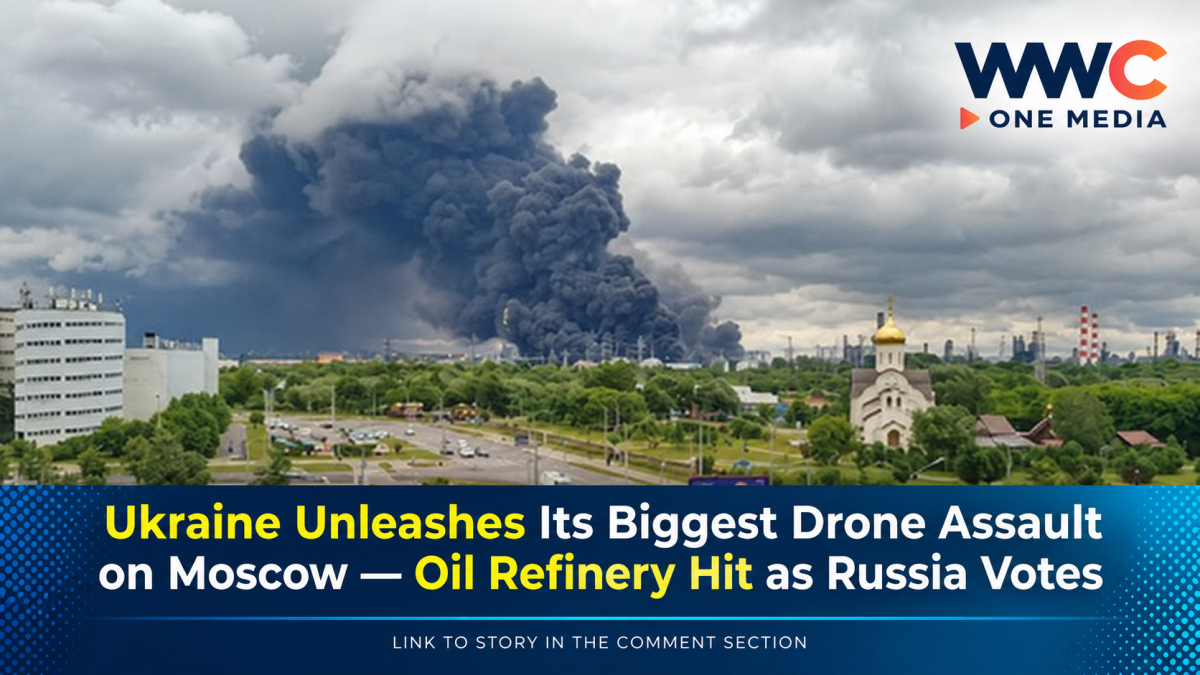
Ukraine launched what Russian authorities described as the largest drone attack yet on Moscow, sending hundreds of drones toward the Russian capital as Russia entered the final day of its parliamentary elections.
The overnight barrage damaged part of the Moscow oil refinery, struck residential infrastructure and killed at least two people in the wider Moscow region, according to Russian authorities. At least 20 others were reported injured.
Moscow Mayor Sergei Sobyanin said Russian air defenses intercepted 450 drones heading toward the capital, calling the assault unprecedented. Russia’s Defense Ministry separately said it had intercepted 1,110 Ukrainian drones nationwide during the overnight period, including drones over occupied Crimea and the Black Sea.
The attack comes at a particularly sensitive moment.
Russia’s three-day parliamentary election was reaching its final day on Sunday, September 20, while Ukrainian and Russian forces continued striking energy infrastructure despite recent statements from US President Donald Trump that the two sides had agreed to halt such attacks.
For Moscow, however, the more immediate problem may be economic.
The attack struck an oil refinery at a time when Russia is already struggling with fuel shortages and reduced refinery output.
Moscow Wakes Up To Fires And Drone Debris
Residents of Moscow and the surrounding region reported explosions overnight as waves of drones approached the capital.
The Moscow refinery, located in the southeastern part of the city, was among the facilities affected.
Russian authorities said several drones reached the refinery grounds, while one drone also struck a residential building. Reuters reported that witnesses saw smoke rising from the refinery area, although the precise extent of damage to the plant was not immediately clear.
Another drone strike in the Moscow region resulted in an apartment-building fire and the evacuation of residents.
Russian regional authorities reported that two people were killed in separate incidents and that 20 others were injured.
The attack also disrupted air travel.
Flights were temporarily affected at Moscow’s major airports as authorities responded to the aerial threat.
The sheer scale of the attack was striking even by the standards of the increasingly intense drone war.
Russia Says 450 Drones Were Heading For Moscow
Sobyanin said Russian air defenses had destroyed or intercepted 450 drones approaching Moscow.
He later said that more than 1,600 drones had been intercepted across the wider battlefront since Saturday, while Russia’s Defense Ministry reported a separate overnight total of 1,110 drones intercepted across Russia, Crimea and the Black Sea.
Those figures are claims from Russian authorities and cannot independently establish how many drones were actually launched, intercepted or destroyed.
But the reported scale illustrates how dramatically long-range drone warfare has expanded during the conflict.
Ukraine has increasingly used unmanned aircraft to strike targets deep inside Russia, particularly oil refineries, fuel facilities and logistics infrastructure.
Ukraine Says It Hit Facilities Funding Russia’s War
Ukrainian President Volodymyr Zelenskyy acknowledged the attack and said Ukrainian-made drones and missiles had struck Russian energy and logistics infrastructure.
Zelenskyy said the targeted facilities generate revenue that supports Russia’s war effort.
That statement reflects Kyiv’s broader strategy.
Rather than limiting attacks to military targets close to the front, Ukraine has increasingly attempted to damage the infrastructure that supports Russia’s economy, transportation network and energy system.
Oil refineries are particularly important because they transform crude oil into gasoline, diesel and other products required by the military and civilian economy.
The strategy has already produced measurable effects on Russian fuel markets.
Russia’s Refinery Network Was Already Under Pressure
The Moscow attack did not occur in isolation.
Reuters reported earlier this month that half of Russia’s six largest diesel-producing refineries had significantly reduced production or completely halted operations after drone attacks.
The six facilities account for roughly half of Russia’s diesel production, according to Reuters’ analysis.
Kirishi had shut down, while the Volgograd and NORSI refineries were operating at only about a quarter of their normal capacity, according to sources cited by Reuters.
Russia subsequently imposed restrictions on fuel exports in an effort to protect domestic supplies.
That makes the Moscow refinery particularly important.
The facility is one of the major suppliers of petroleum products to the Moscow region.
Reuters previously reported that the refinery processed approximately 11.6 million metric tons of crude in 2024, producing about 2.9 million tons of gasoline and 3.2 million tons of diesel.
So another damaging strike could have consequences beyond the immediate fire.
The Bigger Battle May Be Over Diesel
The attacks on Russian refineries are increasingly becoming an economic issue.
Russia has already experienced fuel shortages in several regions, while refinery disruptions have reduced the availability of gasoline and diesel.
Reuters reported that Russia’s diesel exports had fallen sharply before additional restrictions were imposed, while the country was also dealing with the broader disruption to global energy markets.
The fuel pressure has attracted the attention of Washington.
Trump recently called on Ukraine to stop attacking Russian diesel infrastructure, arguing that the strikes were contributing to fuel shortages.
Ukraine has defended its attacks on Russian energy facilities as part of its effort to impose costs on Moscow for the war.
The dispute highlights a complicated reality.
An attack designed to weaken Russia’s war economy can also reduce the amount of refined fuel available to international markets.
That can create consequences well beyond Russia and Ukraine.
Why The Moscow Refinery Matters
The Moscow refinery is operated by Gazprom Neft and sits on the southeastern edge of the capital.
It is not Russia’s largest refinery by crude capacity, but its location makes it strategically important because it supplies the country’s biggest metropolitan area.
The facility has already suffered attacks this year.
Reuters reported in June that previous Ukrainian drone strikes had damaged major processing equipment and forced the plant offline for an extended period.
A June Reuters report said the refinery processed around 230,000 barrels of crude per day in 2024.
Damage to its major processing units can therefore affect the supply of finished petroleum products to the Moscow region even if Russia continues producing crude elsewhere.
Moscow Accuses Ukraine Of Trying To Disrupt The Election
The timing of the attack has generated an additional political dimension.
Sobyanin said the assault was “clearly planned” to disrupt Russia’s parliamentary election.
Russian officials said the attack failed to prevent voting.
However, there is no independent evidence establishing that election disruption was the sole or primary purpose of the attack.
Ukraine has focused its public explanation on the destruction of Russian military and economic infrastructure rather than explicitly framing the operation as an attempt to stop the election.
The election itself has been tightly controlled.
The vote is the first parliamentary election since Russia’s full-scale invasion of Ukraine began in February 2022, and major opposition forces have been largely excluded from the ballot. AP described the election environment as lacking meaningful opposition to President Vladimir Putin’s rule.
The attack therefore created a dramatic backdrop for the final day of voting, even if its precise political objective remains disputed.
The Drone War Is Becoming A Long-Range Economic War
One of the most important developments in the conflict is how far Ukraine can now reach inside Russia.
The latest attack demonstrates that Moscow remains vulnerable despite extensive Russian air-defense systems.
The same pattern has been repeated against refineries and fuel facilities across Russia.
Reuters reported that the International Energy Agency estimated that Russian refineries were being successfully hit by drones, on average, roughly every three days during the first eight months of 2026.
That frequency matters.
A single refinery attack can often be repaired.
Repeated attacks can make it much harder for operators to maintain normal production because repairs, replacement equipment and maintenance schedules begin to overlap.
That is the economic logic behind Ukraine’s campaign.
Russia Is Also Striking Ukrainian Energy Infrastructure
The escalation is not one-sided.
Russian forces have continued attacking Ukrainian energy and civilian infrastructure.
The latest Moscow attack came amid continued Russian strikes on Ukraine, with civilian casualties reported in Kyiv and other parts of the country.
The continued attacks are significant because Trump had recently said Russia and Ukraine had agreed to stop targeting energy infrastructure.
Yet the strikes have continued.
That has raised fresh questions over whether any informal understanding can hold while both sides believe energy infrastructure provides strategic leverage.
Global Fuel Markets Are Watching
The consequences could extend beyond the battlefield.
Russia is one of the world’s major oil producers and refined petroleum exporters.
When refinery capacity is knocked offline, the immediate effect is not necessarily a shortage of crude.
It is a shortage of refined products.
That distinction matters.
A country can continue pumping large quantities of crude oil while simultaneously struggling to produce enough gasoline or diesel.
That is precisely why refinery attacks can have an outsized impact on fuel markets.
Reuters reported earlier this month that Russia’s refinery disruptions were already contributing to fuel shortages and export restrictions.
And global markets are already dealing with additional energy disruption from the conflict in the Middle East.
That leaves little room for another major shock to refined-product supplies.
The Attack Also Shows How Ukraine’s Weapons Are Evolving
Another important element is the increasing use of domestically produced Ukrainian weapons.
Zelenskyy said Ukraine used domestically produced drones and missiles in the latest strikes.
The Guardian reported that Ukrainian officials said the attack involved the country’s newly developed long-range weapons, although individual weapon claims and battlefield details remain difficult to independently verify.
That development matters because Ukraine’s ability to manufacture weapons domestically reduces its dependence on foreign-supplied systems for certain long-range missions.
It also means the economic war against Russia’s energy sector could become more sustained.
The Next Question Is Whether Moscow Can Keep Fuel Flowing
The immediate damage from the latest attack will depend on how much of the Moscow refinery’s operating capacity was affected.
Authorities have not released a comprehensive independent assessment of the damage.
That means it is too early to determine whether the strike will materially reduce Russia’s nationwide refining capacity.
But the attack comes at a particularly vulnerable time.
Russia is already experiencing refinery disruptions.
Fuel exports have been restricted.
Domestic fuel supplies are under pressure.
And international energy markets are dealing with their own geopolitical shocks.
The cumulative effect is therefore more important than any single drone attack.
A New Phase Of The War Is Emerging
The battlefield in Ukraine remains heavily contested, but the economic battlefield is becoming increasingly important.
Ukraine is targeting the infrastructure that turns Russian crude into usable fuel.
Russia continues attacking Ukrainian energy facilities.
Both sides are attempting to raise the economic cost of the war.
And the consequences are increasingly spilling into international fuel markets.
The latest Moscow attack is therefore about more than the hundreds of drones that appeared over the Russian capital.
It is another sign that the war is increasingly being fought against the economic machinery behind the battlefield itself.
For Russia, the immediate challenge is keeping refineries operating and fuel supplies moving.
For Ukraine, the challenge is sustaining a long-range campaign without triggering wider international backlash or further destabilizing global energy markets.
And for the rest of the world, the question is becoming increasingly uncomfortable:
How many more refineries can be hit before a battlefield drone war becomes a global fuel-market problem?