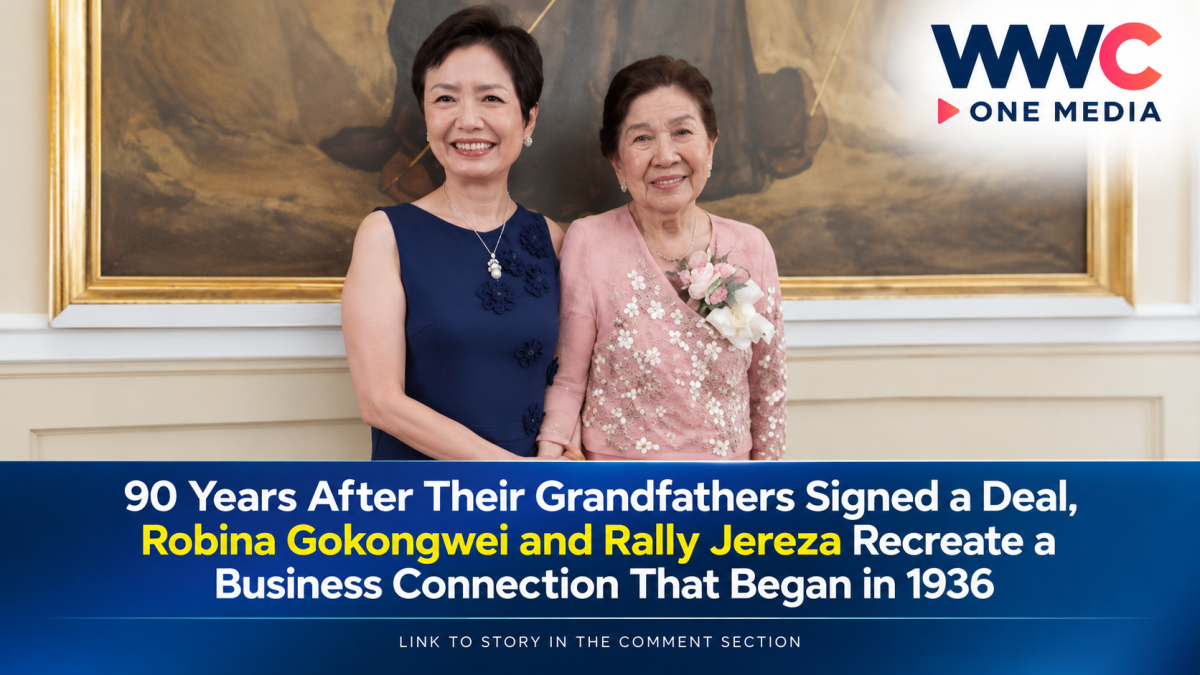
Some business deals are measured in pesos, contracts and expansion plans.
Others come with a family history spanning generations.
For Robina Gokongwei-Pe and Rally Jereza, a recent business agreement unexpectedly revealed a connection between their families that reaches all the way back to 1936 — when their grandfathers signed a contract involving one of Cebu’s early movie theaters.
The remarkable discovery came while Gokongwei-Pe was researching the history of the movie theaters once operated by her paternal grandfather, John Go Kong Wei, in Cebu.
What she found was a decades-old contract dated January 31, 1936.
The document showed that her grandfather had entered into an agreement with Agustin Jereza and his wife, Beatriz Duterte de Jereza, involving the lease and operation of Vision Theatre on Colon Street in Cebu.
Nearly nine decades later, their descendants would find themselves signing another agreement.
This time, however, the deal had nothing to do with a movie theater.
It was about bringing banking services into retail stores.
From a Cebu movie theater to modern retail banking
The original 1936 agreement reflected a very different era in Philippine business.
Under the arrangement, the Jerezas would build and furnish the theater, while John Go Kong Wei would provide the equipment needed for a “cinematógrafo parlante,” or talking-picture theater.
Vision Theatre would eventually be promoted as “the only air-conditioned theatre in the Visayas,” with a restaurant called Cozy Corner operating on the ground floor.
The theater was part of John Go Kong Wei’s business activities in Cebu.
According to the account shared by Gokongwei-Pe, her father, the late industrialist John Gokongwei Jr., had told family stories about the six movie theaters his father operated in the city.
But the family’s fortunes changed dramatically after John Go Kong Wei died in 1939 at only 34 years old.
He died following a blood-type error during a transfusion while being treated for typhoid, leaving behind his wife and six children, including the future businessman John Gokongwei Jr.
The family’s home and business interests were later discovered to have been mortgaged, forcing the young John Jr. to rebuild the family’s fortunes.
He eventually changed the family’s surname from Go to Gokongwei, in honor of his father.
The family connection was hiding in plain sight
The extraordinary part of the story is that neither Gokongwei-Pe nor Jereza initially realized that their families had crossed paths nearly 90 years earlier.
Gokongwei-Pe encountered the Jereza surname while researching the old Vision Theatre contract.
Years after that original agreement, she happened to be working on a project involving Robinsons Retail Holdings Inc. (RRHI) and Bank of the Philippine Islands (BPI).
That brought her into contact with Rally Jereza, who heads BPI’s Agency Banking division.
The surname immediately caught her attention.
She asked whether Jereza knew an Agustin Jereza.
He checked with his relatives.
The answer was the kind of discovery that sounds almost too perfect for a business-history story:
Agustin Jereza was Rally Jereza’s grandfather.
Gokongwei-Pe later described the moment as a remarkable surprise.
The new deal has nothing to do with cinemas
The second-generation connection is not a repeat of the original business.
Instead of building a movie theater, the descendants are helping connect banking and retail.
BPI and Robinsons Retail have been expanding a partnership designed to allow customers to access banking services inside Robinsons Retail stores.
In November 2025, BPI announced that customers could withdraw cash from participating Robinsons Retail stores without using an ATM card by generating a barcode through the BPI mobile application.
The initial rollout covered more than 300 stores across several Robinsons Retail brands, including Robinsons Supermarket, Robinsons Easymart, The Marketplace, Shopwise, Robinsons Department Store and Toys“R”Us.
The arrangement was designed around a simple idea:
Customers should be able to handle basic banking transactions while doing their regular shopping.
The partnership has continued to expand
The relationship between BPI and Robinsons Retail has not remained limited to cash withdrawals.
In 2026, the two groups expanded their store-based banking services to include barcode-based cash deposits.
Philippine Star reported in May that BPI planned to roll out the cash-deposit service across more than 1,000 Robinsons Retail stores nationwide by the end of the year.
Rally Jereza, BPI’s agency banking head, described the expansion as part of the bank’s effort to make financial services more accessible and relevant to Filipinos.
That means the descendants’ modern business connection is ultimately about a very different kind of infrastructure from the one their grandfathers built in Cebu.
In 1936, their families were connecting people to a new form of entertainment.
Today, their descendants are connecting people to banking services where they already shop.
Robina Gokongwei’s role in the Robinsons empire
The modern side of the story is also significant because of Gokongwei-Pe’s position within the Robinsons group.
Robinsons Retail lists Gokongwei-Pe as its chairman, a position she has held since January 1, 2025. She has been a director of the company since 2013.
She also serves as a director of JG Summit Holdings and Robinsons Land Corp., among other roles, and is secretary of the Gokongwei Brothers Foundation.
Jereza, meanwhile, serves as head of Agency Banking at BPI, placing him directly in charge of a business area focused on extending banking services beyond traditional branches and ATMs.
The positions explain why their modern paths crossed.
The historical connection was pure coincidence.
The contemporary business relationship is not.
Banking moves into the places Filipinos already visit
The BPI-Robinsons Retail partnership reflects a broader change in how financial institutions deliver services.
Instead of requiring customers to make a separate trip to a bank branch or ATM, agency banking places selected services inside everyday commercial locations.
BPI said its partner-store model was intended to expand access while making banking transactions more convenient.
Customers can generate a transaction barcode through the BPI app and present it at participating stores.
For withdrawals, BPI initially set a limit of up to ₱10,000 per transaction, with customers allowed up to five transactions per day, subject to brand-specific limits.
The cash-deposit service represents another step in that expansion.
The result is a business model that places financial services closer to supermarkets, department stores and other high-traffic retail locations.
A deal that began before either descendant was born
The most striking element of the story remains the timeline.
The original contract was signed in 1936.
John Gokongwei Jr. was only a child at the time.
Rally Jereza was not yet born.
Robina Gokongwei-Pe would not be born for decades.
Yet the business relationship created by their grandfathers remained buried in a family history that eventually resurfaced through an entirely different transaction.
Nearly 90 years later, their descendants found themselves signing a new agreement.
Gokongwei-Pe summed up the coincidence with a reference to the old movie business: the first agreement involved a movie house; the new one involves banking and retail.
“What a sequel!” she wrote in recounting the discovery.
From “talking pictures” to digital banking
There is something almost cinematic about the progression.
In 1936, the challenge was bringing talking pictures to Cebu audiences.
The solution was Vision Theatre.
Nearly a century later, the challenge is bringing banking services closer to consumers.
The solution is a partnership connecting a major Philippine bank with one of the country’s largest retail networks.
The technology has changed completely.
The business families have evolved.
The industries are different.
But the underlying theme remains remarkably similar:
Two families found a way to build a business connection across generations.
The Gokongwei-Jereza story is bigger than one contract
The rediscovered 1936 document offers a glimpse into a much earlier chapter of Philippine commerce, when entrepreneurs were building businesses around emerging technologies and changing consumer habits.
For the Gokongwei family, that history eventually became part of one of the country’s largest business groups.
For the Jereza family, the connection resurfaced almost a century later through another piece of Philippine commercial infrastructure.
And for Gokongwei-Pe and Jereza, what began as an ordinary modern business project suddenly acquired an extraordinary family dimension.
The first contract connected a cinema operator and a theater-building family.
The latest agreement connects a retail empire and a bank.
Different industries.
Different century.
Different technology.
But the same two family names are once again appearing on a business deal.
Ninety years later, the sequel has arrived — and this time, there isn’t a movie theater involved.