France’s vineyards are facing one of their most damaging harvests in generations.
After months of drought, repeated heatwaves and extreme summer temperatures, France is expected to produce just under 34 million hectoliters of wine in 2026, according to the latest estimate from the French Agriculture Ministry’s statistics service, Agreste.
That would represent a 6% decline from 2025 and leave production 17% below the 2021–2025 average. If the estimate is confirmed, it would be France’s smallest wine harvest since 1957.
The crisis is particularly severe in some of France’s most prestigious wine regions.
In Champagne, production is forecast to plunge by roughly 48% from last year. Burgundy-Beaujolais is projected to fall by about 33%, while Jura faces an estimated 36% decline.
And the biggest concern for French winemakers may not be what happens to one year’s bottles.
It is whether increasingly extreme weather is turning what used to be exceptional harvest failures into a recurring problem.
A harvest squeezed by heat, drought and shrinking vineyards
France entered the 2026 growing season with hopes of recovering from two consecutive weak harvests.
Instead, the weather delivered another blow.
Agreste says the expected decline reflects two factors: a reduction in vineyard area and lower yields caused by adverse weather, particularly drought and summer heatwaves.
The scale of the heat was extraordinary.
Reuters reported that France endured severe heat and drought that damaged vines and grapes, forcing many regions into an unusually early harvest.
The damage was not uniform.
Some areas actually expect production to increase from last year’s particularly weak harvest.
Bordeaux, for example, is forecast to produce about 10% more wine than in 2025, while Languedoc-Roussillon is expected to rise about 5%.
But both regions remain below their recent five-year averages.
That regional contrast is crucial.
France isn’t experiencing one identical wine disaster from north to south.
Instead, individual vineyards are responding differently depending on rainfall, soil, grape varieties, previous crop conditions and the severity of extreme weather.
Champagne takes one of the biggest hits
Perhaps the most dramatic number is coming from Champagne.
Agreste estimates that Champagne’s total wine production could fall to approximately 1.34 million hectoliters, down 48% from 2025 and 46% below the five-year average.
For Champagne appellation production specifically, the projected decline is even steeper — approximately 49% compared with 2025.
The region was hit by a combination of frost, hail and prolonged drought.
Harvesting also began unusually early.
Yet there is an important distinction between a smaller grape harvest and an immediate shortage of Champagne bottles in stores.
Why Champagne won’t suddenly disappear from shelves
A nearly 50% decline in this year’s Champagne harvest does not mean Champagne production available to consumers will immediately fall by 50%.
That’s because Champagne producers have stocks of wine from previous harvests that can be blended with newer production.
Euronews reported that Champagne’s production system allows producers to rely on reserve wines accumulated from earlier vintages, helping cushion the effect of a disastrous harvest.
Champagne therefore has a buffer that many other wine producers do not possess to the same degree.
But that doesn’t mean the damage is insignificant.
For individual growers, losing roughly half a harvest can mean a substantial reduction in grapes available for production.
And if similarly poor harvests continue, reserves could eventually come under pressure.
That is where the long-term risk becomes much more serious.
Three weak harvests in a row
France’s 2026 crop is not an isolated event.
The country has now endured a series of weak harvests.
Reuters described 2026 as potentially the third consecutive year of reduced French wine production.
That creates a fundamentally different problem from a single bad growing season.
A one-year crop failure can potentially be absorbed through inventories, insurance, pricing and reserve stocks.
Repeated production losses are harder to manage.
Wine producers still have to pay for labor, equipment, land, energy, financing and vineyard maintenance even when fewer grapes are available.
That means a smaller harvest can increase the cost of producing every bottle.
The climate problem is changing the economics of French wine
For decades, French wine has been closely associated with terroir — the combination of soil, climate, geography and traditional production methods that gives each region its distinctive character.
Climate change is challenging some of those assumptions.
Higher temperatures can accelerate grape ripening.
Drought can reduce berry size and yields.
Extreme heat can stress vines at critical stages of development.
Frost can destroy young growth.
Hail can physically damage grapes.
And wildfires create another threat.
The Guardian reported that some French vineyards were also concerned about smoke taint from wildfires affecting grapes and wine quality.
That means the risk isn’t simply “less wine.”
The industry also has to worry about when grapes ripen, how much they produce and whether extreme weather affects quality.
An earlier harvest is becoming part of the story
French winemakers began harvesting earlier than usual in several regions this year.
That is partly a response to accelerated grape maturation under unusually warm conditions.
The trend has been developing for years.
Warmer temperatures can cause grapes to reach harvest readiness earlier, potentially altering the balance between sugar, acidity and other characteristics that influence wine.
Le Monde reported in July that France’s 2026 harvest was expected to begin unusually early after vines suffered from water shortages, even though the vintage initially showed promise.
The later summer heat and drought worsened the production outlook.
This illustrates how quickly conditions can change during a wine-growing season.
A promising spring does not necessarily guarantee a strong harvest.
Burgundy and Jura also face severe losses
Champagne is receiving much of the attention, but several other regions have suffered major declines.
Burgundy-Beaujolais production is estimated to fall 33% from 2025.
Jura is projected to decline 36%.
Val de Loire is expected to fall 12%.
Alsace is forecast to decline about 6%.
The figures underline how widespread the problem has become.
At the same time, regions such as Bordeaux and Languedoc-Roussillon are expected to produce more than they did in 2025.
That doesn’t necessarily mean those regions are thriving.
Their projected output remains below their recent five-year averages.
There is a strange twist: less wine can sometimes help
France’s wine industry has another problem besides extreme weather.
Some producers have been dealing with weak demand and excess inventories, particularly in parts of the red-wine market.
That creates an unusual economic contradiction.
A smaller harvest is bad news for a grower whose vineyard produces fewer grapes.
But a smaller national supply can also help reduce excess stocks and bring production closer to actual demand.
Euronews reported that the smaller 2026 harvest could therefore have a mixed economic effect: it hurts productivity and individual producers, but lower aggregate supply can help rebalance markets where inventories have been excessive.
The problem is that this balancing effect only works up to a point.
If production falls too far, producers can lose the ability to supply customers consistently.
The global wine market could feel the consequences
France is one of the world’s major wine producers and exporters.
A prolonged reduction in production therefore has consequences beyond French vineyards.
Lower supply can put upward pressure on prices for certain wines, particularly when inventories are limited and demand remains strong.
But the effect will vary dramatically by region and product.
Champagne, Burgundy and other high-value appellations operate differently from lower-priced bulk wine markets.
And consumers should not assume that every French bottle will suddenly become dramatically more expensive.
The size of the harvest is only one factor.
Inventories, exchange rates, consumer demand, export markets and pricing strategies all influence what ultimately happens at retail.
Quality could tell a different story from quantity
One of the most important details emerging from the 2026 harvest is that low production does not automatically mean poor-quality wine.
In Champagne, early assessments have suggested that the grapes harvested were in some cases highly ripe and potentially capable of producing strong wines despite the dramatically smaller crop.
That creates another paradox.
French vineyards can have a disastrous year financially and still produce some exceptional wine.
A small harvest can even increase the scarcity value of certain vintages.
But quality assessments will take time.
The full character of the 2026 vintage cannot be determined simply from early harvest statistics.
The real danger is repetition
The biggest question for France’s wine industry isn’t necessarily whether 2026 will be a historic low.
It is whether such extreme harvests become more frequent.
A single record-low harvest can be absorbed.
A decade of increasingly unpredictable weather is a different challenge.
Wine producers may need to adapt through changes in pruning, irrigation where permitted, vineyard management, grape varieties, planting locations and harvesting schedules.
Some may also need to reconsider what types of wine can be produced economically in particular regions.
That is a much larger transformation than simply surviving one difficult summer.
France’s wine industry faces a new reality
The 2026 harvest is currently an estimate, not a final audited production figure.
But the warning signs are already clear.
Agreste expects approximately 34 million hectoliters.
That’s 6% below an already weak 2025 crop and 17% below the five-year average.
And if historical comparisons hold, France could record its smallest wine harvest since 1957.
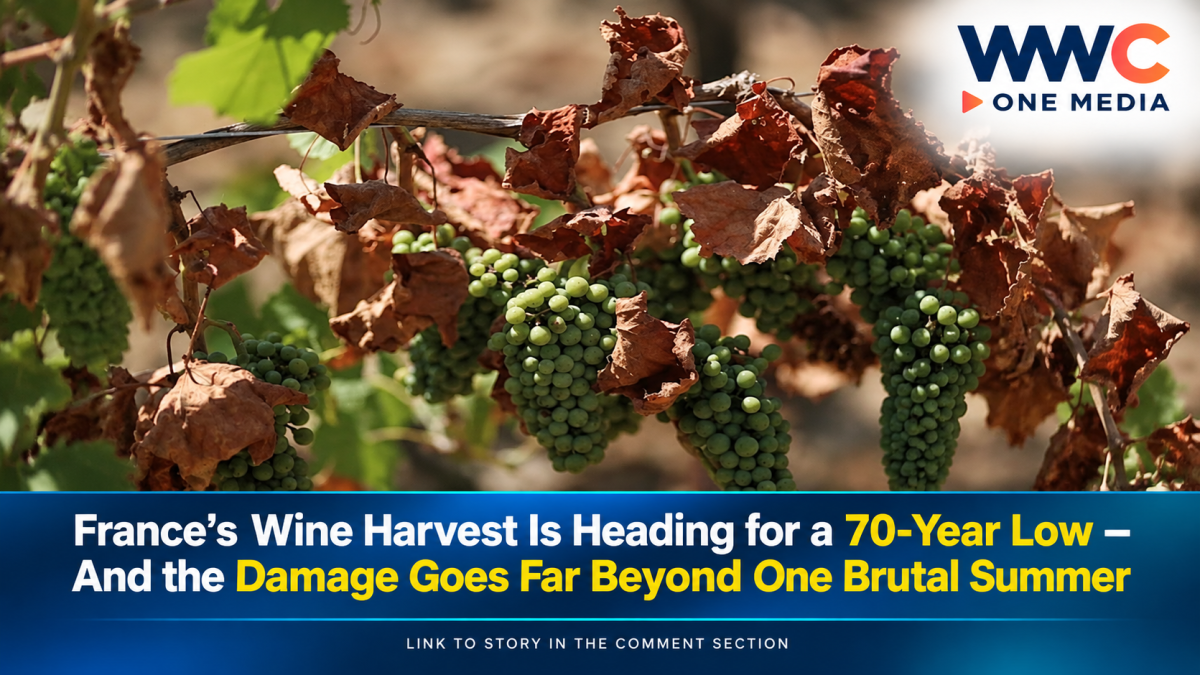
The vineyards of Champagne, Burgundy, Jura and other regions are showing the physical consequences of drought, heat and extreme weather.
Yet the story is more complicated than a simple “wine shortage.”
Existing stocks will cushion consumers in the short term.
Some regions are actually producing more than last year.
Some producers may benefit from lower inventories.
And the quality of the wine ultimately produced cannot yet be determined solely from the volume forecast.
But for French winemakers, the message is unmistakable.
The climate is changing the equation — and the 2026 harvest may be the clearest warning yet that France’s centuries-old wine industry is entering a very different era.