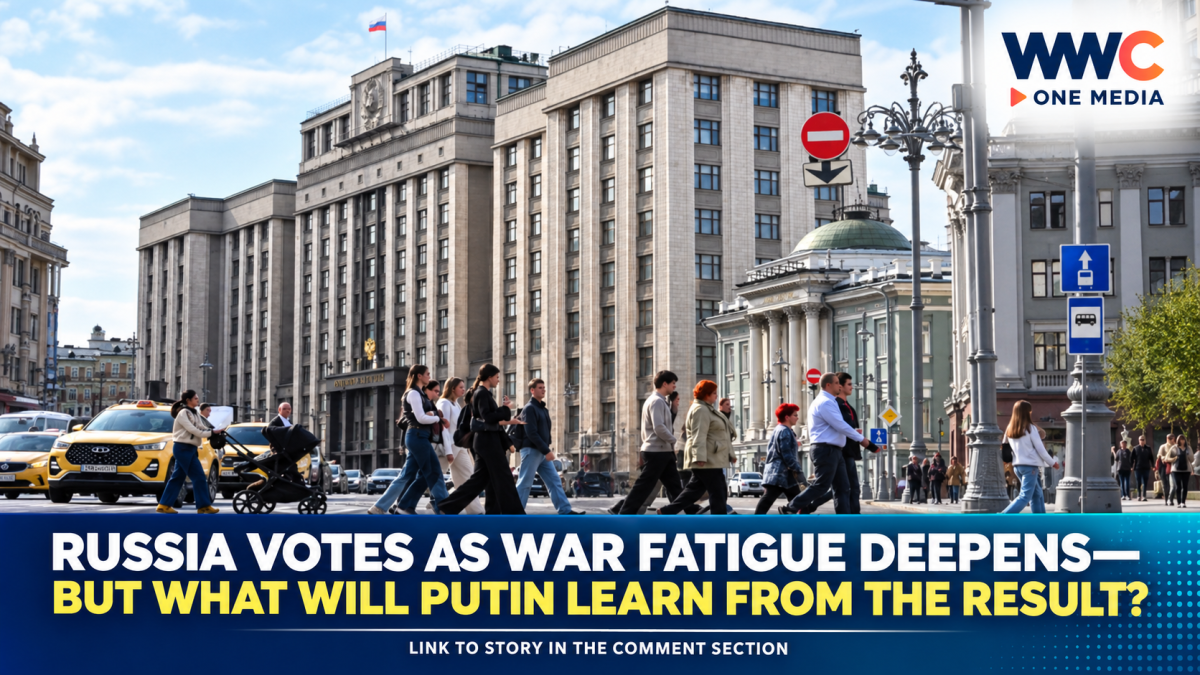
MOSCOW — Russians are heading to the polls in a closely watched parliamentary election as anxiety over the war in Ukraine, economic pressures, fuel shortages and fears of another military mobilization increasingly shape the national mood.
The three-day election for Russia’s 450-seat State Duma began on September 18 and concludes on September 20. It is the first parliamentary election held since Russia launched its full-scale invasion of Ukraine in February 2022.
While the Kremlin is presenting the vote as a demonstration of national unity and support for President Vladimir Putin’s policies, independent reporting and polling cited by German broadcaster DW and Reuters point to growing anxiety among sections of the Russian population.
According to DW, nearly half of respondents in surveys by Russia’s state-run Public Opinion Foundation said anxiety was the prevailing mood among people around them. Independent pollster ExtremeScan, meanwhile, found that 60% of Russians surveyed believed the war had negatively affected their everyday lives.
War fatigue is increasingly visible
The election comes after months of Ukrainian drone attacks inside Russia, disruptions affecting fuel supplies and renewed speculation about another mobilization.
Reuters reported earlier this month that anxiety had remained unusually high in polling by the Public Opinion Foundation. The news agency also documented growing demand for insurance against drone strikes and protective window film, illustrating how the effects of the war have increasingly reached ordinary Russian households.
Some Russians have also left the country temporarily because of concerns that authorities could announce another mobilization after the election, although President Putin and other Russian officials have repeatedly denied that a new call-up is imminent.
The Kremlin has not indicated that a new mobilization will follow the election, meaning such concerns remain speculation rather than an announced government policy.
United Russia remains dominant
The ruling United Russia party is expected to retain its dominance in the State Duma.
The chamber has 450 seats, with half elected through a nationwide party-list system and the other half through single-member constituencies. United Russia currently holds 310 seats and would need at least 300 to preserve its existing supermajority.
Other major parties competing for seats include the Communist Party, Liberal Democratic Party, A Just Russia and New People. Reuters noted that the main parties expected to remain represented in parliament generally support the government’s position on the war, limiting the scope of parliamentary opposition to the Kremlin’s Ukraine policy.
Anti-war opposition faces major restrictions
One of the most significant controversies surrounding the election is the exclusion of Yabloko, the country’s only registered political party openly campaigning against the war.
Russia’s Supreme Court removed Yabloko’s federal candidate list from the election after a legal challenge brought by the Rodina party. Yabloko disputed the allegations underlying the decision, while Russian authorities cited campaign-related violations. The Supreme Court later refused to reopen the case.
The exclusion has further narrowed the field for voters seeking an explicitly anti-war party on the national ballot.
The broader opposition landscape has also been weakened by imprisonment, exile and restrictions on anti-war politicians. AP reported during the election that Yabloko and Communist Party representatives had raised complaints involving observers and voting procedures at some polling stations.
Russia also did not invite observers from the Organization for Security and Cooperation in Europe (OSCE) to monitor the election, according to AP reporting. Russian authorities said they had invited other international observers instead.
Cyberattacks add another layer of tension
The election has also been accompanied by reported attacks on Russia’s voting infrastructure.
Russian authorities said Moscow’s online voting system came under a major cyberattack during the second day of voting. Officials also reported an attempted disruption of communications infrastructure in Russia’s Far East.
President Putin accused Ukraine of attempting to interfere with the election, although Reuters reported that he provided no evidence for the allegation.
As of Saturday afternoon, nationwide voter turnout was reported at 32.58%, according to Russian election authorities cited by Reuters.
The election’s bigger significance
For the Kremlin, the election is about more than filling seats in parliament.
Putin has portrayed the vote as evidence of national solidarity and support for Russian troops. Reuters reported that the Kremlin is likely to use the outcome as a political signal regarding support for its wartime policies.
But interpreting the result as a straightforward measure of public opinion comes with significant limitations.
The exclusion of major anti-war candidates, restrictions on political dissent and the tightly controlled political environment mean voters do not have the same range of choices found in a competitive multiparty election.
At the same time, the election could reveal other indicators the Kremlin is watching closely—including turnout and the level of support received by the smaller parties that are allowed to compete.
Russia waits for the final numbers
The official results are expected after voting ends Sunday, with preliminary figures anticipated later that day and fuller results expected Monday.
Whatever the final seat count, the election is taking place against a Russia very different from the country that last elected a State Duma in 2021.
The war has increasingly touched daily life through drone attacks, economic pressure, restrictions on information and persistent uncertainty over military mobilization.
The Kremlin may emerge from the vote with another dominant parliamentary majority. But the more difficult question could be what the election reveals about the mood underneath that political stability—and how long that stability can withstand the pressures of a war that continues to reshape Russian society.