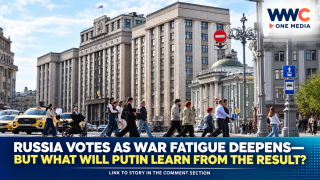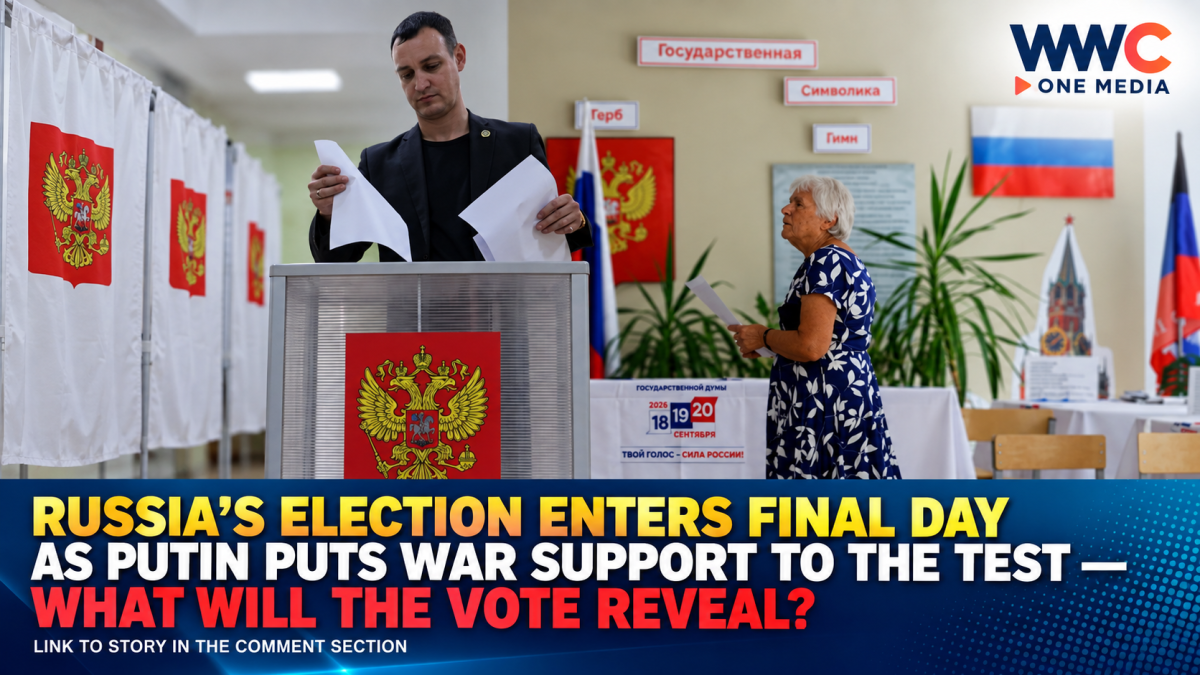
MOSCOW — Russia’s three-day parliamentary election enters its final day on Sunday, with the Kremlin watching turnout and the eventual result for signs of public support for President Vladimir Putin and his continuing war in Ukraine.
The vote, which began on Friday and runs across Russia’s 11 time zones, is the country’s first parliamentary election since Moscow launched its full-scale invasion of Ukraine in February 2022.
Putin has publicly framed participation as a demonstration of national unity and support for Russian troops, making the election more politically significant than a routine vote for the 450-seat State Duma.
Reuters reported that Putin has described the election as a barometer of support for the war, while most anti-war candidates have been excluded from the ballot. The ruling United Russia party is widely expected to retain its dominance in the tightly controlled political system.
Turnout becomes a key number to watch
By Saturday afternoon, nationwide turnout had reached 32.58 per cent, according to figures from Russia’s Central Election Commission cited by Reuters and other outlets.
The Kremlin is expected to pay close attention not only to the eventual vote totals but also to participation levels, amid signs of economic pressure and concern among some Russians about the costs of the war.
Reuters previously reported that the Kremlin would be watching the election for indications of public anxiety and possible war fatigue as the conflict continues.
The election has also been extended over three days, with electronic voting available in a bid to make participation easier across the world’s largest country.
Opposition faces major restrictions
The election is taking place in a political environment where anti-war candidates have faced significant restrictions.
The liberal Yabloko party was removed from the nationwide party-list ballot after Russia’s Supreme Court ruled that it had violated electoral rules. Yabloko disputed the decision. Some of its members are nevertheless running in individual constituencies.
The result is an election in which United Russia faces limited organized opposition at the national level.
The Associated Press described the vote as Russia’s first wartime parliamentary election and reported that the political environment offers virtually no meaningful opposition to the Kremlin-backed ruling party.
Cyberattacks add another layer of tension
The election has also been accompanied by reports of attacks on Russia’s electronic voting infrastructure and communications networks.
Russian officials said Moscow’s online voting system came under an intense cyberattack overnight between Friday and Saturday. Authorities said the system continued operating.
Officials also reported an attempted attack on communications infrastructure in Russia’s Far East.
Putin accused Ukraine of attempting to interfere with the election, but Reuters reported that he provided no evidence for the allegation. Kyiv has not accepted Russia’s accusations.
The reports add another unusual dimension to an election already being closely watched because of the ongoing war.
Voting in Ukrainian territories sparks controversy
Another major point of contention is the inclusion of residents in Ukrainian territories that Russia claims to have annexed.
Russia is holding parliamentary voting in parts of Donetsk, Luhansk, Kherson and Zaporizhzhia that Moscow claims as part of the Russian Federation.
Ukraine and its allies reject those territorial claims. Reporting from multiple outlets has highlighted the political and legal controversy surrounding Russia’s decision to conduct elections in areas it seized during the war.
For Moscow, however, allowing residents of those territories to participate reinforces its claim that the areas have been incorporated into Russia.
A dispute also emerges with Moldova
The election has generated tensions beyond Ukraine.
Russia opened or planned polling stations in Moldova’s breakaway Transdniestria region, where Moscow says roughly 220,000 residents hold Russian passports.
Moldovan authorities objected to the move and said Russian citizens should vote only at the Russian embassy in Chisinau. Moldova’s government has described the planned polling arrangements as unacceptable, while Moscow defended the voting rights of Russian passport holders.
Reuters reported that the dispute has become another diplomatic flashpoint surrounding the election.
What happens when voting ends?
Voting is scheduled to conclude on Sunday, after which attention will turn to turnout and the preliminary results for the State Duma.
United Russia won more than two-thirds of the seats in the previous parliamentary election in 2021, and current reporting indicates that the party is expected to maintain its dominance again.
But the political significance of this year’s vote extends beyond the composition of parliament.
For Putin’s government, the election provides an opportunity to demonstrate domestic political stability while the war in Ukraine continues. For observers, turnout, the distribution of votes and any reported irregularities will be closely watched for clues about the public mood.
The central question may therefore emerge only after the polls close:
Will the election demonstrate genuine public enthusiasm for the Kremlin’s wartime policies — or primarily reflect the tightly controlled political environment in which Russians are being asked to vote?
The answer will depend not only on the final numbers, but also on how those numbers are interpreted against the backdrop of a war that has reshaped Russia’s politics, economy and relations with the outside world.