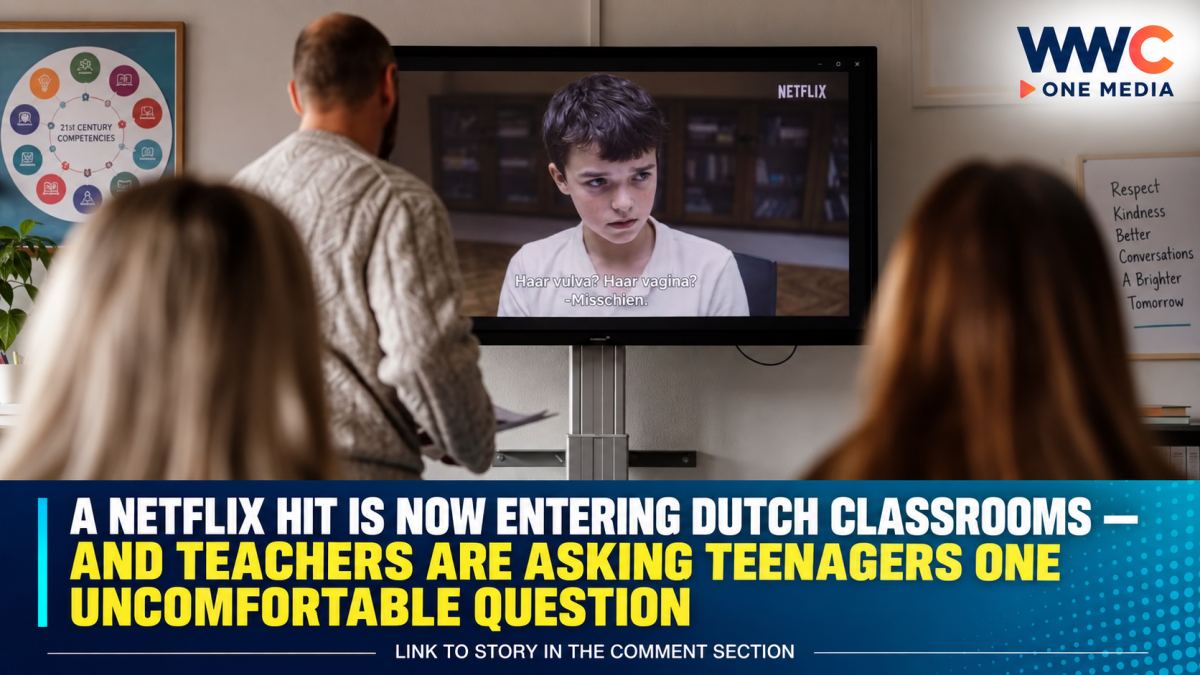
WARNSVELD, Netherlands — A Netflix drama about a teenage boy caught in a world of online misogyny is becoming an unexpected classroom tool in the Netherlands, where teachers are using selected scenes to start difficult conversations about social media, bullying, masculinity and the influence of online personalities.
At a secondary school in the small eastern Dutch town of Warnsveld, social studies teacher Gijs Korenblik recently built a lesson around Adolescence, the four-part Netflix drama that follows a 13-year-old boy accused of killing a female classmate after becoming influenced by misogynistic online communities.
Rather than simply screening the series, Korenblik uses selected scenes to ask students questions about their own online experiences and ideas about gender.
One question in particular stopped the class in its tracks:
What makes a man a man?
The lesson opened a discussion about masculinity, gender roles, bullying and influencers — including the online communities commonly described as the “manosphere.”
The approach reflects a growing concern among educators internationally: young people can encounter highly influential content about relationships, gender and identity long before parents or teachers know what they are seeing.
From Netflix drama to classroom discussion
The Dutch initiative is not about making students watch the entire series from beginning to end.
Instead, the Dutch Institute for Sound & Vision, known as Beeld & Geluid, has developed educational material using selected scenes from Adolescence, alongside material from its wider media collection.
The free educational package is designed for secondary-school students across Dutch VMBO, HAVO and VWO education and covers subjects including digital literacy, social studies and mentoring. It addresses influencers, online “bubbles,” relationships, self-image, responsibility and the ways media can shape young people’s perceptions.
The material was developed with teachers and tested with students, according to Beeld & Geluid. Teachers can choose ready-made lessons, selected clips or material from the entire series depending on their classroom and learning objectives.
That distinction is important: Adolescence itself is a fictional drama, while the educational program uses the series as a starting point for discussing real-world issues surrounding digital media and youth culture.
Why the “manosphere” has become a classroom issue
The term “manosphere” refers broadly to online communities and influencers focused on masculinity, relationships and gender, although the communities within it vary considerably.
Some spaces focus on self-improvement or men’s issues, while others promote misogynistic ideas or hostility toward women.
The concern for schools is how easily teenagers can encounter this material through social-media recommendation systems, influencer videos and online communities.
The New York Times reported in September that a survey of almost 500 Dutch education professionals found that more than half of high-school respondents had observed an increase over the previous four years in behaviours among boys that they associated with the manosphere, including praise for controversial influencers and expressions of sexist views.
That does not establish that online content causes particular behaviour in individual students. It does, however, illustrate why some educators are looking for ways to discuss the subject before teenagers encounter it entirely on their own.
Dutch schools are not alone
The Netherlands is part of a wider international conversation surrounding Adolescence.
In 2025, educational initiatives connected to the series emerged in several countries. In the Netherlands, Beeld & Geluid created its classroom materials in cooperation with teachers and Netflix. In France, schools were also offered classroom sessions based on excerpts from the drama, while the series was being used in educational discussions in Britain and elsewhere.
Dutch public broadcaster NOS previously reported that the country’s educational package was intended to help students discuss issues including media influence and peer pressure and learn to recognise how influencers can affect their thinking.
The Netherlands has subsequently continued discussing how widely the educational package should be used. A parliamentary motion introduced in late 2025 called for broader awareness of the free Adolescence en mediawijsheid teaching materials among schools.
But educators warn against turning boys into suspects
The classroom experiment also comes with a major caveat.
Not every expert believes Adolescence is automatically an appropriate teaching resource.
Sophie King-Hill, an associate professor at the University of Birmingham who researches young people’s sexual behaviour, told The New York Times that the series presents an unusually extreme scenario and could risk making boys feel that they are being treated as potential threats.
Other experts have similarly cautioned that the fictional story should not be mistaken for a typical representation of teenage boys or treated as a direct explanation for real-world violence.
Harriet Over, a psychology professor at the University of York involved in developing educational approaches to online misogyny, also told The New York Times that some professionals were concerned that poorly handled lessons could make boys feel demonised rather than encouraging them to participate.
That concern has shaped the Dutch approach.
Korenblik has said the series should be used as a starting point for conversation rather than an end in itself.
What happens when teenagers are given the floor?
In Korenblik’s classroom, students offered different answers when asked what makes someone a man.
Some focused on keeping promises and treating people with respect. Others discussed family responsibilities and personal identity.
The teacher’s method is deliberately discussion-based rather than simply telling students what they should think.
When students express controversial views, Korenblik says he asks questions and encourages them to recognise that classmates may have completely different perspectives.
The goal is not necessarily to produce one approved answer.
It is to make students stop, question what they encounter online and listen to people outside their own social-media bubbles.
A bigger question for schools worldwide
The Dutch experiment points to a broader challenge facing educators: what happens when the classroom becomes one of the few places where teenagers can openly examine the online culture already shaping their lives?
Social-media platforms do not necessarily provide context when teenagers encounter provocative claims about relationships, masculinity or gender.
A viral video may last only seconds.
A classroom discussion can take an hour.
That is why Adolescence has attracted interest from educators despite the controversy surrounding its use.
Beeld & Geluid’s educational materials explicitly frame the series as a tool for media literacy — helping students examine how media can influence behaviour, identity and relationships, while encouraging them to reflect on their own choices.
The Dutch experience also highlights the limits of using popular entertainment as education.
A television drama can open a conversation, but it cannot by itself explain the complicated realities of teenage behaviour, online communities or gender relations.
For teachers such as Korenblik, the real lesson may therefore begin after the screen goes dark.
That is when students have to confront a question that has little to do with Netflix — and much more to do with the world they are growing up in:
Who is shaping the way young people think when nobody in the classroom is watching?