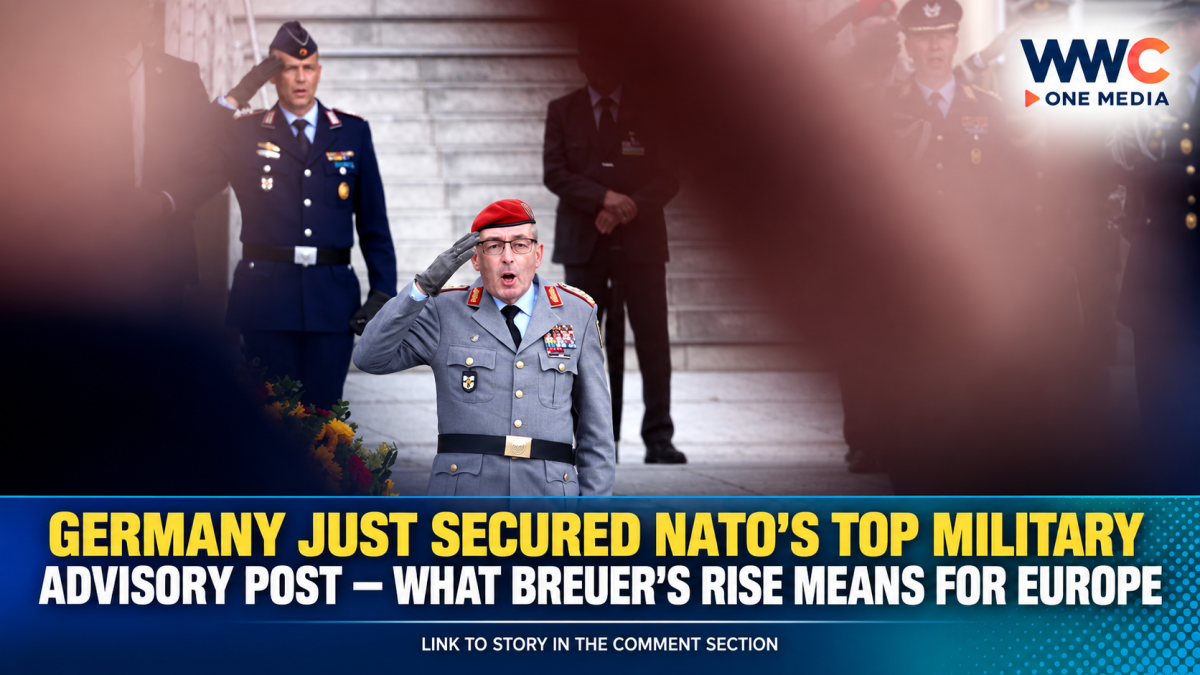
COPENHAGEN — Germany’s top military officer, General Carsten Breuer, has been elected to lead NATO’s Military Committee, placing a German general at the head of the alliance’s highest military authority at a pivotal moment for European defence.
NATO’s 32 chiefs of defence elected Breuer during the alliance’s Military Committee Conference in Copenhagen on Sept. 19, 2026. He will take office in summer 2027, succeeding Italian Admiral Giuseppe Cavo Dragone, and will serve a three-year term.
The Military Committee is NATO’s senior military authority. Its chair serves as the principal military adviser to NATO Secretary General Mark Rutte and helps convey the collective military advice of the alliance’s chiefs of defence to NATO’s political leadership and strategic commanders.
Breuer takes the post at a critical moment
Breuer’s appointment comes as NATO continues adjusting its defence posture following Russia’s full-scale invasion of Ukraine and amid pressure for European allies to assume a greater share of responsibility for the continent’s conventional defence.
At the Copenhagen conference, NATO’s military chiefs discussed strengthening collective deterrence and defence, accelerating the adoption of new defence technologies and capabilities, and continuing support for Ukraine.
The wider alliance is also navigating a changing transatlantic defence relationship. Reuters reported that U.S. President Donald Trump has pushed European NATO members to take greater responsibility for Europe’s defence, while governments across Europe have increased defence spending in response to the changing security environment.
Germany has been among the countries increasing its military investment. Reuters reported that Berlin aims to raise military expenditure to more than €200 billion by 2030.
Who is Carsten Breuer?
Breuer, 61, has served as Germany’s chief of defence since 2023. He began his Bundeswehr career in an air-defence unit in 1984 and later completed military staff training in Germany and at the U.S. Army Command and General Staff College at Fort Leavenworth, Kansas. He also served with NATO’s International Security Assistance Force in Kabul in 2014.
He became nationally prominent during the COVID-19 pandemic after then-Chancellor Olaf Scholz selected him to lead a crisis-management team coordinating Germany’s response in 2021 and 2022. That role earned him the nickname “the chancellor’s general,” according to Reuters.
Germany’s government has also highlighted Breuer’s experience in reshaping the Bundeswehr as Berlin seeks to strengthen its armed forces.
Breuer defeated Canada’s Jennie Carignan
Breuer was elected over Canadian General Jennie Carignan, Canada’s chief of the defence staff.
Carignan’s election would have made her the first woman to chair NATO’s Military Committee. Canadian media reported that the vote was conducted among the alliance’s 32 military chiefs.
Carignan subsequently congratulated Breuer and said she looked forward to continuing to work with him on NATO initiatives, according to CBC reporting.
The outcome also means Germany will once again hold the influential military-advisory position after more than two decades. German broadcaster Tagesschau reported that the last German to chair the Military Committee was General Harald Kujat, who held the post from 2002 to 2005.
What Breuer’s new role actually means
The chair of NATO’s Military Committee is not the alliance’s operational commander. That distinction is important.
The Military Committee provides military advice to NATO’s political decision-making bodies. The chair acts as a senior military adviser and helps translate the collective views of NATO’s defence chiefs into advice for the alliance’s political leadership.
NATO’s operational command structure remains separate, with the Supreme Allied Commander Europe (SACEUR) responsible for the alliance’s military operations and strategic command.
Breuer’s appointment therefore gives Germany a prominent role in NATO’s military policymaking and advisory structure, while the alliance continues to balance national defence priorities, collective deterrence and the evolving transatlantic relationship.
The bigger picture
The timing of Breuer’s appointment is significant for NATO.
At its September 2026 conference, the alliance’s military leadership focused on turning increased defence commitments into actual capabilities, including stronger deterrence, new technologies and improved military readiness.
Breuer will inherit the Military Committee leadership as NATO continues adapting to these challenges. His term is scheduled to begin in July 2027, giving the alliance time to prepare the transition from Dragone.
Germany will also need to appoint a successor to Breuer as its chief of defence. Reuters reported that Lieutenant General Christian Freuding is expected to succeed him in that German role later this year.
For NATO, the leadership change is more than a personnel transition: it comes as European allies face pressure to strengthen their own military capabilities while the alliance continues to reinforce deterrence and coordinate its response to a rapidly changing security environment.