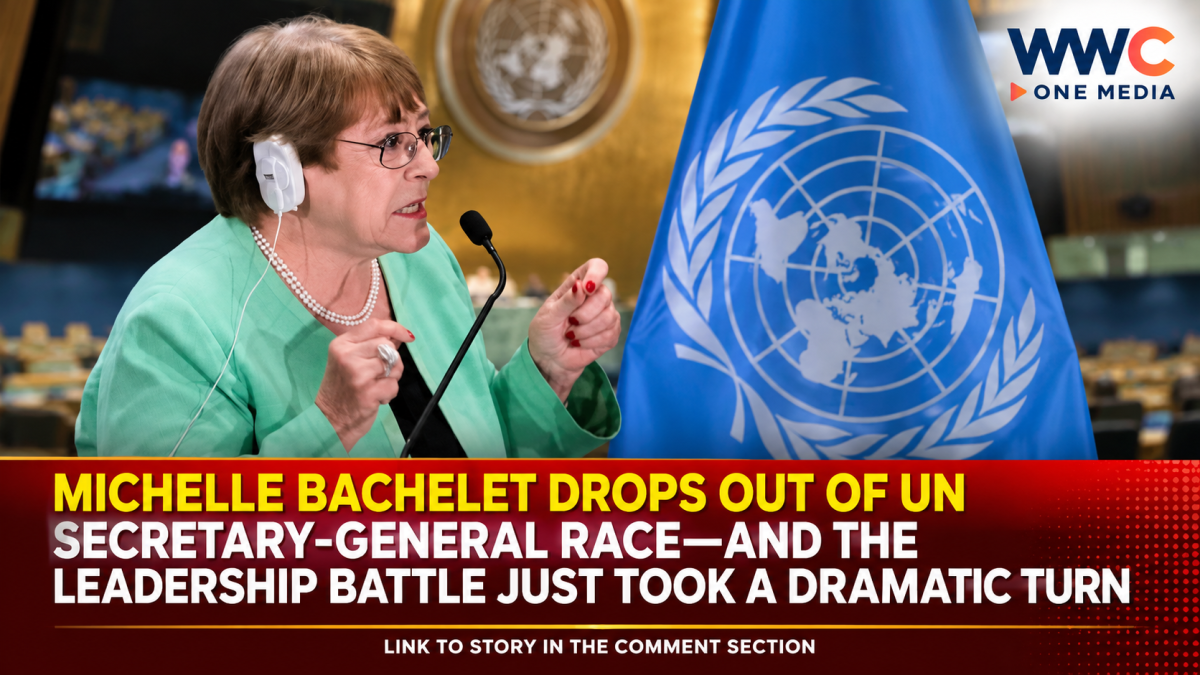
Former Chilean President Michelle Bachelet has withdrawn from the race to become the next secretary-general of the United Nations, ending a high-profile bid that sought to put a Latin American woman at the helm of the world body for the first time.
Bachelet announced her decision on Saturday, September 19, in a video posted to social media. She did not give a specific reason for ending her candidacy, but her withdrawal came one day after she recorded a sharply weakened result in the latest informal poll of the UN Security Council.
“Today I announce that I have decided not to continue with my candidacy for secretary-general of the United Nations,” Bachelet said, according to AFP and Reuters reports.
She added that she did not regret taking on the challenge and argued that her campaign had helped advance the idea that the next UN secretary-general should be a woman from Latin America.
Bachelet’s Candidacy Lost Momentum
The withdrawal followed the third informal Security Council straw poll conducted on Friday, September 18.
According to Reuters, Bachelet received one “encourage” vote, 11 “discourage” votes and three “no opinion” votes, placing her seventh among the eight remaining candidates at the time.
The result was weaker than her showing in the previous informal poll in August, when she received two “encourage” votes, six “discourage” votes and seven “no opinion” votes.
The informal ballots are not a formal election. They are part of the Security Council’s process for assessing candidates before the council eventually recommends one name to the 193-member General Assembly.
Chile Had Already Withdrawn Its Support
Bachelet’s campaign had faced a major setback months before her decision to withdraw.
Chile’s government announced in March that it was withdrawing its support for Bachelet’s candidacy, saying it had concluded that the regional dispersion of candidates and differences among important actors made the bid unviable.
The Chilean Foreign Ministry said at the time that Chile would not support another candidate if Bachelet chose to continue, but would stop promoting her campaign.
Despite the loss of Chilean government backing, Bachelet continued her campaign with support from Brazil and Mexico. She specifically thanked Brazilian President Luiz Inácio Lula da Silva and Mexican President Claudia Sheinbaum after announcing her withdrawal.
A Historic Bid for Latin American Women
Bachelet’s candidacy carried a broader significance.
No woman has ever served as secretary-general of the United Nations in the organization’s more than eight-decade history. Bachelet had argued that the next leader should be a woman from Latin America, potentially opening a new chapter for representation at the highest level of the UN.
Her international résumé included two terms as Chile’s president, from 2006 to 2010 and again from 2014 to 2018. She also previously served as executive director of UN Women and as UN High Commissioner for Human Rights.
The UN’s official selection records show that Bachelet was initially nominated on February 2, 2026, by Chile, Brazil and Mexico. Chile subsequently withdrew its nomination in March, while Bachelet remained in the race with continued backing from Brazil and Mexico.
Who Is Still in the Race?
Bachelet’s departure leaves the contest with eight? Correction: following her withdrawal, the field moves from eight candidates to seven formally remaining candidates, based on the UN’s published candidate list and the latest reported field.
The candidates listed by the UN before Bachelet’s withdrawal included Costa Rica’s Rebeca Grynspan, Guyana’s Carolyn Rodrigues Birkett, Argentina’s Rafael Mariano Grossi, Senegal’s former president Macky Sall, Ecuador’s Ivonne Baki, Ecuador’s former foreign minister María Fernanda Espinosa, and Uganda’s Olara Otunnu, alongside Bachelet.
The latest Security Council straw poll put Rebeca Grynspan at the top with nine “encourage” votes, five “discourage” votes and one “no opinion.” Guyana’s Carolyn Rodrigues Birkett followed with eight “encourage,” six “discourage” and one “no opinion.”
However, the results do not determine the eventual winner. The Security Council still needs to reach agreement on a candidate, and any nominee must avoid a veto from one of the council’s five permanent members: China, France, Russia, the United Kingdom and the United States.
The UN’s Leadership Change Is Now Entering a Critical Stage
The next secretary-general will succeed António Guterres, whose second five-year term ends on December 31, 2026.
Under the UN’s established procedure, the Security Council recommends a candidate to the General Assembly, which then appoints the secretary-general.
The UN has also introduced a more transparent selection framework for the 2025–2026 process, including public candidate information, vision statements, curriculum vitae, campaign-financing disclosures and interactive dialogues with nominees.
With Bachelet now out, attention shifts toward the remaining candidates—and whether the Security Council can build enough consensus around a nominee before Guterres leaves office at the end of the year.
For now, one part of the contest is clear: Bachelet’s bid for the UN’s top diplomatic post has ended, but the historic question she raised—whether the United Nations is finally ready to choose its first woman secretary-general—remains very much alive.