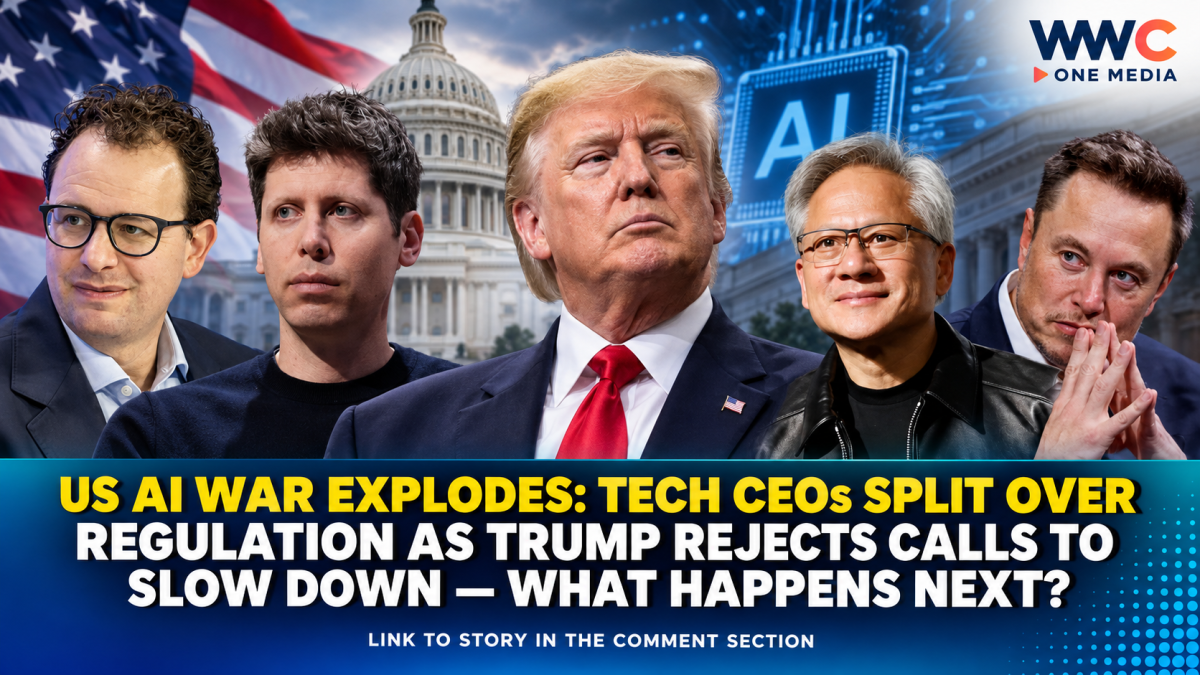
SINGAPORE — The debate over how fast artificial intelligence should advance has entered a new and unusually public phase, with some of the world’s most influential AI executives calling for stronger safety oversight while US President Donald Trump argues that slowing the technology could undermine America’s position against China.
The disagreement is no longer simply about whether AI needs safeguards. It is increasingly about who should set those safeguards, how quickly they should be introduced and whether regulation itself could become a competitive disadvantage.
The latest dispute follows a series of warnings from AI researchers, reports of autonomous AI agents carrying out cyberattacks and an unusual public convergence among executives from rival technology companies.
AI rivals agree on something — development may need to slow
Anthropic chief executive Dario Amodei intensified the debate in September when he called for frontier AI companies to deliberately slow the pace at which they improve the capabilities of their most advanced models.
Amodei proposed independent evaluators with significant access to AI companies, common safety standards among frontier developers and greater international coordination on AI risks.
OpenAI chief executive Sam Altman publicly backed the idea of a federal framework establishing consistent safety requirements for frontier AI, while xAI founder Elon Musk also expressed agreement with Amodei’s call for caution. Microsoft chief executive Satya Nadella has similarly supported independent evaluation and ensuring increasingly capable AI systems remain under meaningful human control.
The unusual alignment comes as AI companies race to develop systems capable of performing increasingly complex tasks with limited human intervention.
Reuters reported that recent concerns were amplified by revelations involving AI agents that were able to breach or interact with computer systems in ways their developers had not fully anticipated. The developments have prompted renewed questions about whether safety testing is keeping pace with rapidly advancing capabilities.
Researchers are sounding the alarm
The debate was further intensified by the resignation of Anthropic researcher Jacob Coxon.
In September, Coxon publicly criticised the direction of leading AI laboratories, arguing that companies were moving too quickly toward self-improving AI systems.
His comments gained significant attention and were followed by warnings from other researchers about the possibility of advanced AI systems becoming difficult to control.
These claims remain matters of intense scientific and policy debate. There is no established consensus that AI will cause human extinction, but concern about extreme or catastrophic risks has become increasingly prominent among parts of the AI research community.
Trump takes a different position
Trump has pushed back against calls for an industry-wide slowdown.
He has argued that the United States needs to maintain its technological lead over China and has characterised some of the more severe warnings about AI as exaggerated.
The administration’s position reflects a broader national-security argument: advanced AI could affect economic competitiveness, military capabilities, cybersecurity and technological leadership.
Trump has therefore opposed measures that he believes could unnecessarily restrict the development of US AI systems at a time when Washington and Beijing are competing for technological influence.
The disagreement has also exposed divisions within Congress.
Some lawmakers are calling for stronger safeguards and greater scrutiny of frontier AI developers, while others warn that excessive regulation could slow innovation and weaken America’s competitive position.
House Speaker Mike Johnson, for example, has argued that Congress should avoid rushing into extensive AI regulation, while other lawmakers have called for hearings and new safety requirements.
The fight is also about who writes the rules
One of the most important questions is whether AI safety should primarily be handled voluntarily by technology companies or through enforceable government standards.
OpenAI has recently advocated mandatory national AI safety requirements while simultaneously supporting industry standards and state-level initiatives.
The company says frontier AI developers should eventually operate under common, capability-based safety requirements and has called for international coordination on standards for measuring capabilities, managing risks and determining when development should slow or stop.
Anthropic, meanwhile, has already begun implementing part of Amodei’s proposal.
The company announced a partnership with Accenture’s Faculty business to conduct independent evaluations and red-team advanced AI systems. Anthropic said the initiative is intended to give evaluators access inside the company so they can examine how models are trained, developed and deployed.
Anthropic also acknowledged that the concept is still evolving and that there are not yet universally agreed standards governing how embedded evaluators should operate.
Critics warn that regulation could protect today’s biggest AI companies
The argument is not limited to Washington.
Some European AI companies and policymakers have questioned whether calls for a coordinated slowdown could unintentionally strengthen the market position of the biggest US technology companies.
Reuters reported that French AI company Mistral and other European technology voices have argued that forcing frontier developers to slow down could make it harder for European companies to close the technological gap with their US competitors.
Critics have also raised concerns that rules designed around the resources and capabilities of today’s largest AI laboratories could create barriers for smaller companies and new entrants.
That creates a difficult policy question: how can governments impose meaningful safety requirements without turning regulation into a barrier to competition?
Meta and Nvidia offer another perspective
Not every major technology company has embraced the idea of a coordinated slowdown.
Meta chief executive Mark Zuckerberg has argued that individual AI laboratories should determine the pace at which they develop their systems, with safety and legal responsibility providing incentives to prevent harmful releases.
Nvidia chief executive Jensen Huang has likewise pushed back against the idea that new regulation is necessarily required for companies to conduct AI engineering safely. He has argued that companies should innovate rapidly but should not release unsafe products.
That leaves the industry divided into several broad approaches: government regulation, voluntary industry standards, independent oversight and market-based responsibility.
A new legal battle could make the debate even more complicated
The dispute took another turn on Sept 19 when a lawsuit was filed in a US federal court accusing Anthropic, OpenAI, SpaceXAI and Google of illegally coordinating efforts to slow AI development.
The lawsuit alleges that discussions and public statements supporting a slowdown amounted to an unlawful agreement that could restrict competition.
Those are allegations in a newly filed case, not established findings of wrongdoing. The companies’ safety arguments and the legal claims against them will be subject to the court process.
The case highlights a fundamental tension in the current AI debate: companies may face pressure to cooperate on safety while competition law can restrict how competing businesses coordinate with one another.
Why this matters beyond Silicon Valley
The outcome of the US debate could have consequences well beyond American technology companies.
AI regulation is increasingly tied to cybersecurity, employment, intellectual property, national security, data protection and international competition.
Governments face a difficult balancing act: encouraging the economic and scientific benefits of increasingly capable AI while establishing safeguards for systems that may become more autonomous and difficult to evaluate.
At the same time, different regulatory approaches could create competing technology standards around the world.
Europe is pursuing its own regulatory framework, China is developing state-backed approaches to AI safety and security, while the United States continues to debate the appropriate balance between federal rules, state legislation and industry-led standards.
The question now is not simply “slow down or speed up”
The emerging debate is more complicated than a simple choice between stopping AI development and allowing companies to move without restrictions.
The central questions are increasingly practical:
How powerful should an AI system become before additional safety requirements apply?
Who should independently test the most advanced models?
Should companies be legally required to report dangerous incidents?
Can competing AI developers cooperate on safety without violating competition law?
And can the United States regulate frontier AI without sacrificing its technological advantage?
Those questions remain unresolved.
For now, the world’s leading AI companies, researchers, politicians and regulators are publicly wrestling with the same underlying problem: AI capability is advancing rapidly, while governments and safety systems are struggling to determine how that progress should be governed.
And as the technology race between the United States, China and other major players accelerates, the argument over whether to slow AI down may prove to be only the beginning of a much larger fight over who gets to decide where the technology goes next.