
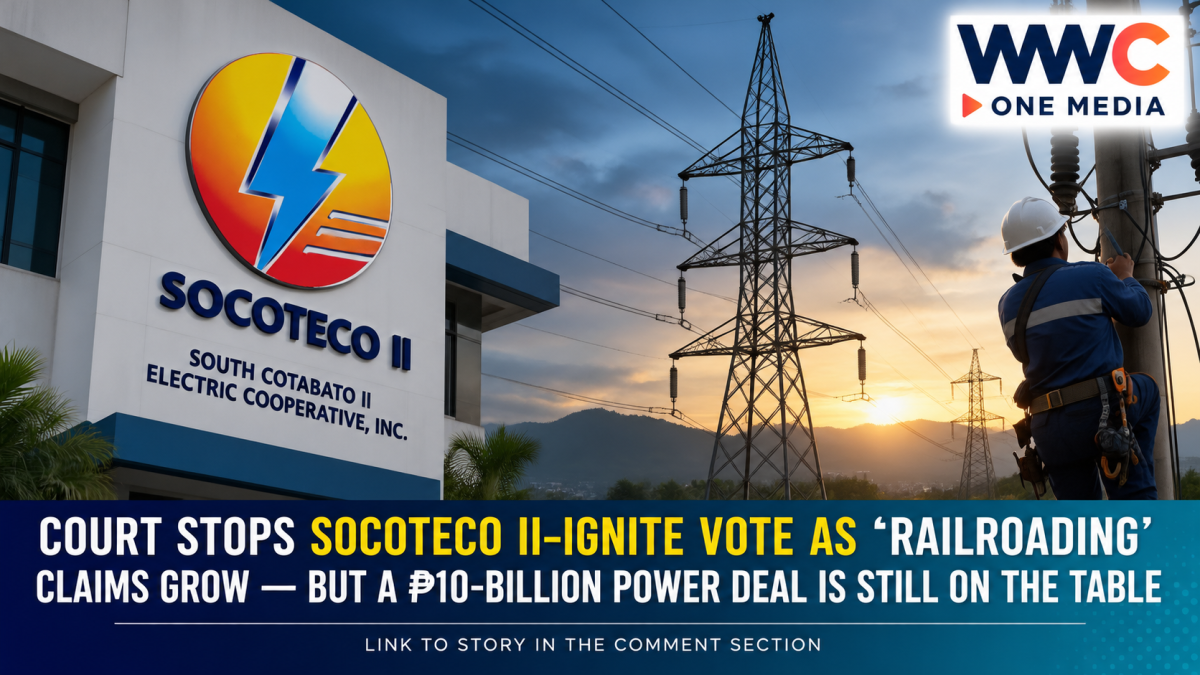
GENERAL SANTOS CITY, Philippines — A proposed deal that could fundamentally reshape electricity distribution across General Santos City, Sarangani and parts of South Cotabato has entered a far more explosive phase.
Former Bayan Muna lawmaker Carlos Isagani Zarate is backing a congressional investigation into the proposed joint venture between South Cotabato II Electric Cooperative Inc. (SOCOTECO II) and Ignite Power and Energy Corp., accusing proponents of trying to rush a decision before member-consumer-owners fully understand its long-term consequences.
Zarate described the process as alleged “railroading” and called for the plebiscite to be deferred until documents and information surrounding the agreement are fully accessible to cooperative members. Those are political allegations from Zarate and should not be presented as established findings of wrongdoing.
But while that argument was intensifying, the courts intervened.
On Sept. 4, Regional Trial Court Branch 62 in Polomolok, South Cotabato issued a 72-hour temporary restraining order preventing the first round of voting from proceeding. SOCOTECO II subsequently announced that its scheduled Sept. 5–6 plebiscite had been deferred.
That means the dispute is no longer just political.
It is now being fought simultaneously inside Congress, before the courts and among roughly 200,000 electricity consumers whose votes could decide the future of the cooperative.
The House investigation has been requested — but it has not started yet
General Santos City Rep. Shirlyn Bañas-Nograles filed House Resolution No. 1401, seeking an inquiry into the Conditional Joint Venture Agreement between SOCOTECO II and Ignite.
The resolution asks lawmakers to examine whether the arrangement complies with existing laws and regulations, whether cooperative assets are being handled prudently, and whether transparency, accountability and the economic interests of member-consumer-owners are adequately protected.
There is an important procedural distinction.
As of the latest congressional record reviewed, HR 1401 remains pending with the House Committee on Rules. So headlines saying Congress is already conducting a full investigation would be premature.
A House probe has been formally sought, but an actual Committee on Energy investigation has not yet produced findings.
That matters because neither Zarate’s accusations nor the opposing claims of the deal’s supporters have yet been adjudicated by Congress.
Zarate calls it a corporate takeover
Zarate, now Bayan Muna’s national executive vice president, framed the dispute in much stronger terms.
He accused private interests of using SOCOTECO II’s financial and operational difficulties to justify transferring control of a member-owned electricity cooperative to corporate investors.
He called the situation a form of “disaster capitalism” and argued that the cooperative’s member-consumer-owners risk losing meaningful democratic control over assets they collectively own.
He also criticized the planned month-long plebiscite, saying members were being pushed to vote while legal questions and demands for greater disclosure remained unresolved.
Zarate called on the House Committee on Energy to undertake an immediate and impartial investigation and said the vote should be delayed until members have sufficient access to the agreement and related documents.
Those statements represent Bayan Muna’s position.
They do not establish that Ignite has illegally taken over SOCOTECO II or that the agreement has been proven unlawful.
In fact, the deal is still conditional.
The court just stopped the first vote
The most consequential development arrived before voting could even begin.
Executive Judge Allan Edwin P. Boncavil issued the temporary restraining order after SOCOTECO II member-consumer-owner Eugene Mangilaya went to court seeking to invalidate the plebiscite and its guidelines and asking for injunctive relief and damages.
The court said that once ballots were cast under rules being challenged, it might be impossible to restore members to their previous position if those procedures were later found defective.
The TRO was initially effective for 72 hours, subject to a ₱200,000 bond, and the court ordered a summary hearing to determine whether the restraint should be extended.
SOCOTECO II then announced that the Sept. 5 and 6 voting dates were deferred.
The remaining scheduled voting weekends were:
Sept. 12–13, Sept. 19–20 and Sept. 26–27, unless SOCOTECO II announces further changes.
Crucially, the TRO is not a final judgment on the legality of the joint venture.
It is a temporary measure while the court considers the challenge.
Why some members are questioning the process
Opposition intensified after SOCOTECO II’s July 25 annual general membership assembly.
Supporters of the deal said more than 32,000 member-consumer-owners endorsed the proposed agreement during assemblies held at several venues. SOCOTECO II subsequently moved toward a formal plebiscite.
But the Social Action Center of the Diocese of Marbel challenged the way that endorsement was obtained.
The church-linked group alleged that Board Resolution No. 104 was declared adopted without a formal counted vote showing precisely how many members supported or opposed it. It also questioned the use of a standing vote and demanded greater transparency.
Again, those are allegations.
SOCOTECO II and Ignite have pointed to the subsequent plebiscite as the process through which the entire qualified membership—not merely people present at the July assembly—would make the decisive choice.
That distinction is significant because the conditional agreement cannot simply become final because a board or assembly supports it.
Roughly 200,000 members ultimately hold the key
SOCOTECO II says around 200,000 qualified member-consumer-owners are expected to participate in the referendum.
Reporting on the planned vote says the deal needs the approval of a qualified majority—50 percent plus one—before it can proceed.
The same basic model was used when Central Negros Electric Cooperative members voted on a joint venture involving Primelectric in 2023; that plebiscite ended once the required majority threshold had been reached.
SOCOTECO II says spreading the vote over several weekends was intended to maximize participation across its large franchise area, not rush the process.
So one of the central disputes is almost paradoxical:
Opponents say the process is being accelerated before consumers are sufficiently informed.
SOCOTECO II says the extended voting schedule is specifically designed to give consumers more time and opportunity to participate.
What does Ignite actually get under the deal?
This is where the story moves beyond political slogans.
According to details reported by GMA News, the Conditional Joint Venture Agreement would see Ignite Power acquire SOCOTECO II’s distribution assets.
Approximately 70 percent of the consideration would be paid in cash, while the remaining 30 percent would become SOCOTECO II’s equity stake in the new distribution company.
That means this is not simply a contractor being hired to repair poles and substations.
It represents a major restructuring of how SOCOTECO II’s electricity-distribution assets would be owned and operated.
That is precisely why critics say members deserve intense scrutiny of the contractual details.
Supporters counter that private capital is necessary because the cooperative cannot finance the modernization required on its own.
And the proposal could involve around ₱10 billion
Ignite Power was formed by Primelectric Holdings, controlled by businessman Enrique Razon Jr., together with MP Holdings, associated with Manny Pacquiao.
BusinessMirror reported that Ignite’s ownership was envisioned as 70 percent Primelectric and 30 percent MP Holdings, with the partners preparing approximately ₱10 billion for a SOCOTECO II modernization program if the deal proceeds.
Ignite President Roel Castro later said SOCOTECO II’s existing capital-expenditure catch-up plan itself would require around ₱10 billion over five years.
The proposed program includes upgrading substations, replacing aging lines and equipment, expanding network capacity and deploying newer distribution technologies.
For consumers frustrated by outages and aging infrastructure, that is the deal’s strongest selling point.
SOCOTECO II says it is losing more than ₱40 million every month
The cooperative’s financial condition provides the backdrop to the proposal.
SOCOTECO II has reported accumulated financial losses of about ₱2.1 billion as of December 2025.
Its system losses have reportedly climbed to nearly 14 percent, with the cooperative losing more than ₱40 million per month.
“System loss” refers broadly to electricity that enters a distribution system but is not ultimately billed to customers because of technical losses in lines and transformers and, in some cases, nontechnical losses.
Not all of SOCOTECO II’s approximately 14-percent system loss can simply be passed on to customers.
GMA reports its current recoverable cap at 8.25 percent.
Ignite says it intends to drive that figure substantially lower.
Ignite promises to cut system losses to 5.5%
The proposed venture targets a 5.5-percent system loss, along with fewer outages and upgraded distribution infrastructure.
Ignite has also said it would seek competitively priced electricity to manage generation costs.
Company information officer Jonathan Cabrera said Ignite intends to spend its own money on improvements before going to the Energy Regulatory Commission to seek approval for cost recovery.
Those commitments are among the main arguments offered by proponents.
But promised improvements should not be confused with guaranteed outcomes.
Whether system losses actually fall to 5.5 percent, whether outages decline as expected and what eventual effect the investment has on consumers’ electricity bills would depend on implementation and regulatory approvals if the deal goes forward.
There are more regulatory hurdles even after a “yes” vote
Another important point often lost in the political rhetoric is that a favorable plebiscite would not immediately hand over the power system to Ignite.
Castro has said additional approvals would still be required, including regulatory processes involving the National Electrification Administration, Energy Regulatory Commission and Philippine Competition Commission, as well as franchise requirements.
That makes Zarate’s description of an imminent “takeover” politically powerful but legally incomplete.
The agreement still faces multiple stages.
The consumers’ vote is crucial, but it is not necessarily the final regulatory step.
Meralco is another major player in the controversy
The fight became even more complicated because Manila Electric Co. (Meralco) also wanted to partner with SOCOTECO II.
SOCOTECO II’s board rejected Meralco’s unsolicited proposal.
Meralco Senior Vice President Arnel Paciano Casanova subsequently accused the cooperative of an “illegal direct award,” partiality toward Ignite and lack of transparency, and said Meralco was studying legal options.
Casanova accused the July proceedings of failing to give consumers adequate information and described the process as violating competition and bidding principles.
Those are Meralco’s allegations and have not been established as judicial findings.
Ignite responded that the July assembly itself was not final approval and emphasized that the broader membership still had to vote.
A previous court challenge involving Meralco was already dismissed
There is another detail that complicates claims that the process has already been found unlawful.
In June, RTC Branch 62 dismissed an attempt by a Bantay Kuryente plaintiff to invalidate SOCOTECO II’s rejection of Meralco’s proposal.
The court ruled that the plaintiff had failed to exhaust available remedies before seeking judicial intervention.
That earlier ruling did not validate every aspect of the later Ignite agreement.
Nor does it resolve the new challenge against the September plebiscite.
The two court proceedings concern different legal questions.
But the history shows why statements such as “the courts have already ruled the Ignite deal illegal” would be inaccurate.
They have not.
Even the House resolution has a procedural wrinkle
The official House database shows Bañas-Nograles filed HR 1401 on Aug. 27, and it was read on Sept. 2 before being referred to the Committee on Rules.
Interestingly, congressional records also list an earlier HR 1392 with essentially the same title, filed on Aug. 25.
For public reporting, HR 1401 is the resolution consistently cited by Bañas-Nograles and current media coverage.
What matters more is its status:
the investigation has been requested, but Congress has not yet rendered any judgment about the deal.
This is ultimately a fight over ownership—and risk
Supporters look at SOCOTECO II and see a financially strained cooperative with aging infrastructure, recurring outages and billions of pesos in modernization requirements.
They ask a practical question:
If private investors are prepared to put up the money, why reject the opportunity?
Opponents look at the same deal and see valuable member-owned assets moving into a privately controlled corporate structure.
Their question is different:
Once those assets and operating control are transferred, how much influence will ordinary consumers really retain?
Both questions deserve answers before the final vote.
The proposed 30-percent SOCOTECO II equity stake means the cooperative would retain an ownership interest.
But Ignite’s planned private-sector position would still be substantially larger.
That makes the fine print—governance rights, asset valuation, tariff implications, investment commitments, exit provisions and long-term control—at least as important as the headline promise of ₱10 billion in modernization.
And now the clock has stopped
SOCOTECO II originally expected consumers to begin voting Sept. 5.
Instead, the first ballots never opened.
The court intervened.
Zarate escalated his call for a congressional investigation.
The House resolution remains pending.
And the next scheduled voting weekend is Sept. 12–13 unless the legal situation changes again.
That leaves the proposed Ignite deal in an unusual position.
Its supporters say SOCOTECO II cannot afford to delay modernization.
Its critics say a decision this consequential cannot be rushed.
The courts are now examining at least part of the process.
Congress has been asked to examine the rest.
And approximately 200,000 member-consumer-owners are still waiting to cast the votes that ultimately determine whether the joint venture clears its most important democratic hurdle.
The ₱10-billion promise may be what attracts attention—but the real battle is over who will control SOCOTECO II’s power system once the money arrives.
WWC ONE MEDIA M.J.E




Leave a Reply