
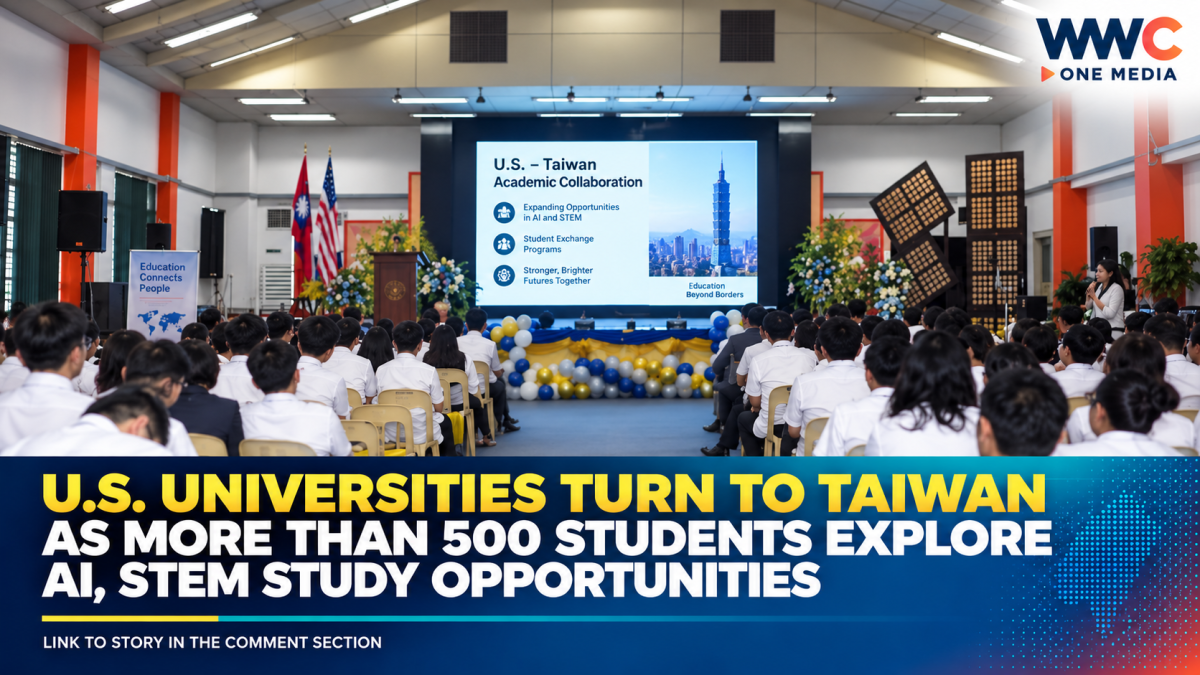
TAIPEI, Taiwan — A major push to connect Taiwanese students with U.S. higher education took center stage in Taipei this weekend as the American Institute in Taiwan (AIT) and EducationUSA Taiwan hosted their first-ever AIT-organized education fair, bringing together representatives from 27 U.S. higher-education institutions.
More than 500 Taiwanese students, parents and educators attended Saturday’s event, which placed a particular spotlight on artificial intelligence and STEM — science, technology, engineering and mathematics — fields that are increasingly important to both economies.
The event was part of AIT’s wider Freedom250 activities commemorating the United States’ 250th anniversary. Other events during the week included a Workforce First Summit and a semiconductor networking reception.
27 U.S. institutions arrive in Taipei
The education fair featured 30 representatives from 27 American higher-education institutions, giving Taiwanese students and families an opportunity to speak directly with schools about admissions, scholarships and academic programs.
Four speaker sessions also addressed practical issues including scholarship opportunities and U.S. student-visa policies, while EducationUSA Taiwan provided guidance on the application process for students considering American universities.
The American Association of State Colleges and Universities also sent a delegation, underscoring the broader effort to deepen connections between U.S. state institutions and Taiwan’s education and industry sectors.
Why Taiwan matters to U.S. universities
The event comes as education ties between Taiwan and the United States continue to receive attention.
AIT said the United States remains the top study destination for Taiwanese students on a per-capita basis, highlighting the unusually strong student-to-population relationship between Taiwan and American higher education.
EducationUSA, a U.S. Department of State-supported network, operates an advising center through the AIT American Center in Taipei. Its services include guidance on choosing U.S. universities, scholarships, admissions and student visas.
The wider U.S. international-education market is also substantial. The U.S. hosted more than 1.1 million international students during the 2023-24 academic year, according to data reported through the Institute of International Education and the U.S. Department of State. International students have also become an important contributor to the American economy and to U.S. university campuses.
AI and STEM take center stage
The emphasis on AI and STEM is particularly significant.
Taiwan is a critical player in the global semiconductor and technology supply chain, while American universities remain major centers for research and training in artificial intelligence, computer science, engineering and related disciplines.
That overlap gives education exchanges a strategic dimension beyond traditional university recruitment: students trained in these fields can potentially contribute to research, technology development and international business links between Taiwan and the United States.
Taiwan’s own education system is simultaneously seeking to strengthen internationalization. Government education materials describe the U.S.-Taiwan Education Initiative, launched in 2020, as an effort to expand educational and language cooperation and increase two-way exchanges.
A two-way education relationship
The relationship is not limited to Taiwanese students heading to America.
Taiwan is also positioning itself as an international education destination. Taiwan’s Ministry of Education reported 140,417 international students in the 2025-26 academic year, including students from the United States.
That two-way movement is part of a broader effort to build academic, cultural and professional connections between Taiwan and the United States.
For the hundreds who attended Saturday’s Taipei fair, however, the immediate focus was more personal: finding the right university, understanding how to pay for it and figuring out what it takes to study in the United States.
And with artificial intelligence and STEM dominating the event, the message from the participating institutions was clear: the next generation of Taiwan-U.S. ties may be built as much in classrooms and laboratories as in government offices.

Leave a Reply