
ILOILO CITY, Philippines — The government has money to buy rice from Filipino farmers.
It has raised its buying price.
It is building new warehouses and mechanical dryers.
Yet as the country’s crucial wet-season harvest gets underway, the National Food Authority is still far behind its 2026 palay procurement target—and bad weather is exposing one of the weakest links in the Philippine rice system: what happens to freshly harvested grain when farmers cannot dry it.
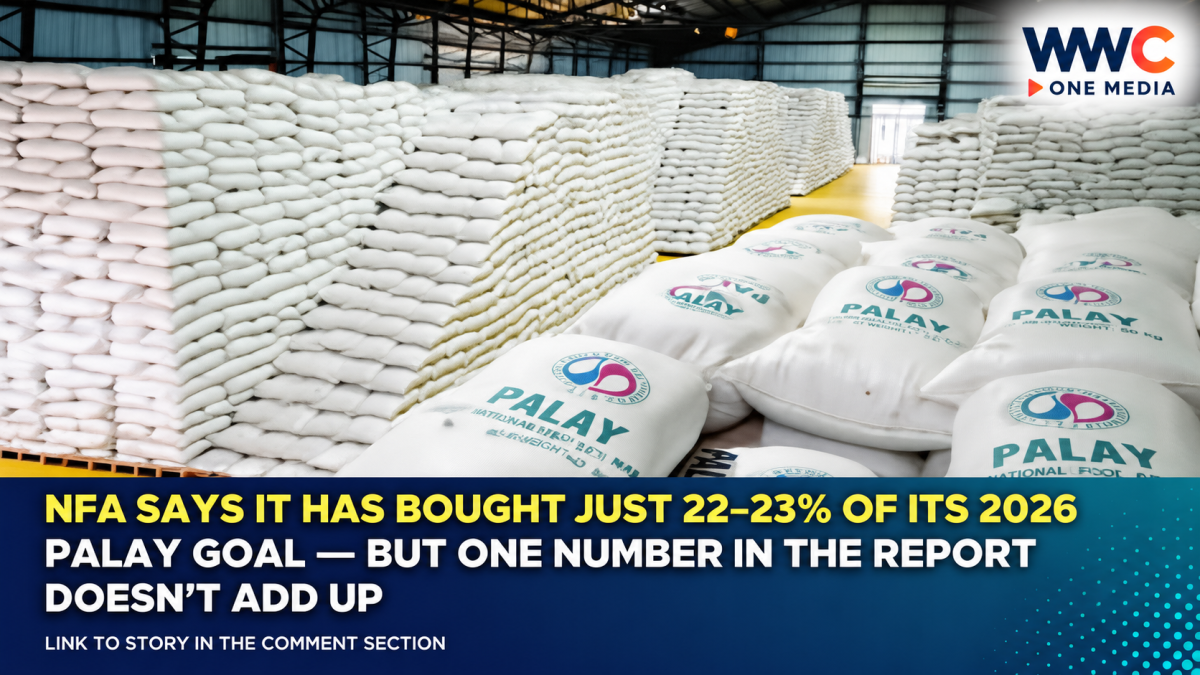
NFA Administrator Larry Lacson said the agency’s full-year procurement target is around 790,000 metric tons of palay, equivalent to approximately 15.8 million 50-kilogram bags. He told Super Radyo dzBB that procurement was only around 22% to 23% of the target, leaving the agency with substantial ground to make up before the end of 2026.
The problem, according to Lacson, is not simply that farmers are unwilling to sell.
In many areas, they cannot properly dry what they harvest.
Persistent rains have prevented newly harvested palay from reaching acceptable moisture levels, while the NFA itself still lacks enough mechanical drying capacity to absorb all of the wet grain coming off farms.
And when farmers have a wet crop but nowhere to dry it, time works against them.
They often have to sell immediately.
Usually for less.
Farmers Can’t Wait for the Sun
Rice farmers face a simple but brutal calculation during a rainy harvest.
Freshly harvested palay contains substantially more moisture than properly dried grain. If it remains wet for too long, quality deteriorates and the risk of spoilage rises.
That means farmers without access to mechanical dryers may have little bargaining power.
Lacson said traders and agents can offer substantially lower prices when palay is extremely wet because farmers may have no practical option except to dispose of the crop quickly.
The NFA itself accepts fresh or wet palay with moisture content within prescribed standards, but expanding purchases of wet grain requires sufficient drying capacity.
Earlier this year the agency relaxed some procurement rules, including widening the acceptable specifications for palay, in an effort to make it easier for farmers to sell to government. For fresh and wet palay, accepted moisture content can range from 22% to 29.9%, subject to quality requirements.
But accepting wetter palay creates another problem.
Someone still has to dry it.
The P21 Buying Price Sounds Simple — Its Rollout Isn’t
Beginning with the September wet harvest, the government raised the NFA’s minimum buying price for wet palay from ₱17 to ₱21 per kilogram.
Agriculture Secretary Francisco Tiu Laurel Jr. said the increase was intended to help farmers cope with higher fertilizer and other production costs.
At ₱21 per kilo, Lacson previously estimated many producers could earn a margin of roughly ₱3 to ₱5 per kilogram, depending on production costs in their area.
There is, however, an operational caveat.
Although the government announced the higher wet-palay buying price as a national policy, Lacson later said its initial implementation would be concentrated in locations where the NFA has access to adequate rice-drying facilities. Regional offices have been told to identify additional dryers so the scheme can be expanded.
That distinction matters.
A higher government price does little for a farmer if the nearest NFA buying station cannot take the crop because it lacks the equipment to handle wet palay.
Iloilo Shows Both the Problem and the Government’s Planned Solution
Iloilo is particularly important because it produces about half of Western Visayas’ rice and more than 5% of the country’s total output, according to the Department of Agriculture.
In July, the government opened a ₱355.4-million modernized NFA grains facility in Dumangas, Iloilo.
The complex includes a 10-metric-ton-per-hour rice mill and a mechanical dryer capable of handling 240 metric tons per day.
The facility can process roughly 4,800 50-kilogram bags of palay daily, allowing the NFA to buy freshly harvested grain even during periods when sun-drying is difficult.
Government estimates suggest the upgraded Dumangas operation could add about 324,000 bags of palay procurement over two cropping seasons, more than doubling the site’s historical buying volume.
The DA says another two large processing facilities in Iloilo are expected to come online around the October harvest.
Nationwide, the NFA is developing 36 modern rice-processing facilities, with roughly half expected to operate during this wet season and the remainder before the next dry-season harvest.
That expansion explains why officials describe drying capacity—not merely funding—as one of the key constraints on procurement.
But There Is a Problem With the Numbers Being Reported
This is where the original story requires an important accuracy note.
Both Bombo Radyo Iloilo and GMA reported Lacson saying the NFA had purchased “less than two million bags” while also saying procurement stood at roughly 22% to 23% of a 790,000-metric-ton annual target.
Those figures do not mathematically align.
A 790,000-metric-ton target corresponds to roughly 15.8 million 50-kilogram bags.
If purchases were genuinely below two million 50-kilogram bags, that would equal less than 100,000 metric tons—or under roughly 13% of the annual target, not 22% to 23%.
Conversely, 22% to 23% of 790,000 metric tons would equal roughly 174,000 to 182,000 metric tons, or about 3.5 million to 3.6 million 50-kilogram bags.
Therefore, either the “less than two million bags” figure or the 22%–23% figure appears to have been misstated in the interview or subsequent reporting.
For publication, I recommend using this construction:
“NFA says procurement remains far below its 790,000-MT annual goal and estimates progress at about 22% to 23%, although a separate bag count cited by the agency does not reconcile with that percentage.”
That is more accurate than repeating both figures as though they agree.
There is another wording problem in some coverage: GMA’s headline describes procurement as “barely half” of the target, even though its own article quotes the NFA putting progress at 22% to 23%. A quarter is clearly not “barely half.”
The 790,000-Metric-Ton Goal Has Been on the Books for Months
The annual target itself is not new.
As early as May, PNA reported that the NFA planned to buy 790,000 metric tons of palay in 2026. At that time, however, procurement had reached only around 25,000 metric tons after private traders offered strong prices during the earlier harvest.
BusinessMirror similarly reported that the agency bought only 13,127 metric tons from January through the first week of May, just 4.2% of the procurement target established for that period.
The situation highlights how the NFA’s role changes depending on the market.
When commercial traders bid aggressively, government officials have sometimes avoided competing too strongly because doing so could push prices even higher.
When private buying prices weaken, however, the NFA is expected to step in more aggressively to prevent farmers from being forced to sell too cheaply.
The wet season has produced a different obstacle.
Now the constraint is not only price.
It is rain, moisture, storage and drying capacity.
Government Has More Money to Buy Palay This Year
Funding has also increased.
The DA said President Ferdinand Marcos Jr. raised the NFA’s 2026 palay-procurement resources to around ₱14 billion, compared with ₱9 billion in 2025, to give the agency greater ability to intervene in the farmgate market.
Earlier PNA reporting put available procurement funding, including carry-over resources, at around ₱12 billion before subsequent additional support was announced.
So the current bottleneck cannot be explained simply as the NFA having no budget.
Warehouse space and post-harvest infrastructure matter too.
The agency has repeatedly auctioned or milled older stocks this year in order to create room for new harvests. In February it sold nearly 90% of about 737,000 bags of aging rice offered at auction, generating ₱936.5 million while freeing storage space.
By August, the NFA was again preparing warehouses for the wet harvest.
Why the NFA Is Releasing Rice While Trying to Buy More
At first glance, another government policy can seem contradictory.
The NFA is trying to buy more palay from farmers.
At the same time, it is releasing rice from its warehouses through the government’s Benteng Bigas, Meron Na! subsidized rice program.
But Lacson said releasing existing rice stocks helps create warehouse room for the new harvest.
The administration is expanding the ₱20-per-kilo program, with the DA aiming to eventually distribute as much as 40,000 metric tons a month through the initiative.
That creates a constant inventory cycle:
Government buys palay from farmers.
The palay is dried and milled.
Rice enters the buffer inventory.
Older stocks are sold or distributed.
Warehouse space is cleared.
Then the NFA buys again.
If drying or milling slows down anywhere in that chain, procurement can back up.
NFA Says the Eight-Day Buffer Is Still Enough
Despite the procurement lag, Lacson said the country’s NFA rice buffer currently represents roughly eight days of national consumption.
He argued that an eight- or nine-day government reserve remains substantial and said the procurement slowdown does not mean the Philippines is facing an immediate rice shortage.
A separate Philippine Statistics Authority inventory report provides broader context.
The country’s total rice inventory stood at about 2.18 million metric tons in August, although that was 6.3% lower than a year earlier.
Stocks physically held in NFA depositories were about 306,820 metric tons, down 32.2% from August 2025. Commercial warehouses held 47.5% of the country’s rice stocks, households 38.4%, and the NFA 14.1%.
Those PSA figures cover national rice inventories across different holders and should not be confused directly with the NFA’s separate “days of buffer” calculation.
The DA has maintained that overall rice supply should remain sufficient through the end of 2026 because of existing inventories, imports and the incoming harvest.
Yet the Weather Risk Is Getting Harder to Ignore
The NFA’s procurement problem is unfolding after weeks of severe weather.
The Department of Agriculture reported significant agricultural damage from the enhanced southwest monsoon and recent tropical cyclones.
Agriculture Secretary Tiu Laurel said around 75,000 hectares of farmland had been affected, including roughly 67,000 hectares planted with rice.
That does not mean all 67,000 hectares were completely destroyed.
But prolonged rain can hurt farmers even when crops survive.
It delays harvesting.
It increases grain moisture.
It complicates drying.
And it can force producers to sell more quickly than they otherwise would.
Those are precisely the problems the NFA says are now constraining its buying program.
And After the Rain Could Come El Niño
The government is also preparing for a second climate threat.
The DA expects a potentially strong El Niño late in 2026, with projections suggesting domestic palay production could fall by roughly 700,000 to 750,000 metric tons.
That prospect explains why the government has resisted calls for a nationwide rice-import suspension this year.
Tiu Laurel said rice imports reached around 3.3 million metric tons as of August 3, and the government intends to maintain sufficient supply ahead of the anticipated El Niño impact.
There is a narrower exception in Iloilo.
The DA previously announced that imported rice would not be allowed to unload through Iloilo ports from mid-September through the end of November, specifically to reduce pressure on farmgate palay prices during the province’s peak harvest.
So the current policy is not a national ban on rice imports.
It is a broader policy of keeping imports available for food security while using targeted local interventions to protect farmers during harvest.
The Bigger Problem Is No Longer Just the Price of Palay
For years, the Philippine rice debate has centered on one question:
How much should farmers receive per kilogram?
The current harvest shows that price is only part of the answer.
Government can promise ₱21 per kilo.
It can allocate billions for procurement.
It can tell the NFA to buy aggressively.
But when a farmer harvests during days of continuous rain and no mechanical dryer is available nearby, that official buying price may be irrelevant.
Wet palay deteriorates.
Farmers need cash.
Traders know it.
And the bargaining power shifts immediately.
That makes the NFA’s 2026 procurement gap more than an accounting problem.
It is a warning about infrastructure.
The government has already begun responding with new dryers, mills and warehouses, including major investments in Iloilo.
But the agency’s struggle to meet its buying target suggests those facilities are still catching up with what farmers need today.
The Philippines may have enough rice for now. The harder question is whether it has enough dryers, warehouses and buying capacity to protect the farmers producing the next supply.
WWC ONE MEDIA M.J.E




Leave a Reply