
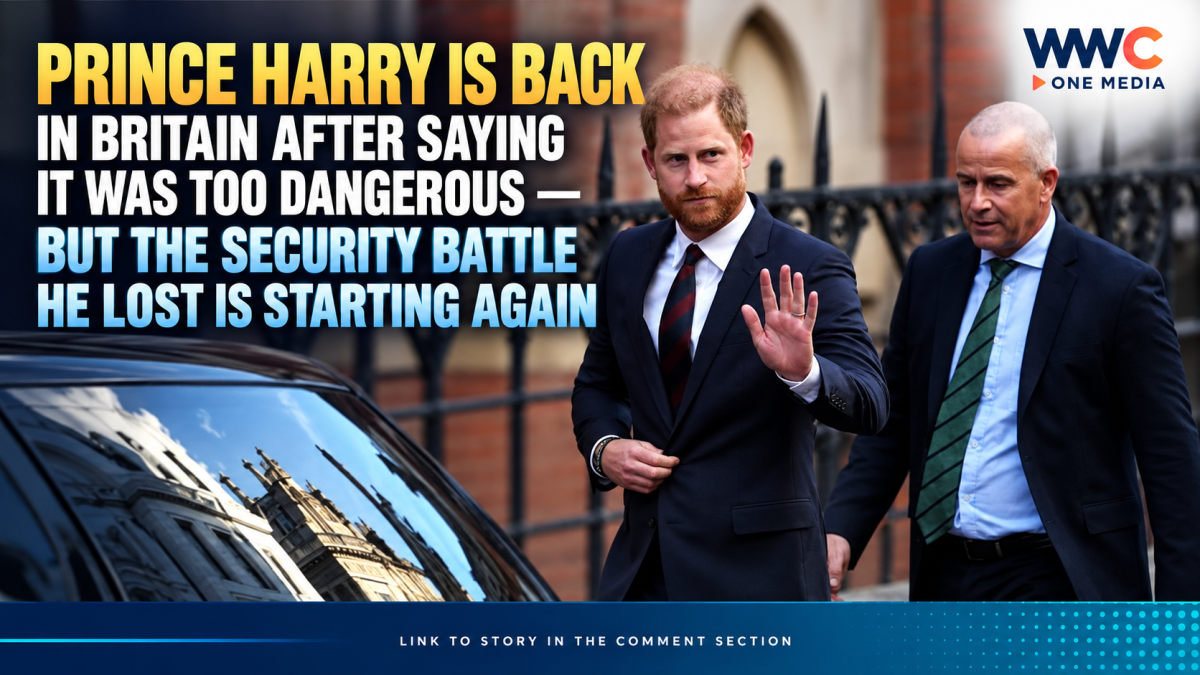
LONDON — Six years after Prince Harry and Meghan walked away from frontline royal duties and built a new life in California, the Duke of Sussex is back in Britain with his wife and children.
But one of the biggest arguments surrounding their departure never went away.
Who should protect them — and who should pay for it?
Harry, Meghan, seven-year-old Prince Archie and five-year-old Princess Lilibet returned to Britain on Aug. 26, landing at Birmingham Airport before beginning what is expected to be an extended stay in the UK. Their children are enrolled in British schools, while the family is expected to live privately outside London.
The return is remarkable because Harry had previously said security concerns made bringing his family back to Britain effectively impossible.
After losing his Court of Appeal case in May 2025, he said he could not envisage returning with Meghan and their children under the arrangements then in place.
Now they are here.
And the security dispute has immediately returned with them.
The family arrived with private security — not automatic police protection
According to AFP reporting carried by Manila Standard and Malay Mail, Harry and his family arrived with private security personnel rather than a dedicated police protection team.
That distinction is crucial.
Private bodyguards can provide close protection, transport planning, advance reconnaissance and other security services.
But in Britain, private security personnel do not have the same powers or armed capability available to specialist police protection officers.
Former royal protection officer Simon Morgan told AFP that this lies at the heart of Harry’s argument: if the assessed threat is serious enough to require an armed state response, private security cannot simply duplicate what specialist police units provide.
That means the debate is not merely about whether a wealthy prince can afford bodyguards.
It is about whether his risk profile justifies access to capabilities only the state can realistically provide.
What Harry actually lost in court
There has been considerable confusion about Harry’s previous legal defeat.
Some headlines have suggested that British courts ruled he should receive no publicly funded police protection.
That is too simplistic.
The dispute began after Harry and Meghan ceased being working royals in 2020.
The Royal and VIP Executive Committee, commonly known as RAVEC, decided Harry would no longer automatically receive the same degree of publicly funded police protection that he had enjoyed while performing full-time royal duties.
Harry challenged that decision.
The High Court rejected his challenge in 2024.
The Court of Appeal dismissed his appeal in May 2025.
But the judgment also describes a system in which Harry’s circumstances and threats can continue to be assessed.
The original RAVEC decision said his security should remain subject to monitoring and periodic threat assessments, with arrangements considered according to his circumstances when he returned to Britain.
So the legal defeat did not permanently close the door on police protection.
It upheld the government’s right to use a different, bespoke system rather than automatically treating Harry exactly like a full-time working royal.
That distinction has suddenly become far more important now that Harry is once again living in Britain.
A permanent or extended UK presence changes the equation
When Harry lived primarily in California, most of his UK appearances were relatively short visits.
Now the family’s circumstances are different.
Their children are beginning school in Britain.
The Sussexes are expected to spend considerably more time here.
And daily life produces predictable routines.
Former protection officer Scott Hamer, who previously protected King Charles when he was Prince of Wales, told AFP that school drop-offs and collections could create particular vulnerabilities because they occur repeatedly at similar times and locations.
Hamer questioned why Harry should automatically be considered at lower risk than some other individuals who continue to receive state protection.
That is an expert opinion — not a government assessment.
But other former senior police figures have raised similar concerns.
Former senior Metropolitan Police officer Neil Basu, whose responsibilities included units involved in royal and VIP protection, said publicly in August that he struggled to understand why Harry’s overall threat profile would necessarily have fallen since 2019. He referred to extremist threats previously investigated against Harry and Meghan.
Those interventions complicate the argument that the dispute is simply about royal privilege.
There have been documented threats
Harry’s security concerns are not based solely on paparazzi attention.
His public profile creates several potential threat categories.
He is the son of King Charles III.
He served twice with the British military in Afghanistan.
His 2023 memoir Spare included the controversial disclosure that he believed he had killed 25 Taliban fighters during his military service.
Former security officials have said extremist threats against the Sussexes have previously involved both Islamist actors and far-right individuals hostile to Harry’s marriage to Meghan, who is mixed race.
Veterans and security specialists criticized Harry at the time for publishing the Taliban figure, warning that it could unnecessarily increase his risk profile.
That does not automatically mean taxpayers must fund his protection.
But it does make the question of his threat level more complicated than ordinary celebrity security.
Then came the allegation about an al-Qaeda threat
The latest controversy goes even further.
British reports say Harry’s lawyers wrote to Home Secretary Shabana Mahmood in August asking her to become personally involved in the reassessment of the family’s protection.
Harry’s legal team reportedly alleged that RAVEC’s leadership knew about an al-Qaeda threat against him in 2023 but that the information was not passed to his private protection team or US authorities at the time.
The allegation was first reported by The Sunday Times and subsequently carried by Press Association and other British media.
Harry’s camp reportedly says he eventually learned of the threat through US intelligence channels.
RAVEC and the Home Office have not publicly released operational details that would allow outsiders to independently assess the allegation.
That is important.
The alleged intelligence failure should therefore be described as Harry’s claim, not an established finding against the security committee.
Government says the system is ‘rigorous and proportionate’
The British government is refusing to disclose the Sussexes’ exact protection arrangements.
That is standard practice.
A government spokesperson said the UK’s protective security system is “rigorous and proportionate” and explained that publicly revealing individual arrangements could undermine their effectiveness.
Prime Minister Andy Burnham has also declined to become publicly involved in the funding dispute, calling the Sussexes’ arrangements a private matter.
And legally, the prime minister does not personally decide who receives royal or VIP protection.
Those assessments are handled through the specialist government and police process surrounding RAVEC and its risk-management system.
That means neither King Charles nor Downing Street can simply announce that Harry will receive permanent police bodyguards.
The official justification must ultimately come from security assessments.
Harry reportedly gave officials limited notice of the move
There is another complication.
Reports say Harry’s team did not provide the usual amount of advance notice normally requested for security planning before the family’s return.
British reporting said officials received less than two weeks’ notice, rather than the 28 days typically expected for such requests.
Harry’s representatives have reportedly disputed the relevance of that criticism, arguing that following the notice process previously did not resolve the broader dispute.
Even so, it illustrates the operational difficulty.
Specialist police protection cannot necessarily be assembled instantly, particularly when risk assessments, personnel and intelligence support are involved.
The British public appears far less sympathetic
Security specialists may believe Harry faces genuine risks.
Public opinion is another matter.
An opinion poll cited by AFP found only 6% of respondents believed Harry’s protection should be fully taxpayer-funded, while 63% said Harry and Meghan should pay for their own security.
Royal author Andrew Lownie told AFP that because Harry pays for private security in the United States, many taxpayers struggle to understand why the British state should cover the cost now that he has voluntarily returned.
That argument has political force.
Harry and Meghan are wealthy private citizens.
They earn money through commercial ventures.
They chose to leave royal duties.
And there has been no suggestion that they are returning as working members of the monarchy.
The Guardian reports that their status has not changed: there will be no resurrection of the “half-in, half-out” arrangement rejected when they stepped back in 2020.
So critics ask:
Why should taxpayers finance the protection of private individuals who no longer undertake duties for the Crown?
Security experts say royal employment status is not the whole issue
The counterargument is equally straightforward.
Protection should be based on threat and risk, not popularity or employment status.
Hamer pointed out that former prime ministers can retain police protection even after leaving office.
His argument is that if professional intelligence assessments show Harry and his family face a comparable or greater threat, the fact that he is no longer a working royal should not automatically decide the issue.
That is fundamentally the philosophical divide behind the entire controversy.
One side sees police protection as a privilege attached to royal duties.
The other sees it as a security response determined primarily by the danger faced by the individual.
RAVEC’s task is supposed to separate those political and emotional arguments from the professional risk assessment.
Harry’s return also changes another family relationship
The security fight comes as relations between Harry and King Charles III appear to have improved.
Charles reportedly met Harry, Meghan, Archie and Lilibet privately at Highgrove in July, giving the King time with grandchildren he had not seen for several years.
The King is understood to welcome having his younger son and grandchildren physically closer.
But the wider royal family remains divided.
Relations between Harry and his brother, Prince William, are still described as deeply strained, and there has been no announcement of Harry resuming official royal duties.
That means the Sussexes’ return may create a peculiar new reality:
physically back in Britain and closer to the Royal Family, but still constitutionally outside its working structure.
Archie and Lilibet make the security question harder to ignore
For years, much of Harry’s argument focused on brief visits.
Now there are children going to school.
Harry has repeatedly said he wants Archie and Lilibet to understand their British heritage.
In his earlier legal case, he argued that Britain was central to his children’s identity but that he could not make them feel at home there if he believed they could not be kept safe.
Their relocation makes that argument immediate rather than hypothetical.
School runs.
Family outings.
Visits to charities.
Trips to see King Charles.
Appearances connected with next year’s Invictus Games in Birmingham.
Each one creates movements that potentially require security planning.
And unlike a three-day royal visit, those requirements could continue week after week.
So who actually pays?
For the moment, there is no publicly confirmed final answer.
Harry and Meghan have private security.
British media report that a fresh risk assessment has been undertaken or is being considered in light of their changed circumstances.
Former protection officers say the threat should be taken seriously.
Harry’s lawyers are pressing the Home Office.
The government refuses to discuss operational arrangements.
And public opinion appears heavily against simply restoring automatic taxpayer-funded protection.
That leaves RAVEC facing a difficult decision.
Harry may have stepped away from royal duty.
But he did not stop being the King’s son.
He did not erase his military history.
He did not stop being internationally recognizable.
And moving his children permanently or semi-permanently into predictable British routines may change the practical risk calculation considerably.
The court already ruled that Harry cannot demand his old security package simply because he wants it.
What has not yet been answered is whether his new life back in Britain now creates enough risk for the state itself to decide that he needs it.
WWC ONE MEDIA M.J.E

Leave a Reply