
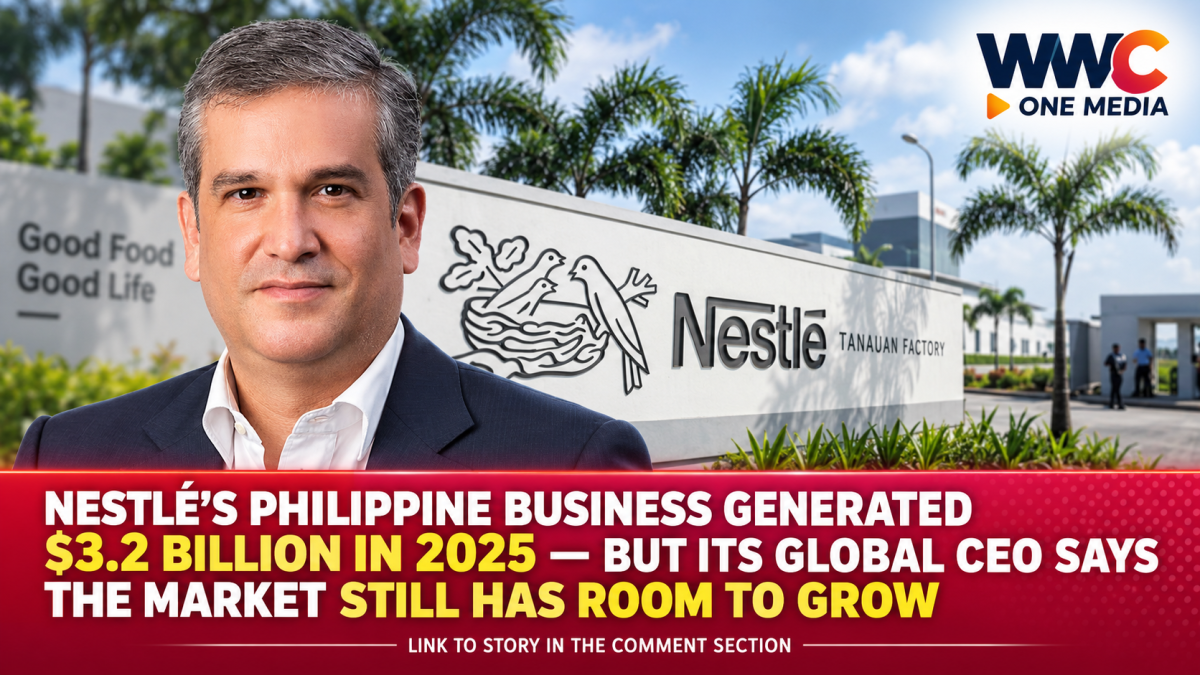
MANILA — More than a century after Nestlé first established itself in the Philippines, the Swiss food giant still believes one of its oldest Asian markets could become substantially bigger.
Nestlé Group CEO Philipp Navratil, making his first official Philippine visit since taking the global chief executive role in September 2025, described the country as one of Nestlé’s most dynamic and promising markets and said the company sees significant room for further growth.
The numbers explain his enthusiasm.
The Philippines is already Nestlé’s largest market in Southeast Asia and one of its 10 largest markets worldwide, according to the company.
BusinessWorld reported earlier this year that Nestlé Philippines generated about US$3.2 billion in revenue in 2025, ranking it as the company’s sixth-largest market globally behind the United States, China, Brazil, the United Kingdom and Mexico.
Nestlé’s own 2025 annual review lists Philippine sales at CHF2.608 billion, with organic growth of 3.7%, and says the Philippines was among the strongest contributors to growth in its Asia, Oceania and Africa zone.
So Navratil did not arrive in Manila trying to fix a marginal business.
He arrived looking for the next stage of growth in one of Nestlé’s largest.
Nestlé says the Philippines has three things it likes: growth, youth and brand loyalty
During the visit, Navratil was joined by Remy Ejel, CEO of Nestlé’s Asia, Oceania and Africa zone.
The executives toured retail outlets, met local business leaders and employees and visited one of Nestlé’s Philippine manufacturing facilities.
Nestlé identified several reasons behind its confidence in the country:
a young and growing population;
long-term economic expansion;
and strong consumer familiarity with brands such as Nescafé, Milo, Bear Brand, Maggi and Chuckie.
Navratil said the company intends to keep investing in its brands, capabilities and operations to capture those opportunities.
That language matters.
Nestlé did not announce a giant new multibillion-peso investment package during the CEO visit itself.
Instead, the company reaffirmed a growth strategy that is already visible in its factories.
Just two days earlier, Nestlé opened a nearly ₱500-million expansion
The timing of Navratil’s visit was particularly significant.
Nestlé Philippines has just expanded its Tanauan, Batangas ready-to-drink facility through an investment of nearly ₱500 million.
The added production capacity is expected to allow the plant to make an additional 144 million packs of Chuckie chocolate milk annually.
Nestlé Philippines Chairman and CEO Mauricio Alarcón said the investment was intended to help meet growing consumer demand while strengthening local manufacturing.
That provides something more concrete than optimistic executive language.
When a consumer company says it expects growth, one test is whether it is willing to spend money on additional manufacturing capacity.
Nestlé is.
The Chuckie expansion is part of a much bigger Philippine investment programme
The ₱500-million project does not stand alone.
In January 2025, Nestlé Philippines said it had allocated ₱6 billion for factory expansion and efficiency upgrades as part of ₱18.1 billion in Philippine investment planned for 2019 through 2027.
Executives said the company had effectively been investing around ₱2 billion a year to increase capacity, introduce new technology and make its factories more efficient.
That long investment cycle demonstrates why the CEO’s latest comments are important.
Nestlé is not merely forecasting Philippine consumer growth from its headquarters in Switzerland.
It has already been spending against that forecast.
Nestlé has four major manufacturing sites in the country
Nestlé’s current Philippine manufacturing network includes facilities in:
Cabuyao, Laguna;
Cagayan de Oro;
Lipa, Batangas;
and Tanauan, Batangas.
The factories produce products across categories including coffee, milk, beverages, cereals and other food products.
Three of the facilities — Lipa, Cabuyao and Cagayan de Oro — have also served as supply centres for other Nestlé markets in the region.
That means Philippine manufacturing is not purely about feeding local supermarket shelves.
Parts of the network also sit inside Nestlé’s wider ASEAN supply chain.
The relationship goes back more than 115 years
Nestlé’s Philippine history reaches back to 1911, when Nestlé and Anglo-Swiss Condensed Milk Company established their first sales office in Manila.
The company celebrated 100 years in the Philippines in 2011.
Local manufacturing began in 1962, when the first Nutritional Products factory opened in Alabang to manufacture Nescafé.
That long history helps explain the unusually strong penetration of Nestlé brands in the country.
Nescafé, Milo, Bear Brand, Maggi, Nido, Chuckie and KitKat span completely different consumption occasions, age groups and income levels.
A Filipino household may therefore interact with several Nestlé categories without necessarily thinking of them as products from the same company.
That scale is difficult for a newer competitor to reproduce.
And the Philippines stood out even inside Nestlé’s huge Asia business
Nestlé’s 2025 results provide important context.
Its Asia, Oceania and Africa zone recorded 3.2% organic growth for the year.
But the company specifically identified the Philippines, South Asia and Central and West Africa as the strongest geographic contributors outside Greater China.
That matters because Nestlé’s Asian division includes enormous markets such as India, Indonesia and China.
The Philippines being specifically identified as a growth driver suggests the company’s local optimism is not based only on market size.
The business has also been delivering.
The momentum continued across emerging markets in 2026
Nestlé’s global first-half results show why the company is increasingly looking toward developing economies for growth.
In the first half of 2026, emerging markets excluding China delivered 7.1% organic growth, including 3.9% real internal growth — the measure Nestlé uses to track changes in actual sales volume and product mix before pricing.
For Nestlé’s Asia, Oceania and Africa zone, organic growth reached 4.3% in the first half.
By the second quarter, that accelerated to 6.5%.
Excluding Greater China, second-quarter organic growth reached 7.7%, including real internal growth of 6%.
Nestlé did not break out a separate Philippine number in those first-half figures.
So those regional numbers should not be presented as Philippine growth.
But they illustrate the strategic backdrop behind Navratil’s visit:
emerging Asia is becoming increasingly important to Nestlé’s global growth plans.
Milo, Maggi and Nescafé are helping drive the wider Asian business
Nestlé’s latest regional results also reveal which categories are working.
Coffee delivered high-single-digit organic growth in its Asia, Oceania and Africa zone during the second quarter, led largely by Nescafé.
Food and snacks grew at a double-digit organic rate, with Maggi contributing strongly.
And Nestlé specifically said Milo continues to perform well across geographies.
All three are deeply established Philippine brands.
That gives Nestlé Philippines exposure to several of the categories currently carrying strong momentum across its wider Asian portfolio.
But growth is colliding with an affordability problem
There is a major complication.
Nestlé’s global costs are rising again.
Just days before the Philippine announcement, Navratil told Reuters that conflict in the Middle East was pushing up energy, freight and raw-material costs, creating inflation throughout the company’s global supplier network.
Nestlé has responded internationally through a mix of:
price increases;
product reformulation;
cost reductions;
and removing products that consumers do not value enough to justify their cost.
That strategy becomes much harder in a highly price-sensitive market like the Philippines.
Growth potential means little if consumers cannot afford the products generating it.
Nestlé Philippines says raising prices is its last choice
Local executives have already acknowledged that tension.
In March, Nestlé Philippines said it would try to avoid raising prices wherever possible, even as geopolitical disruption pushed up supply costs.
Corporate affairs head José Uy III said price was the last lever the company wanted to pull and that Nestlé would attempt to absorb higher costs through operational efficiencies first.
That may become one of the most important parts of Navratil’s Philippine growth plan.
Global consumer-goods companies can grow by increasing prices.
But sustainable growth usually requires actual consumption volume too.
Nestlé itself is now emphasizing real internal growth, rather than relying heavily on inflation-driven pricing.
The Philippine test therefore becomes:
Can Nestlé sell more products without making them materially less affordable?
Coffee and cocoa costs remain another pressure point
Nestlé is particularly exposed to agricultural commodities.
Coffee and cocoa prices have experienced major volatility in recent years, affecting enormous brands including Nescafé and KitKat.
The company said commodity inflation in coffee and cocoa weighed on margins in 2025.
It has responded partly by trying to make supply chains more resilient.
In Brazil, for example, Nestlé is expanding cocoa sourcing and working with farmers on regenerative practices that could improve yields and reduce fertilizer dependence.
That may appear far removed from Philippine supermarkets.
But commodity prices set thousands of kilometres away eventually influence what multinational food companies can charge consumers in Manila, Cebu or Davao.
This is why local manufacturing matters
Producing products inside the Philippines cannot eliminate imported commodity exposure.
Coffee, cocoa, energy, packaging and other inputs can still be affected by international markets.
But local manufacturing can provide greater control over production, logistics and inventory.
Nestlé’s Philippine factory investments are explicitly intended both to increase capacity and improve efficiency.
That can become a competitive advantage when costs are rising.
A more efficient factory can absorb more inflation before the company has to pass it through to consumers.
The new Tanauan production line is therefore not only about making 144 million additional Chuckie packs.
It is also part of the larger struggle to produce them competitively.
Nestlé is also using sustainability as an efficiency strategy
Nestlé Philippines has increasingly linked its environmental projects to operating resilience.
The company says all of its local manufacturing sites and its Makati head office use 100% renewable electricity, mainly from hydroelectric and geothermal sources.
As of March, five of its six distribution centres were also powered by renewable electricity, with the company targeting the remaining centre by year-end.
Nestlé says it has reduced Philippine net greenhouse-gas emissions by around 20%, driven substantially by the energy transition.
At the Cabuyao facility, locally sourced wooden pallets are also being converted into biomass fuel.
Those projects have an environmental purpose.
But they can also reduce vulnerability to fossil-fuel prices.
That makes sustainability increasingly relevant to the same cost pressures threatening consumer affordability.
Even delivery trucks are changing
Nestlé has also partnered with logistics company Mober to deploy electric vehicles for product distribution around Greater Manila.
Meanwhile, the company has shifted many ready-to-drink products to paper straws, including brands such as Chuckie, Bear Brand, Nescafé and Milo.
Nestlé says its packaging changes have eliminated millions of kilograms of plastic.
But executives acknowledge the larger recycling problem is far from solved, particularly because packaging design alone cannot compensate for insufficient collection and recycling infrastructure.
That is an important caveat when describing the company’s sustainability claims.
“Reducing plastic” is supportable.
“Solving the Philippines’ plastic problem” would not be.
Nutrition is another major pillar of the Philippine strategy
Navratil and Ejel also visited the Nestlé Wellness Campus, a nutrition-education programme run in partnership with the Department of Education.
InsiderPH says the programme now reaches 12 million students in 26,000 public schools across nine regions.
An earlier Nestlé disclosure said the initiative was already reaching more than 10.5 million students in 21,246 schools, illustrating how the programme has expanded.
It promotes nutrition, hydration, physical activity and environmental awareness.
The programme forms part of Nestlé’s wider global goal of helping 50 million children lead healthier lives by 2030.
But Nestlé’s nutrition messaging should not be confused with a public-health endorsement of every product
Nestlé promotes food fortification heavily in the Philippines.
The company says products including Bear Brand, Chuckie, Milo and Maggi contain added micronutrients such as iron, iodine, vitamin A and zinc.
That can help address nutrient gaps.
But fortified does not automatically mean every packaged food is nutritionally ideal in unlimited quantities.
Globally, packaged-food manufacturers including Nestlé are facing increasing scrutiny over sugar, salt and fat levels and the health impact of ultra-processed foods.
Reuters recently reported on regulatory pressure in India for stronger front-of-package health warnings, with Nestlé arguing that labels should account accurately for serving size.
That debate is separate from the Philippine CEO visit, but it forms part of the wider environment facing global food companies.
Navratil is also restructuring Nestlé globally
The Philippine expansion comes while Navratil is reshaping the broader company.
He became Nestlé CEO on September 1, 2025 and has since accelerated efforts to focus capital and management attention on businesses where Nestlé believes it has its strongest competitive advantages.
Nestlé has been simplifying its portfolio, increasing investment behind leading brands and pursuing substantial cost savings.
During the first half of 2026, the company reported CHF43.1 billion in sales, organic growth of 3.6% and CHF3.5 billion in net profit.
Net profit nevertheless fell 31.4% year on year, while foreign-exchange movements reduced reported sales growth.
That means Navratil’s growth push is taking place under real financial pressure.
Nestlé is selling businesses while investing harder in the ones it wants
The company is also reshaping its global portfolio.
Nestlé has moved toward separating or selling businesses including parts of its waters, ice-cream and mainstream vitamin operations while concentrating investment on areas it considers core growth engines.
That makes the Philippine commitment more noteworthy.
At a time when Nestlé is willing to dispose of weaker or less strategic assets elsewhere, management is publicly describing the Philippines as a market where it wants to invest more.
That is a strong indication of internal strategic priority — even though it is not itself a guarantee of future sales.
Emerging markets are increasingly important because mature markets are difficult
Nestlé is not alone in looking harder at emerging economies.
Large consumer-goods groups face slower growth, saturated categories and strained household budgets in many wealthy markets.
Reuters Breakingviews noted that food and consumer-goods groups are increasingly looking toward markets in Asia, Africa and Latin America for growth, although those markets bring their own problems including intense competition and economic volatility.
The Philippines fits that opportunity profile well:
a large population;
relatively young demographics;
rising urbanisation;
growing modern retail and e-commerce;
and decades of familiarity with multinational consumer brands.
But it also has a highly price-conscious consumer base.
That is why volume and affordability matter so much.
Nestlé’s Philippine advantage is difficult to copy
New food brands can enter the Philippines.
Competitors can spend heavily on advertising.
Retailers can create private-label alternatives.
But Nestlé has something that cannot be built quickly:
time.
The company has been operating in the Philippines since 1911.
Nescafé manufacturing began locally more than six decades ago.
Brands such as Milo, Bear Brand and Maggi have been embedded in Filipino households for generations.
That longevity creates distribution knowledge, retailer relationships, supply infrastructure and consumer familiarity that function almost like physical assets.
Navratil’s job is to turn that historical advantage into future growth rather than simply maintain it.
The ₱500-million Chuckie line may offer the clearest evidence of what comes next
Executive visits can be symbolic.
Statements about “confidence” can be corporate language.
Factory capacity is harder to fake.
Nestlé is adding enough production in Tanauan to make 144 million additional packs of Chuckie every year.
That means management expects somebody to buy those packs.
Combined with the ₱18.1-billion investment programme running through 2027, it shows that Nestlé is preparing its Philippine operation for greater volume rather than merely protecting what it already has.
But the real test is not how many packs Nestlé can make
It is how many Filipino households can keep buying them.
Nestlé has the brands.
It has the factories.
It has more than a century of local history.
The Philippines is already its biggest Southeast Asian market and among its largest anywhere in the world.
And Navratil believes it can grow further.
Yet the same CEO is warning globally about rising energy, freight and raw-material costs.
That creates the tension likely to define the next phase of Nestlé’s Philippine story.
The company can build more production lines.
It can launch more products.
It can spend more on marketing.
And it can make another 144 million packs a year.
But in a market where every peso matters, the winning strategy will ultimately depend on whether Nestlé can grow without pricing millions of consumers out of the brands that made the Philippines one of its biggest markets in the first place.


Leave a Reply