
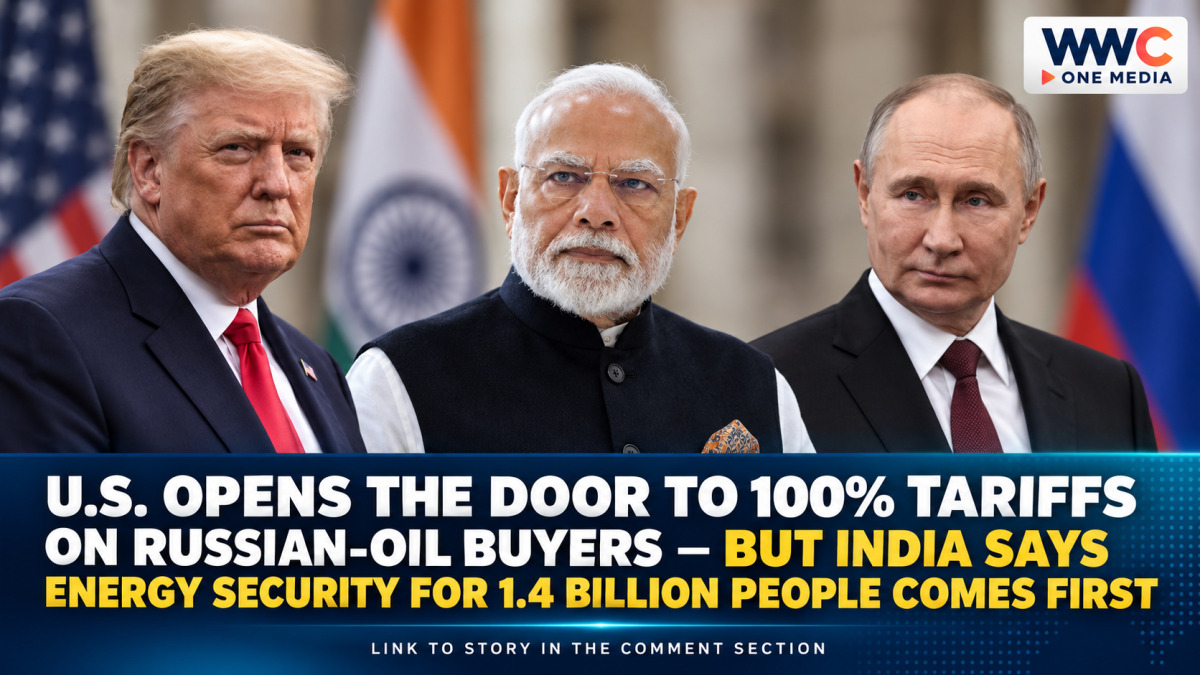
NEW DELHI — September 17, 2026 — India has warned Washington that a sweeping new U.S. sanctions law targeting buyers of Russian energy could strain relations between the two countries, while making clear that New Delhi is not prepared to sacrifice energy security for its 1.4 billion people simply to satisfy foreign pressure.
The warning came after the U.S. House of Representatives approved legislation giving President Donald Trump authority to impose tariffs of as much as 100% on goods from countries that continue making major purchases of Russian oil and gas, potentially putting India and China directly in the crosshairs. The Senate had already passed the measure, meaning it now goes to Trump for his signature.
But there is an important distinction behind the dramatic “100% tariff” headline.
India has not automatically been slapped with a fresh 100% tariff.
The legislation gives the U.S. president authority to impose tariffs of up to 100% and contains discretion over how those measures are applied. Reuters reported that the bill also allows sanctions to be waived on national-interest grounds.
That means the immediate battle is likely to move from Congress to diplomacy.
And New Delhi is already drawing its line.
India: Energy Security Comes First
India’s Ministry of External Affairs said the government had repeatedly warned American officials about the possible consequences of penalizing countries that continue buying Russian energy.
New Delhi said it remained “firmly committed” to securing energy supplies for its population and would continue buying from diversified suppliers according to changing market conditions. India also said it was prepared to take necessary steps to protect its trade and economic interests.
The ministry said India had explained to U.S. officials the potential consequences not only for bilateral relations but also for the international energy market.
That position reflects a longstanding Indian argument: as one of the world’s biggest crude-oil importers, the country says it must prioritize reliable and affordable supplies rather than restrict purchases on geopolitical grounds alone.
Washington sees the issue differently.
Supporters of the new legislation argue that Russian energy exports provide Moscow with revenue that helps finance its war against Ukraine. The bill targets Russia’s energy and defense sectors, along with the so-called shadow fleet of tankers used to move Russian oil around existing sanctions.
Those competing positions now put two important U.S. goals into potential conflict: increasing economic pressure on Russia while maintaining closer strategic and economic relations with India.
Why India’s Russian Oil Purchases Suddenly Matter So Much
India barely bought Russian crude on today’s scale before Moscow’s full-scale invasion of Ukraine in February 2022.
Western sanctions and European moves away from Russian energy subsequently redirected heavily discounted Russian crude toward Asian buyers, particularly India and China.
India became one of Moscow’s biggest oil customers.
And in July 2026, the dependence reached an extraordinary level.
Russian crude represented 50.83% of India’s total oil imports that month, a record share, according to trade data reported by Reuters. India imported about 2.47 million barrels per day of Russian crude in July.
Across April through July, Russia supplied an average 43.25% of Indian crude imports, up from about 37% a year earlier.
Those figures make India highly exposed to any sudden disruption in Russian supply.
But there is another reason New Delhi is reluctant to abandon those barrels now.
The Middle East Is Already Making India’s Oil Problem Harder
India’s confrontation with Washington is occurring at an exceptionally difficult moment for global energy markets.
The continuing Middle East conflict has disrupted traditional crude flows into Asia and driven oil prices sharply higher.
India is particularly vulnerable because it imports the majority of the oil it consumes.
Disruptions following the Iran conflict already forced Indian refiners to rely more heavily on Russian barrels earlier this year. Reuters reported that India’s Russian crude share surged to its July record partly because instability in Middle Eastern supplies left refiners searching for alternatives.
The situation has become even more complicated following attacks on Saudi energy infrastructure.
Saudi Arabia’s crucial East-West pipeline — which allows crude to reach the Red Sea port of Yanbu while bypassing the Strait of Hormuz — was knocked out following drone attacks, threatening millions of barrels per day of export capacity.
Saudi Arabia has since begun offering additional crude to Asian buyers using alternative arrangements through Oman, helping ease immediate market fears. Brent crude was trading around $104 a barrel on September 17, still far above levels seen before the latest supply crisis.
For India, therefore, the Russian oil issue is no longer simply a choice between Moscow and Washington.
It is also about where replacement barrels would come from — and what they would cost — during one of the most disrupted global energy markets in years.
Indian Refiners Are Already Worried About the Cost
Indian refiners have secured their September and October crude requirements, including Russian oil, according to industry sources cited by Reuters.
But refiners are concerned about what happens if Washington moves quickly to activate the tariff provisions.
Two refining sources told Reuters they wanted the Indian government to seek some form of relaxation from Washington, potentially allowing existing transactions to wind down or creating a quota under which India could continue importing a limited amount of Russian crude.
Their concern is straightforward.
Removing large volumes of Russian oil from India’s supply mix while Middle Eastern supplies are already constrained could push crude prices higher and squeeze refiners whose fuel-selling margins are already under pressure.
Indian state-run oil companies are facing particularly difficult economics because elevated crude prices have not always been fully passed through to consumers at the pump.
The pressure is visible across Asia.
Diesel refining margins in the region recently surged above $87 a barrel, an all-time high in LSEG data cited by Reuters, reflecting fears that supplies of refined fuels could tighten further.
Washington’s Bill Is About Russia — But India Could Pay the Trade Price
The legislation is officially designed to increase pressure on Moscow.
It passed the U.S. House by 262 votes to 159, after previously clearing the Senate by an overwhelming 86-11 vote.
The measure has been renamed the Lindsey O. Graham Sanctioning Russia and Iran Act of 2026, honoring the late Republican senator who championed tougher penalties against Moscow.
Supporters argue that targeting countries still buying large quantities of Russian energy would reduce the revenue available to President Vladimir Putin’s government.
Critics inside the U.S. Congress raised a different concern: granting the president broad tariff authority could expose American allies and partners to major new trade barriers.
Some House Democrats opposed the legislation partly because they argued that the tariff powers were too broad and could be used against friendly countries.
India could become the first major test of that tension.
The Timing Could Hardly Be Worse for India-U.S. Trade Talks
India and the United States have spent months trying to deepen their economic relationship.
Earlier this year, the two governments announced an interim trade framework that reduced U.S. reciprocal tariffs on many Indian products to 18%, while negotiations continued toward a broader bilateral trade agreement. India also committed to substantially increase purchases of U.S. energy, technology and other products over several years.
But the full trade negotiations remain unfinished.
Reuters reported Thursday that Indian analysts believe the threat of additional tariffs tied to Russian oil could complicate or delay those discussions.
Indian Commerce and Industry Minister Piyush Goyal is expected to travel to the United States for the G20 trade ministers’ meeting later this month, where he is due to meet U.S. Trade Representative Jamieson Greer. Russian oil and the new sanctions legislation are now likely to loom over those talks.
The stakes extend far beyond petroleum.
The United States is one of India’s most important export destinations, while Washington increasingly sees India as an important economic and strategic partner in Asia.
A major tariff escalation could therefore spill into manufacturing, technology, pharmaceuticals, textiles and investment — sectors with little direct connection to Russian oil.
India Is Already Diversifying — Just Not Away From Russia Completely
New Delhi’s statement emphasized “diversified sourcing,” and the numbers show that Indian refiners are indeed buying crude from a wide range of suppliers.
Russia remains the largest source, but India has also increasingly turned to producers including the United Arab Emirates, Venezuela, Brazil, Iraq and African suppliers.
In August, Russian crude volumes fell from the extraordinary levels reached earlier in the summer. Industry data put Russian supplies at around 2.1 million barrels per day, still representing more than 40% of Indian imports.
The decline did not necessarily indicate a political decision by New Delhi to abandon Moscow.
Market analysts instead pointed to lower Russian availability, competition from Chinese buyers and changing economics.
That distinction matters.
India has repeatedly argued that it buys oil based principally on price, availability and supply security, rather than political allegiance.
Washington’s new legislation is designed precisely to change that calculation by making the potential trade cost of buying Russian oil much higher.
There Is a Larger Contradiction at the Heart of the Dispute
Washington wants India to reduce the money flowing to Russia through energy purchases.
India says abruptly removing Russian crude from the global market could make an already serious energy crisis even worse.
Both concerns have real economic consequences.
Russia earns substantial revenue from oil exports.
But India is the world’s third-largest oil importer, and sudden competition for replacement barrels could increase prices not only for Indian refiners but across the international market.
That is especially significant in September 2026 because the global system has already lost important supply flexibility.
Shell and Equinor executives warned this week that the energy market’s traditional “shock absorbers” are weakening after months of Middle East disruption and attacks on energy infrastructure.
So Washington’s latest sanctions push arrives at exactly the moment when India has fewer easy alternatives.
What Happens Next?
The biggest immediate question is not whether Congress approved the bill.
It did.
The question is how President Trump uses the authority after signing it.
The legislation allows tariffs of up to 100%, but that does not necessarily mean Washington will immediately impose the maximum rate on every Indian product.
The administration could negotiate with New Delhi over reductions in Russian imports, exemptions, quotas, transition periods or other arrangements.
India, meanwhile, has already signaled that it intends to protect its economic interests and maintain diversified energy supplies.
That sets up a potentially difficult negotiation.
Washington is trying to make Russian oil more expensive politically and economically.
New Delhi is trying to make sure its 1.4 billion people still have access to affordable energy.
And hovering over both sides is a trade relationship they have spent years trying to expand.
For now, therefore, the 100% figure is a threat authorized by legislation — not yet a blanket tariff imposed on India.
Whether it becomes one may depend on what happens next at the negotiating table.




Leave a Reply