
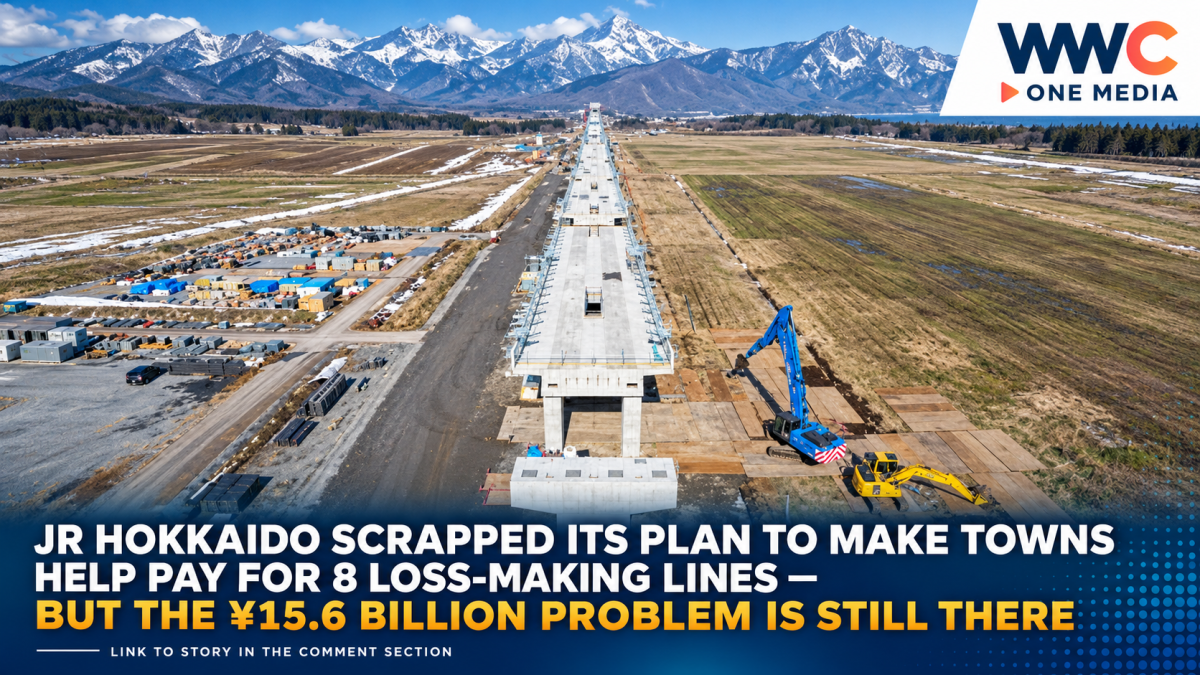
JR Hokkaido has abandoned a controversial proposal that could have left local governments responsible for owning and maintaining tracks, stations and other railway infrastructure across eight chronically loss-making sections.
The railway announced on September 16 that it would withdraw the so-called “vertical separation” model from negotiations with municipalities after encountering strong resistance over the potential financial burden.
Under that proposal, JR Hokkaido would have continued operating trains while local governments or another public entity took responsibility for railway assets and infrastructure.
That could have shifted a substantial share of maintenance costs away from the railway company.
Municipalities pushed back.
Now JR Hokkaido President Yasuyuki Watanuki has apologized for advancing a framework that assumed what the company itself acknowledged would be a heavy burden on communities. JR said the plan had generated strong criticism and made constructive negotiations more difficult.
But dropping the plan does not solve the underlying problem.
The eight routes remain deeply unprofitable.
Local media put their combined annual losses at roughly ¥15.6 billion, and the central government still expects JR Hokkaido to produce fundamental improvement plans by the end of fiscal 2026 — March 31, 2027.
That leaves JR Hokkaido with barely six months to answer a question Japan has struggled with for years:
Who should pay to keep rural railways running when passenger numbers are no longer enough to support them?
What Were Local Governments Being Asked to Take On?
The abandoned model is known in Japan as 上下分離方式 — “vertical separation.”
The basic idea is straightforward.
The “upper” part of the railway — trains and operations — remains with the railway company.
The “lower” part — tracks, stations, land and other infrastructure — is owned or supported by a public body.
JR Hokkaido proposed discussing that structure in April as one of several ways to keep the eight routes alive.
The attraction for the railway company is obvious.
Tracks require inspections.
Snow must be cleared.
Stations must be maintained.
Bridges, signals and crossings need repairs.
Those costs remain substantial whether a train carries 1,000 passengers or 30.
By separating infrastructure from operations, JR Hokkaido could reduce some of those fixed expenses.
But the same costs do not vanish.
They simply move somewhere else.
And local governments feared that “somewhere else” would be their budgets.
The Backlash Was Strong Enough for JR Hokkaido’s President to Apologize
At his September 16 news conference, Watanuki acknowledged that proposing vertical separation had effectively placed the burden of the problem onto municipalities.
He said the company had received strong criticism from multiple parties and apologized before formally withdrawing the model from talks.
The reversal came only about five months after the idea was publicly presented in April.
Hokkaido broadcasters reported that municipal leaders had repeatedly voiced concern that infrastructure ownership could expose them to large and continuing financial obligations.
That resistance effectively stalled discussions.
So JR Hokkaido has changed strategy.
Instead of negotiating primarily with each town over who owns the tracks, the company now wants Japan’s central government to take a much more active role.
Tokyo Is Now Being Asked to Lead
JR Hokkaido says it wants a new body provisionally called the Council on Sustainable Operation of the Yellow-Line Sections.
The proposed structure would include:
- the Hokkaido District Transport Bureau of the Ministry of Land, Infrastructure, Transport and Tourism,
- the Hokkaido prefectural government,
- municipalities along each route,
- and JR Hokkaido.
The national railway bureau and JR Freight would participate as observers.
JR Hokkaido proposes dealing with common issues in a full council while creating separate working groups for each of the eight routes.
Each working group would meet roughly three times before the end of March and attempt to produce a concrete improvement plan.
That is a significant shift.
The problem is no longer being framed primarily as a negotiation between a railway company and cash-strapped towns.
It is increasingly being treated as a broader national and regional transport-policy problem.
These Are the Eight Routes at Risk
JR Hokkaido classifies the affected sections as its “yellow” lines — routes with transport density of between 200 and 2,000 passengers per kilometre per day that the company says it cannot sustainably maintain on its own.
They are:
- Senmo Line: Higashi-Kushiro to Abashiri
- Hanasaki Line: Kushiro to Nemuro
- Sekihoku Line: Shin-Asahikawa to Abashiri
- Soya Line: Nayoro to Wakkanai
- Furano Line: Furano to Asahikawa
- Nemuro Line: Takikawa to Furano
- Muroran Line: Numanohata to Iwamizawa
- Hidaka Line: Tomakomai to Mukawa
These are not obscure lines with no wider significance.
Several pass through some of Hokkaido’s best-known tourism regions.
The Soya Line reaches Wakkanai, Japan’s northernmost major city.
The Sekihoku Line connects inland Hokkaido with Abashiri.
The Senmo Line runs through eastern Hokkaido near the Kushiro wetlands.
The Furano Line serves one of the island’s most recognizable tourism areas.
Yet tourism alone has not generated enough year-round demand to make the lines financially sustainable.
The Combined Losses Have Reached About ¥15.6 Billion
Hokkaido Cultural Broadcasting reported that the eight sections are collectively losing approximately ¥15.6 billion.
Earlier reporting put the combined fiscal 2024 loss at around ¥14.8 billion, showing how persistently large the deficit has become.
The exact number varies by fiscal year, but the direction is clear.
Passenger revenue is nowhere near enough to cover operating and infrastructure costs.
And demographic trends make the mathematics even harder.
Hokkaido has been dealing with population decline, ageing communities and increasing car dependence for decades.
As towns lose residents, fewer people commute to work or school by rail.
But railway infrastructure cannot be scaled down proportionately every time the passenger count falls.
A 50-kilometre track still requires 50 kilometres of inspection, maintenance and snow clearing.
That is the structural problem.
Japan Has Already Closed Several of JR Hokkaido’s Weakest Lines
The argument over the eight yellow routes comes after years of contraction elsewhere in JR Hokkaido’s network.
The railway previously classified several extremely low-use routes as “red” or “brown” sections, generally those with transport density below 200 passengers per kilometre per day.
Those lines have progressively been closed or converted to other transport.
The final remaining section of the Rumoi Main Line shut in April 2026, ending more than a century of railway operation there.
That history explains why communities are nervous.
When JR Hokkaido begins formally describing a route as impossible to maintain independently, local residents know that closure is not merely theoretical.
The company insists, however, that its current objective is to find ways to preserve the yellow routes rather than simply eliminate them.
Watanuki said JR Hokkaido’s commitment to regional public transportation has not changed.
What Could Replace the Scrapped Cost-Sharing Model?
Abandoning vertical separation does not mean JR Hokkaido has thrown away every other cost-cutting idea.
Its new proposal lists several measures for the upcoming council to examine.
One is changing train frequency and service patterns based on actual usage.
That could mean fewer trains or redesigned schedules on the weakest sections.
Another is shifting certain operational jobs to local governments or local contractors.
JR specifically mentioned duties such as snow removal at level crossings and station work.
It is also considering transferring some railway assets, including station facilities, to municipalities to reduce property-tax expenses.
That is narrower than asking towns to own and finance entire railway infrastructures, but it still involves local participation.
And then there is tourism.
JR Hokkaido Wants Tourist Trains to Generate More Revenue
The railway says the new discussions should examine ways of increasing the economic value of each route, including through sightseeing trains such as its planned “Red Star” and “Blue Star” services.
That strategy reflects a broader challenge facing rural Japanese railways.
A line that cannot survive on commuters alone may still have tourism value.
Hokkaido has natural scenery, national parks, winter landscapes and wildlife that attract domestic and international visitors.
JR Hokkaido has increasingly experimented with scenic trains, themed services and tourism partnerships to capture that demand.
But tourism is seasonal.
A sightseeing train full of visitors in July cannot automatically pay for tracks that must remain inspected and snow-cleared through January.
So tourist revenue may help.
It is unlikely to solve the entire funding gap by itself.
Hokkaido’s Governor Is Warning That March May Be Too Soon
The deadline adds another layer of pressure.
The national government has ordered JR Hokkaido to develop fundamental measures for the eight routes by the end of fiscal 2026.
That means March 2027.
After JR Hokkaido announced the policy reversal, company President Watanuki and Hokkaido transport officials met Governor Naomichi Suzuki and asked the prefecture to participate in the new council.
Suzuki welcomed dialogue but cautioned that completing comprehensive solutions within the remaining six months would be extremely difficult.
He urged the process not to become rushed simply to meet the deadline.
That warning matters.
Transport policy decisions made now could determine whether communities retain rail links for decades.
A hurried compromise might technically meet Tokyo’s deadline while failing to produce a financially sustainable system.
Freight Makes Some of These Lines More Important Than Passenger Numbers Suggest
There is another dimension that pure passenger statistics do not always capture.
Hokkaido is one of Japan’s most important agricultural regions.
Railways also play a role in moving freight from farming regions toward major consumption centres.
That is why JR Freight is expected to participate as an observer in the new talks.
Some transport specialists and local advocates have argued that railway preservation should therefore be considered not only in terms of ticket revenue, but also in relation to logistics and national food security.
HBC reporting noted that experts have specifically raised food security when discussing who should bear the cost of maintaining Hokkaido’s rail network.
That complicates the economics.
A passenger railway might appear deeply unprofitable when measured only by fares.
But eliminating it can create costs elsewhere — road maintenance, bus subsidies, trucking capacity, labour shortages and regional depopulation.
Those indirect effects are much harder to put into a simple railway profit-and-loss statement.
JR Hokkaido Also Admits It Needs to Make More Money Outside Rail
Interestingly, the company’s September statement does not blame everything on shrinking passenger numbers.
JR Hokkaido also acknowledged criticism that it had not done enough to expand non-rail businesses and diversify revenue sources.
It said management had failed to move quickly enough in restructuring the business and has established a project team focused on strengthening the company’s earning power.
That admission is significant.
Japan’s most successful railway groups often make large amounts of money outside trains through real estate, hotels, retail, shopping centres and property development.
JR Hokkaido has fewer dense metropolitan areas in which to replicate that model.
Still, management is now explicitly saying the answer cannot simply be demanding more support from communities.
The company itself has to become more commercially resilient.
Yomiuri-linked reporting also says JR Hokkaido plans to establish a new subsidiary before the end of the year aimed at strengthening non-railway revenue.
This Is Bigger Than Eight Train Lines
The fight over Hokkaido’s yellow routes reflects a much wider problem facing Japan.
The country built much of its regional infrastructure during decades when populations were growing.
Now many rural areas are shrinking.
Schools have fewer children.
Hospitals struggle to recruit workers.
Bus operators cannot find drivers.
And railway companies are being asked to maintain networks designed for populations that no longer exist.
Closing a railway can make financial sense on a spreadsheet.
But for an elderly resident without a car, a student travelling to school or a community trying to attract tourists and businesses, losing the line can accelerate decline.
That is why arguments over rural railway economics quickly become arguments about what governments consider essential public infrastructure.
JR Hokkaido Has Removed the Most Controversial Option — Not the Crisis
The September 16 decision is therefore a retreat, but not a resolution.
Municipalities will no longer be asked to negotiate a model in which they assume wholesale responsibility for tracks and infrastructure.
That removes the proposal that triggered the strongest backlash.
But JR Hokkaido still has eight routes it says it cannot maintain alone.
The combined losses still run into billions of yen.
Passenger numbers remain low.
Hokkaido’s population continues to shrink.
And Tokyo’s March deadline is still approaching.
The next phase will determine whether the burden is spread more broadly among JR Hokkaido, municipalities, the prefectural government and Japan’s national government.
That may ultimately be the only politically workable answer.
Because JR Hokkaido has now accepted that local towns cannot simply be handed the bill.
But somebody still has to pay it.




Leave a Reply