
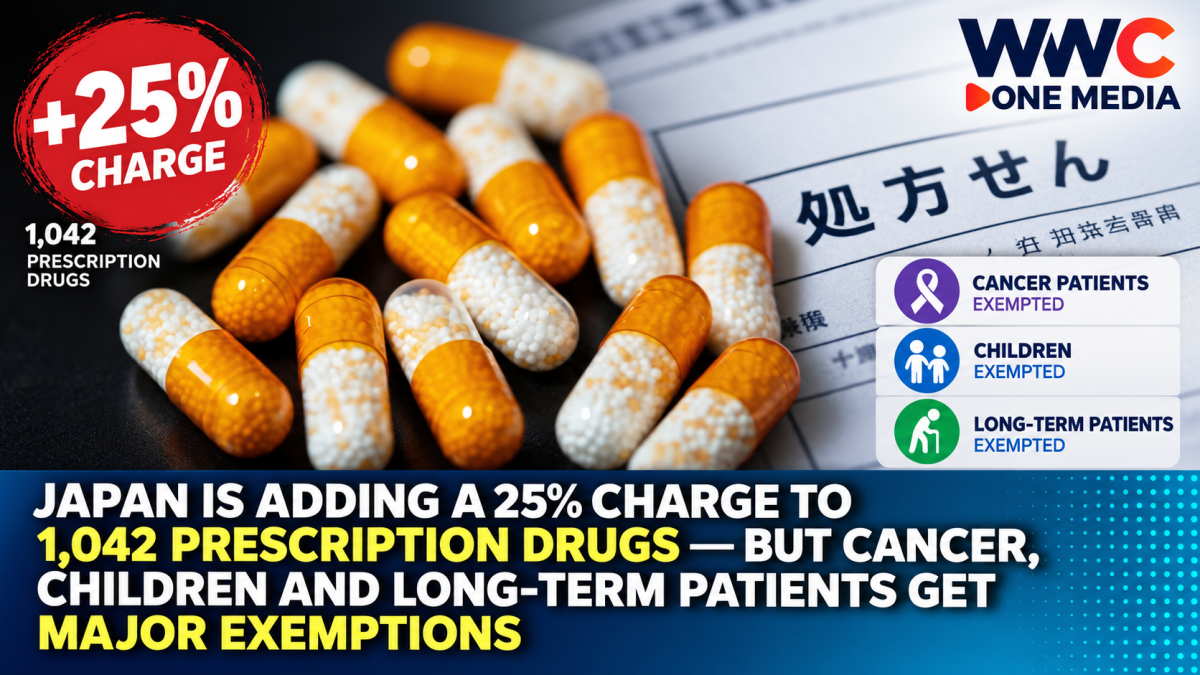
TOKYO — Japan is preparing to make hundreds of commonly prescribed medicines more expensive for patients from March 2027, but the government has now drawn a much clearer line around who will—and will not—have to pay the extra charge.
The Health Ministry’s Social Security Council on September 16 backed operating guidelines for a new system covering prescription medicines whose ingredients, route of administration and maximum daily dosage closely match drugs already available over the counter.
The policy covers 77 ingredients and 1,042 prescription products, including medicines used for allergies, pain, stomach problems, coughs and phlegm, constipation and dry skin.
For most patients, one quarter of the medicine’s official price will be shifted outside public health insurance and charged directly.
The remaining 75% will stay inside Japan’s insurance system, with patients paying their ordinary age- and income-based copayment of between 10% and 30%.
That sounds technical.
For millions of people picking up everyday prescriptions, it means the number at the pharmacy counter is likely to rise.
But the government is now saying something equally important:
A patient who genuinely needs one of these medicines because of cancer, an intractable disease, hospital treatment or medically necessary long-term therapy should not automatically be treated like someone using the same ingredient for a minor short-term condition.
What exactly changes in March?
Take a prescription drug priced at ¥1,000.
Today, a working-age patient subject to the standard 30% copayment generally pays ¥300 of that medicine’s insured price.
Under the new system:
¥250—25% of the medicine price—becomes the special out-of-insurance charge.
The remaining ¥750 stays insured.
A 30% copayment on that ¥750 equals ¥225.
Total patient drug cost:
¥475.
That is ¥175 more than the current ¥300, or an increase of about 58% in that medicine-cost example.
It does not mean every affected patient’s total medical bill rises 58%.
Doctor consultation fees, dispensing fees, treatment charges and the actual prices and quantities of individual medicines vary.
The increase also differs for patients whose normal insurance share is 10% or 20%.
That distinction matters because shorthand descriptions such as “Japan is raising drug copayments to 50%” can obscure how the formula actually works.
For a 30%-copay patient, the effective medicine-only share in the ¥1,000 example is 47.5%, not precisely 50%.
The Health Ministry’s own examples show smaller bills still rising
The ministry’s September material gives more everyday examples for someone paying the standard 30% insurance share.
For one representative five-day fever and pain medicine, the drug component rises from about ¥50 to ¥70.
A five-day cold medicine rises from around ¥50 to ¥70.
A 30-day constipation prescription rises from approximately ¥360 to ¥550.
And a 30-day anti-allergy medicine rises from around ¥540 to ¥790.
Those calculations do not include consultation and dispensing charges.
The government’s argument is therefore not that an individual prescription necessarily becomes prohibitively expensive.
It is that patients using medicines with readily available OTC alternatives should shoulder a somewhat larger share of their cost instead of having other insurance contributors subsidise as much of the prescription price.
Critics and patient advocates have focused on a different concern: seemingly modest charges can accumulate for people taking medicines continuously, and higher costs could discourage some patients from seeking medical care.
That tension is why the exemptions have become so important.
Children are exempt
Under the September framework, children will not have to pay the special additional charge through March 31 following their 18th birthday—roughly the age through which Japanese policy commonly defines the high-school-age population.
This is a blanket patient-category exemption rather than one restricted to a particular disease.
It means a medicine that would trigger the 25% extra charge for many adults may remain under the ordinary insurance-cost structure when prescribed to an eligible child.
Cancer patients are protected—but not for every prescription they receive
The cancer exemption is narrower than simply saying, “Anyone with cancer pays no extra fee.”
If an affected OTC-like prescription medicine is being used for cancer treatment or a condition related to that treatment, the additional charge will not apply.
For example, government testimony has cited moisturisers used to treat skin complications caused by anticancer therapy as the kind of medically related prescription that can be protected.
But if the same cancer patient goes to a doctor for an unrelated problem—such as seasonal hay fever—and receives an affected medicine, the cancer diagnosis alone does not automatically create an exemption.
The Health Ministry explicitly says treatment unrelated to the cancer remains subject to the charge.
That is a crucial accuracy distinction.
The exemption follows the medical necessity connected to the protected illness, not simply a patient’s diagnostic label.
Designated intractable diseases receive similar treatment
Japan will use essentially the same principle for patients with officially designated intractable diseases.
Medicines used for the designated disease—or a condition related to it—can be exempt from the extra charge.
Unrelated treatment is not automatically exempt.
The government is also trying to make verification less rigid when the system begins.
Normally, patients will establish their status through an official recipient certificate or registration document.
But because newer registration procedures can take time, other objectively verifiable documents will temporarily be accepted through the end of fiscal 2027 in some cases.
That transition rule is intended to stop paperwork delays from blocking medically necessary exemptions.
Hospital patients are exempt too
The extra fee will generally not apply when the affected medicines are used during inpatient hospital treatment.
That exemption extends to prescriptions issued when the patient is discharged.
The logic is straightforward.
A person admitted to hospital is not normally in the same position as someone deciding whether to buy a simple OTC remedy at a drugstore.
The medicine may be part of a larger treatment plan managed by hospital physicians.
Medicines connected to surgery or medical procedures also get protection
Another exemption covers short courses associated with:
procedures,
operations,
and medical tests.
The ministry’s framework allows up to 14 days of use connected with such treatment to avoid the special fee.
This addresses cases in which a common painkiller or another OTC-like drug is prescribed not because someone is independently treating a mild symptom but because it is part of post-procedure medical care.
A typical example raised during policy discussions was pain medicine following dental extraction.
Atopic dermatitis became one of the most important test cases
The most significant refinement in September concerns people who need common-looking medicines continuously.
Atopic dermatitis illustrates the problem particularly well.
A moisturiser may appear easy to replace with something from a drugstore.
But for a patient with chronic atopic dermatitis, regular moisturising can form part of a physician-supervised treatment strategy aimed at controlling the disease and preventing recurrence.
The Health Ministry therefore says medically necessary long-term moisturiser use for atopic dermatitis can be exempt.
The council went further with topical steroids.
Earlier discussions had leaned toward keeping steroid ointments inside the additional-payment category.
Patient groups argued that this failed to account for proactive therapy, in which a patient whose symptoms have been brought under control continues applying a topical steroid intermittently—such as twice a week—to areas that repeatedly flare.
The ministry accepted that argument.
When topical steroids are being used regularly throughout the year as part of physician-supervised proactive therapy for atopic dermatitis, the additional fee can be waived.
Six months may be enough to establish long-term need
The government has also clarified what “long-term” actually means.
An earlier benchmark referred to medicine use for approximately 50 weeks, or one year.
Patient representatives argued that forcing everyone to produce a full year of prescription history could be too rigid.
The final approach treats that one-year figure as a guide rather than an absolute requirement.
If at least around six months of continuing or repeated use can be confirmed and the physician determines that the medicine will remain medically necessary throughout the year, the patient can qualify for exemption before a full 50 weeks of prescriptions have accumulated.
That also protects people who change hospitals or doctors but can document an established treatment history.
The final call remains a medical judgment.
That doctor judgment may become one of the hardest parts of the system
This creates an administrative challenge.
Two patients can receive the same active ingredient.
One may have to pay the special charge.
The other may not.
A computer cannot necessarily distinguish them from the medicine name alone.
The ministry says electronic medical record and billing systems will be updated with information including:
affected medicine codes,
conditions for which the OTC alternative does not have an equivalent approved indication,
and standard ways to record exemptions.
But cancer status, intractable disease status and medical necessity for long-term treatment cannot always be decided automatically.
Doctors will ultimately have to confirm many of those cases.
The ministry therefore plans national guidance, checklists and common billing examples in an effort to stop exemption decisions varying excessively from clinic to clinic.
Some prescriptions escape the fee because the OTC drug does not actually treat the same condition
This is another subtle but important feature.
Two medicines can contain the same ingredient without having identical approved uses.
The Health Ministry gives fexofenadine, an antihistamine, as an example.
Prescription fexofenadine can be approved not only for allergic rhinitis but also for urticaria and itching associated with certain skin diseases.
The corresponding OTC product is approved for nasal allergy symptoms such as sneezing, runny nose and congestion.
So when the prescription version is being used for an indication the OTC drug does not cover—such as urticaria—the special charge does not apply.
The policy therefore is not simply:
“Same ingredient equals extra payment.”
Actual approved medical use matters.
The list has fallen from ‘about 1,100’ drugs to 1,042
Earlier reporting repeatedly described the reform as affecting about 1,100 products.
That was accurate when the preliminary list was produced.
The Health Ministry’s refined list now contains 1,042 products across 77 ingredients.
The number changed because some products were removed from Japan’s reimbursement price list and the authorities reassessed which medicines met the criteria.
One ingredient disappeared because all relevant prescription products were removed from the reimbursed list, while the sleep drug ramelteon was added after an OTC version began sales and met the government’s matching criteria.
So 1,042 is the stronger current figure for publication.
What medicines are involved?
The reform covers several categories commonly encountered in primary care.
They include certain:
anti-allergy medicines,
pain and anti-inflammatory drugs,
gastrointestinal medicines,
expectorants,
moisturisers,
antivirals,
disinfectants,
and corticosteroid products.
Frequently cited examples include ingredients used in products such as Loxonin/loxoprofen for pain and Allegra/fexofenadine for allergies, although whether an individual prescription incurs the extra charge still depends on the clinical use and exemption rules.
That final clause matters.
A medicine appearing on the 1,042-product list does not mean every prescription for it automatically costs more.
Japan’s government says the goal is fairness—and lower insurance spending
The reform comes from a wider debate over Japan’s rapidly rising healthcare expenditure and insurance premiums.
Government officials argue that it can seem unfair when one person buys an OTC medicine entirely with their own money while another visits a physician, receives a very similar medicine under public insurance and has much of the price subsidised through premiums paid by everyone else.
The policy therefore attempts to preserve insurance coverage while moving part of the cost back to the patient.
It is a compromise between two alternatives:
continuing the existing subsidy unchanged,
or completely removing OTC-like prescription drugs from health-insurance coverage.
Japan chose neither.
The government estimates about ¥90 billion in annual medical-cost savings
Diet testimony provides a useful measure of the expected financial effect.
A Health Ministry official told lawmakers that, based on fiscal 2024 claims data, the reform was mechanically estimated to reduce medical spending by about ¥90 billion annually.
The ministry divided that estimate into roughly:
¥50 billion shifted through the new patient charges, and
about ¥40 billion from assumed changes in patient behaviour—for example, people purchasing OTC medicine rather than returning to a clinic for another prescription after a diagnosis has already been established.
There is a significant caveat.
The calculation did not account for doctors potentially switching prescriptions toward insured drugs outside the targeted list.
So ¥90 billion is an official estimate, not a guaranteed saving.
The estimated insurance-premium saving per person is surprisingly small
The same Diet testimony put the average reduction in health-insurance premiums at approximately ¥400 per insured person per year, although the actual impact varies among insurers.
That is about ¥33 a month on a simple average basis.
This contrast is likely to remain central to the policy debate.
Supporters can point to ¥90 billion in aggregate healthcare savings and argue that a sustainable national insurance system requires many smaller reforms.
Critics can point out that some patients could face recurring additional pharmacy expenses while the estimated average premium saving per insured person is only a few hundred yen annually.
Those are competing policy perspectives; the eventual real-world balance will depend partly on prescribing and patient behaviour after implementation.
One promised exemption became narrower: low income
Earlier government materials explicitly said officials would consider special treatment for low-income people.
But the final framework does not create a blanket income-based exemption for all households exempt from resident tax.
People receiving public assistance and medical aid are exempt.
Other low-income insured patients, however, generally still face the new charge unless they qualify through one of the medical or other exemption categories.
Health Minister Kenichiro Ueno has defended that approach by arguing that low-income people already receive protections elsewhere in the insurance and premium system, that the special fee has been limited to one quarter of the medicine price, and that medically vulnerable groups receive separate exemptions.
Patient advocates and some participants in the policy process have raised concern about affordability and the possibility that additional costs could alter whether people seek care.
The government says it will monitor those effects after launch.
This reform has already passed parliament
Another important clarification: the underlying system is no longer merely a government proposal.
Japan’s parliament passed the health-insurance reform legislation in May 2026.
What the Health Ministry has been doing since then is determining the detailed operating rules—particularly who should be exempt and how doctors and pharmacies will implement the scheme.
On September 16, the Social Security Council’s health-insurance subcommittee endorsed the latest framework.
The ministry plans to issue detailed instructions to medical institutions and pharmacies and prepare electronic-record and billing systems ahead of the March start.
So the central question is no longer whether Japan will introduce the extra charge.
It is how smoothly a system filled with medical exceptions can work at thousands of clinics and pharmacies.
And this may only be the first stage
The 1,042 medicines are not necessarily the final limit.
Government policy documents say that after the system begins, the Health Ministry will assess its effects and consider expanding the range of medicines covered from fiscal 2027 onward.
Officials have also agreed to consider increasing the share of drug prices subject to the special charge in the future.
No specific future expansion has yet been finalized.
That means it would be inaccurate to claim today that thousands of additional medicines definitely will lose part of their insurance coverage.
But the direction built into the policy is clear:
March 2027 is designed as a starting point, not necessarily the endpoint.
Japan is trying to change patient behaviour without fully abandoning insurance
That may be the most important way to understand the reform.
The government does not want to simply make every familiar prescription medicine an uninsured drug.
Nor does it want the health-insurance system to keep subsidising medicines at exactly the existing level when similar products are widely sold at pharmacies without insurance.
So it has built a hybrid model.
Keep 75% of the drug price within insurance.
Charge another 25% directly.
Then carve out exceptions where medical necessity makes an ordinary OTC comparison misleading.
That is why the exemption list has become almost as important as the drug list itself.
A short course of an allergy medicine for routine hay fever could cost more.
The same active ingredient prescribed for an approved condition not covered by the OTC version might not.
A short-term moisturiser prescription could attract the extra fee.
A patient using moisturiser continuously to control atopic dermatitis may be exempt.
A person with cancer is not automatically exempt from every affected medicine.
A medicine needed because of the cancer or its treatment can be.
The reform therefore turns one simple question into a clinical one
At first glance, Japan’s new policy appears to ask:
“Could this medicine have been bought over the counter?”
In practice, the real question becomes:
“Could an OTC medicine safely and appropriately replace this particular prescription for this particular patient, for this particular condition?”
That difference is why Japan spent months developing exceptions after parliament passed the legislation.
And it explains why a reform designed partly to simplify healthcare spending may create substantial administrative complexity at launch.
Starting in March, some of Japan’s most familiar prescriptions will cost more.
But the medicine’s name alone will not determine the bill.
The patient, the disease, the length of treatment and the doctor’s judgment may matter just as much.


Leave a Reply