
Nomura’s Trading Machine Is Still Growing — Just Nowhere Near as Fast
Japan’s biggest brokerage has just given investors an early warning that one of the hottest parts of its business is beginning to cool.
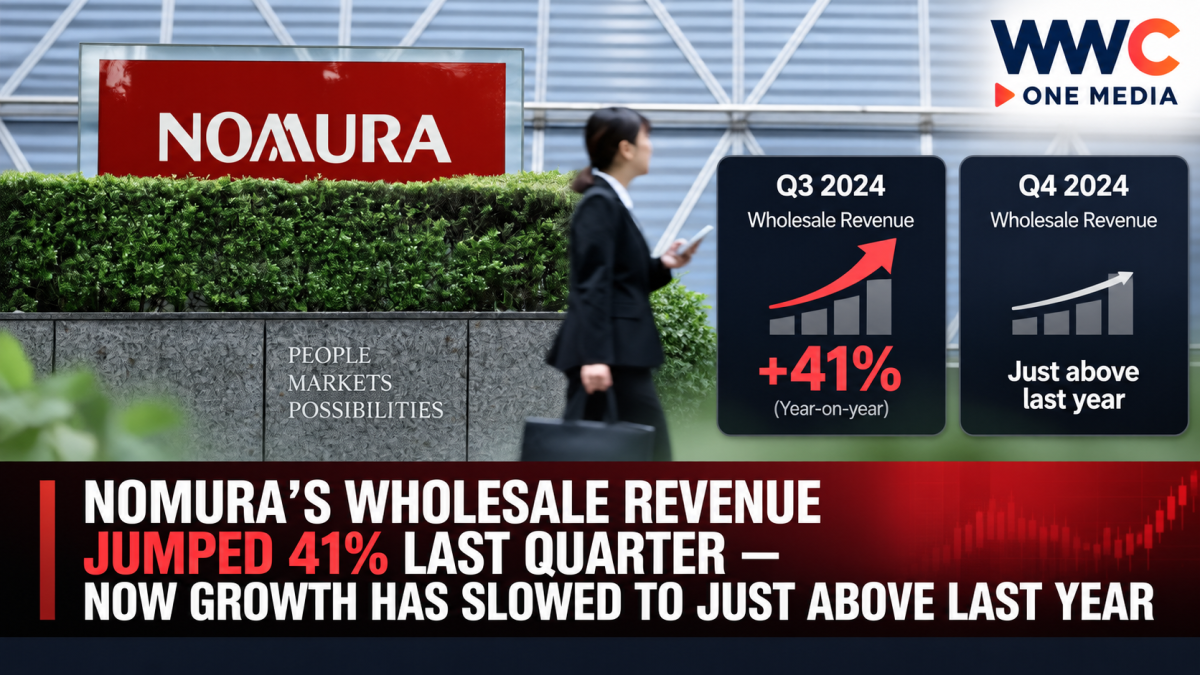
Nomura Holdings said revenue from its global wholesale operation — which includes trading and investment banking — was only slightly higher than a year earlier through September 14, a dramatic slowdown from the 41% year-on-year revenue surge recorded in the April-June quarter.
The message is not that Nomura’s trading business has suddenly collapsed.
Far from it.
Equities remain strong, while foreign-exchange and emerging-markets activity has improved.
The problem is rates trading.
That business — which involves products linked to government bonds, interest rates and related derivatives — has become considerably harder as global borrowing costs rise and bond markets become more difficult to navigate.
For Nomura, the slowdown creates an important test.
The company has spent years rebuilding itself around the idea that it can produce strong, more stable earnings even when favorable market conditions disappear.
Now those conditions may be starting to change.
The Previous Quarter Was Enormous
To understand why “slightly above” last year suddenly matters, look at where Nomura is coming from.
In the fiscal first quarter ended June 30, Nomura reported:
- ¥686.7 billion in group net revenue, up 31% from a year earlier.
- ¥211.5 billion in pretax income, up 32%.
- ¥145.6 billion in net income, up 39%.
- A quarterly return on equity of 15.4%.
Its four main business divisions generated ¥213 billion in combined pretax income, more than double their year-earlier result.
But Wholesale was one of the biggest engines.
Wholesale net revenue reached ¥369.1 billion, up 41% year on year, while pretax income more than doubled to ¥93.3 billion, according to Nomura’s official results.
Equity trading was particularly strong.
Nomura said equity products reached record revenue, supported by derivatives and heavier client activity, including strength in Asia outside Japan.
That is the benchmark against which the latest slowdown is being judged.
Going from 41% growth to only a modest year-over-year increase does not mean revenue is falling.
But it does indicate that the extraordinary trading conditions that powered Nomura’s earlier numbers are becoming much harder to repeat.
And Nomura Is Not Alone
Perhaps the most important context comes from Wall Street.
Goldman Sachs CEO David Solomon said on September 16 that fixed-income, currencies and commodities trading had been somewhat softer during the third quarter, even as the bank’s equities business remained very strong.
Goldman’s fixed-income business has experienced major swings this year.
Its FICC revenue jumped 32% year on year in the second quarter after falling 10% in the first, illustrating how quickly conditions can change in bond, currency and commodities trading.
Bank of America is also preparing investors for slower trading momentum.
CEO Brian Moynihan said this week that sales and trading revenue was likely to be roughly flat from a year earlier during the third quarter. He also expects investment-banking fees to fall by at least 10%, with Bank of America potentially performing somewhat worse than the broader industry.
Moynihan said higher interest rates could eventually slow financing demand even though deal pipelines remained healthy at the time of his comments.
Together, those signals suggest Nomura’s slowdown may not simply be a company-specific problem.
The trading environment itself is changing.
Why Rates Trading Suddenly Became Harder
The timing is especially important because global interest rates are moving higher again.
On September 16, the U.S. Federal Reserve raised its benchmark rate by 25 basis points to 3.75%-4.00%, its first increase since 2023, and policymakers signaled that additional tightening could follow.
Short-term Treasury yields climbed after the decision while the U.S. dollar strengthened, forcing investors to rapidly reassess expectations for borrowing costs around the world.
Higher rates do not automatically mean banks make less money from trading.
Volatility can actually generate lucrative opportunities because clients hedge risks, reposition portfolios and trade more actively.
But violent changes in bond yields can also make positions harder to manage.
That appears to be part of what is happening now.
SMBC Nikko Securities analyst Masao Muraki told Bloomberg that rising interest rates appeared to be restraining investor activity while making position management more difficult.
That distinction helps explain why Nomura’s equities business can remain solid while its rates operation struggles.
Stocks and bonds are responding differently to the same macroeconomic shock.
The Yen Is Also Making the Numbers Look Better
There is another complication inside Nomura’s latest revenue figures: foreign exchange.
Because Nomura reports its financial results in yen but operates major businesses overseas, a weaker Japanese currency raises the yen value of revenue generated in dollars and other currencies.
Nomura indicated that currency translation is contributing to the current quarter’s modest wholesale revenue growth.
In other words, some of the headline year-over-year increase is coming from the exchange rate rather than purely from additional underlying business activity.
But currency movements cut both ways.
A weaker yen also increases the yen-denominated value of Nomura’s overseas expenses.
That means investors will need to look beyond headline revenue growth when the brokerage publishes its full quarterly results.
Nomura Had Just Raised Its Long-Term Targets
The slowdown is arriving only months after Nomura became significantly more ambitious about its future.
In May, the company raised its target for annual pretax income in the fiscal year ending March 2031 from at least ¥500 billion to at least ¥750 billion — a 50% increase.
It also lifted its long-term return-on-equity goal from 8%-10% or higher to 10%-12% or higher.
CEO Kentaro Okuda said the company’s earnings power had improved significantly as Nomura transformed its business model.
The strategy is designed around a basic objective: Nomura does not want to rely entirely on occasional trading booms.
Management has been trying to increase recurring revenue, expand wealth and asset management, strengthen overseas businesses, use artificial intelligence and data more extensively, and remove lower-return operations.
Its capital strategy also calls for reviewing low-ROE businesses while maintaining a common equity Tier 1 capital ratio of between 11% and 14%. Nomura aims for a consolidated dividend payout ratio of at least 40% and total shareholder returns of at least 50% when buybacks are included.
Those targets look achievable when trading revenue is soaring 41%.
The tougher test is whether they can still be delivered when market conditions normalize.
Nomura Has Already Come a Long Way
The warning also comes after an unusually successful period for the 100-year-old financial group.
For the fiscal year ended March 2026, Nomura generated roughly ¥540 billion in pretax income and ¥362 billion in net income, delivering its second consecutive year of record earnings.
Its Wealth Management and Wholesale divisions were major contributors, while assets under management expanded sharply following growth in investment management.
That performance encouraged management to raise the company’s 2030 targets just weeks later.
And momentum carried straight into the new fiscal year.
Nomura’s 15.4% quarterly ROE in April-June was already above even the newly raised long-term target of 10%-12% or more.
The challenge is that a single quarter at 15.4% is not the same thing as consistently producing that profitability throughout different market cycles.
That is exactly what Okuda’s strategy is supposed to prove.
Markets Immediately Noticed the Warning
Nomura shares fell about 0.9% in Tokyo morning trading on September 17, even as the broader Topix index gained around 1%, following the company’s trading update.
Despite the drop, Nomura shares were still up roughly 25% in 2026, having climbed back toward levels last seen around the global financial crisis era.
The stock’s strong performance reflects how dramatically investors’ perception of Nomura has changed.
For years, the company struggled with volatile international operations and repeated concerns about whether its overseas investment-banking business could generate reliable profits.
Today, the debate is different.
Nomura is profitable.
Its balance of businesses is stronger.
Its equity franchise is performing well.
Its management targets have become more ambitious.
The question now is whether investors have already priced in too much of the good news.
Analysts Still Expect Profit Growth
Importantly, the softer wholesale update does not mean Nomura is currently expected to report a bad quarter.
Analysts surveyed by Bloomberg were still forecasting approximately ¥113.1 billion in quarterly net income, representing roughly 23% growth from a year earlier.
That would still represent a healthy result.
The real concern is about the slope of growth.
A brokerage can go from 41% revenue growth to single-digit growth and remain extremely profitable.
But markets often value financial companies based not just on earnings, but on whether those earnings are accelerating or decelerating.
Nomura is now clearly entering the second category.
The Bigger Test Comes When Volatility Stops Paying
The extraordinary trading environment of the past year created opportunities across global banks.
War, volatile energy markets, artificial-intelligence speculation, shifting currency markets and rapidly changing interest-rate expectations all encouraged clients to trade.
Banks benefited.
Nomura benefited substantially.
Now parts of that trading boom appear to be losing momentum.
That does not necessarily undermine Nomura’s turnaround.
In fact, it may provide the clearest test of whether the turnaround is real.
If the company can keep profits growing while rates trading weakens, wholesale growth moderates and currency effects become less favorable, then Okuda’s push toward more durable earnings will look considerably stronger.
But if earnings remain heavily dependent on unusually favorable trading conditions, the slowdown currently emerging in wholesale markets could expose that dependence.
Nomura’s previous quarter showed how much money its trading business can generate during a boom.
The next few quarters may show how much it can generate when that boom starts fading.




Leave a Reply