
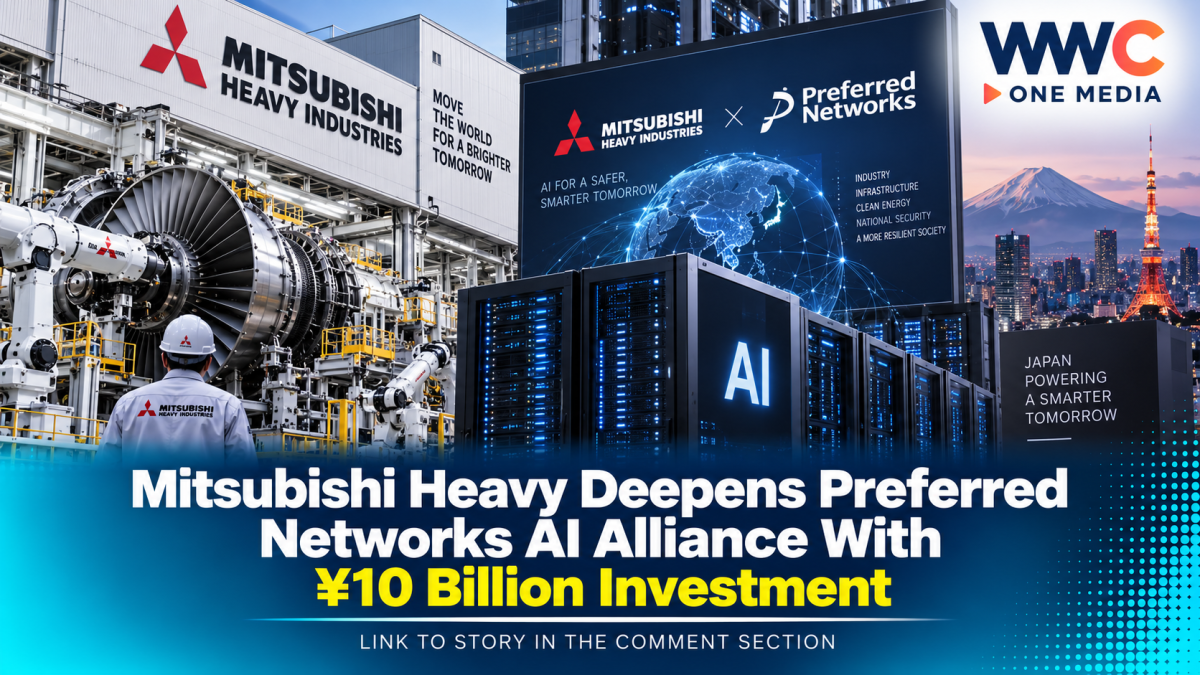
TOKYO — Mitsubishi Heavy Industries is putting serious money behind Japan’s homegrown artificial intelligence push.
Mitsubishi Heavy Industries Ltd. (MHI) and Tokyo-based AI company Preferred Networks Inc. (PFN) have entered a capital and business alliance, with MHI set to invest ¥10 billion in PFN through a third-party share allotment.
The agreement was signed on August 31, 2026, and announced publicly on September 16. The investment remains subject to necessary procedures, including approval by PFN shareholders.
The move significantly deepens a partnership first announced in June, when the two companies agreed to jointly develop AI technologies designed to make machinery and systems more intelligent and autonomous.
From AI Research to Real-World Machines
The partnership is focused on a part of the AI race that goes beyond chatbots and consumer applications.
MHI and PFN want to develop AI-powered machinery and systems for mission-critical applications, particularly in social infrastructure and national-security-related fields where reliability, rapid response and continuous operation are important.
The companies plan to combine MHI’s expertise in hardware, controls, simulation, manufacturing and field operations with PFN’s technologies spanning AI models, computing infrastructure and proprietary AI processors.
That combination could allow AI to move deeper into physical systems — helping machinery assess conditions, respond to changing situations and operate with greater autonomy.
Why Preferred Networks Matters
Founded in Tokyo in 2014, Preferred Networks has built a vertically integrated AI technology portfolio that includes AI processors, computing infrastructure and generative AI foundation models.
Its technologies include the MN-Core series of AI processors, the PFCP cloud platform for AI computing and the Japan-developed PLaMo generative AI foundation model.
For MHI, that creates an opportunity to work with a domestic technology company across multiple layers of the AI stack rather than relying exclusively on outside AI platforms.
The companies have said that developing domestic AI capabilities is increasingly important as Japan confronts labor shortages, aging infrastructure and changing global conditions.
AI Meets Infrastructure, Aerospace and Defense
MHI is one of Japan’s major industrial groups, with businesses spanning energy, infrastructure, industrial machinery, aerospace, defense and space.
Its partnership with PFN therefore has potential applications well beyond conventional software.
The companies have identified areas such as intelligent operations, predictive maintenance and rapid crisis management as potential uses for the technology.
The national-security component is particularly significant because AI systems used in critical environments must meet much higher requirements for reliability, security and responsiveness than many ordinary commercial applications.
The announcement, however, does not mean that autonomous military systems are already being deployed as a result of the investment. The companies describe the initiative primarily as joint research, development and eventual commercialization.
A Bigger Bet on Japan’s AI Independence
The deal also fits into a broader Japanese effort to strengthen domestic AI capabilities.
MHI and PFN’s original June agreement explicitly targeted Japan-developed AI technologies for mission-critical applications and said the companies intended to establish a stronger capital relationship during fiscal 2026.
That next step has now arrived.
MHI says the ¥10 billion investment will provide a stronger foundation for medium- and long-term research, development and commercialization, while PFN says the alliance will connect its AI technology with MHI’s decades of expertise in real-world machinery and industrial operations.
The Bigger Question: Can AI Leave the Screen?
The significance of the MHI-PFN deal is not only the amount of money involved.
It reflects a broader shift in the AI industry toward technology that can operate inside the physical world — from industrial equipment and infrastructure to systems requiring continuous monitoring and rapid responses.
MHI brings the machines, industrial data and operational expertise.
PFN brings AI models, processors and computing infrastructure.
Their challenge now is turning those complementary technologies into systems that can operate safely and reliably outside the laboratory.
If successful, the alliance could become an important example of how Japan’s industrial base is attempting to build AI capabilities around its own hardware, software and engineering expertise.




Leave a Reply