
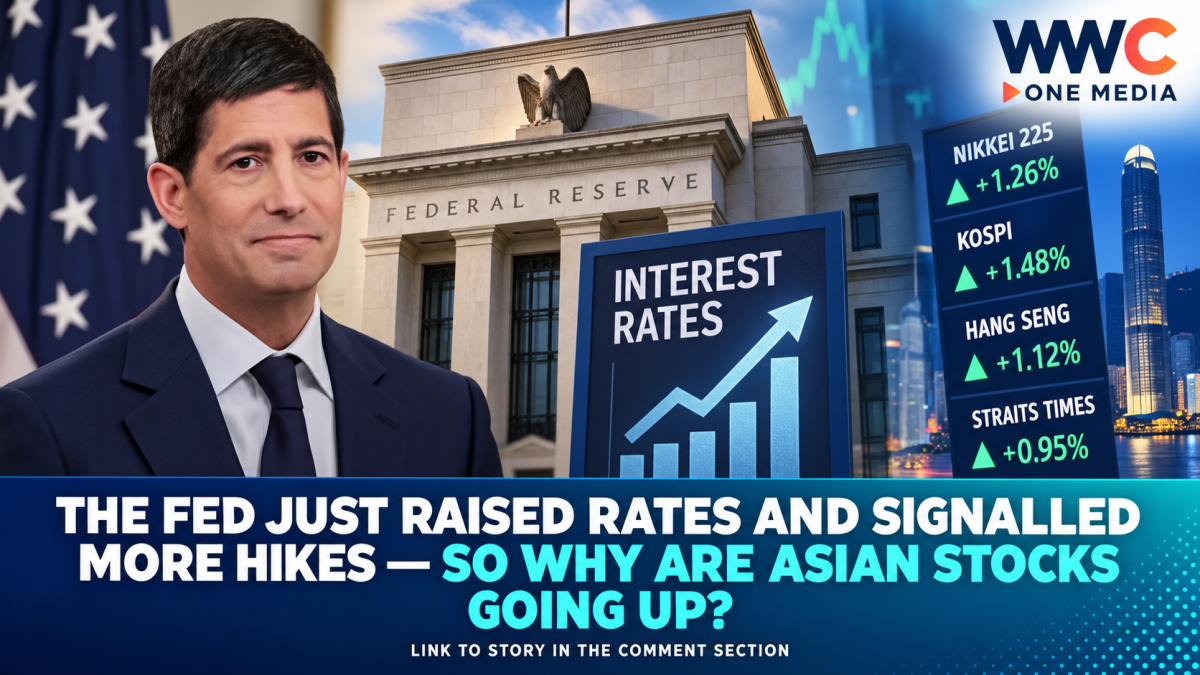
HONG KONG — The Federal Reserve just made borrowing more expensive, warned that inflation is still too high and signalled that another interest-rate increase could arrive before the end of the year.
Normally, that combination would be expected to punish stocks.
Instead, most Asian markets rose on Thursday, September 17.
Tokyo, Seoul, Singapore, Taipei, Wellington and Jakarta advanced in early trading, while Hong Kong and Shanghai moved lower, as investors digested the Fed’s first rate increase since 2023.
The broader MSCI gauge of Asia-Pacific shares outside Japan gained about 0.4%, while Japan’s Nikkei was around 0.5% higher in earlier Reuters trading.
The counterintuitive reaction reveals what markets were really worried about going into the Fed meeting.
Investors did not necessarily want higher rates.
But after weeks of rising bond yields, oil above US$100 and persistent inflation, many wanted evidence that the Federal Reserve was prepared to stop the problem from becoming even worse.
For now, they got it.
The Fed raised rates to 3.75%-4.00%
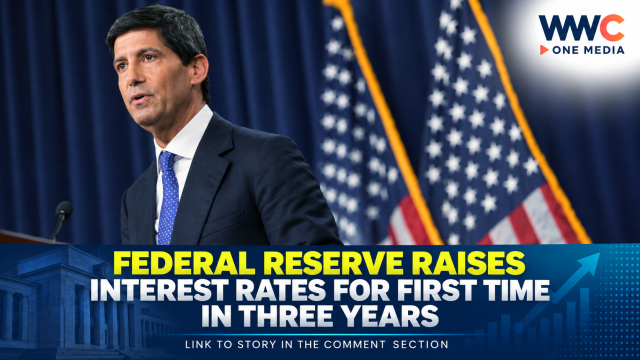
The Federal Open Market Committee unanimously raised its benchmark federal funds target range by 25 basis points to 3.75%-4.00% on Wednesday.
It was the first U.S. interest-rate increase in more than three years.
The Fed said economic activity was expanding at a “solid pace”, domestic spending remained resilient, productivity growth was strong and capital investment robust.
But one problem stood above the others:
inflation remains elevated.
The central bank said the increase was intended to support a quicker return to its long-term 2% inflation target.
Chair Kevin Warsh went further during his post-meeting remarks, saying the Fed had removed some monetary accommodation and intended to demonstrate that it was serious about restoring price stability.
That message was considerably more hawkish than investors had become accustomed to during the previous easing cycle.
Another hike is no longer a remote possibility
The September hike may not be the end.
The Federal Reserve’s updated projections show that 16 of the 18 policymakers submitting 2026 interest-rate projections expect rates to finish the year above today’s midpoint, implying at least one more increase for most officials.
Markets quickly adjusted.
CNA reported that traders were putting roughly 50-50 odds on another hike as soon as October.
Reuters separately reported that markets were assigning about a 90% probability of another Fed increase by the end of 2026.
Goldman Sachs has already moved further, forecasting another quarter-point increase at the Fed’s October meeting.
None of those market probabilities or bank forecasts guarantees what the Fed will do.
Upcoming inflation, employment and spending data could still change the path.
But investors are no longer debating whether the United States has entered a renewed tightening phase.
They are debating how far it goes.
So why did stocks rise?
There are at least three reasons.
The first is simple: Wednesday’s quarter-point increase was widely anticipated.
Markets often react more strongly to surprises than to the headline decision itself, and investors had already spent days adjusting portfolios for a Fed hike.
The second reason is credibility.
Long-term bond yields had surged before the meeting as investors became increasingly worried that inflation would remain high and that the Fed was falling behind the problem.
By acting, the central bank reassured at least part of the market that it was prepared to fight inflation rather than tolerate it.
CNA quoted Stephen Innes of Quintex Intel as saying the hike had removed the immediate question surrounding the central bank’s inflation-fighting credibility, while creating a new debate over how much additional tightening would be required.
That distinction is important.
Markets do not necessarily celebrate higher rates.
But they can prefer a credible central bank raising rates today over one that waits until inflation becomes so entrenched that far more painful hikes are required later.
The real relief came from long-term bonds
Perhaps the most revealing move happened outside the stock market.
Short-term Treasury yields rose after the Fed decision because those securities are closely linked to expectations for monetary policy.
But longer-term yields eased.
The benchmark 10-year U.S. Treasury yield moved back below 5%, after reaching 5.041% earlier in the week — its highest level since 2007.
That matters enormously for stocks.
Long-term Treasury yields influence financing conditions across the economy and are also used by investors when valuing future corporate profits.
When the 10-year yield rises sharply, expensive stocks — particularly technology and other growth companies — can come under pressure.
Its retreat suggested investors had reduced at least some of their long-term inflation concerns after the Fed acted.
CNA reported that long-dated government yields eased as markets pared back inflation expectations.
In other words:
The Fed made money more expensive today, but convinced some investors that it may not have to become dramatically more expensive forever.
The dollar told a very different story
Currency traders focused more heavily on the prospect of additional rate increases.
The U.S. dollar index rose to around 100.33, its highest level since July 31 — a seven-week high.
The yen traded around 156 per dollar, near a two-week low, while the euro fell toward US$1.1456.
The reason is straightforward.
Higher U.S. rates can make dollar-denominated assets more attractive relative to currencies where rates are lower.
That can draw capital toward the United States and increase demand for dollars.
For emerging markets, however, a stronger dollar can create problems.
Countries and companies with dollar-denominated debt may face higher repayment costs, while imported commodities priced in dollars can become more expensive in local-currency terms.
The Indian rupee, for example, came under renewed pressure following the Fed’s decision, with traders watching whether it would weaken through the 96-per-dollar level.
Wall Street did not celebrate the hike
It is also important not to mistake Thursday’s Asian gains for an immediate global vote of confidence.
U.S. stocks actually fell after Wednesday’s Fed announcement.
The Dow Jones Industrial Average dropped 1.2% to 51,461.90, while the S&P 500 lost 0.4% to 7,551.81.
The Nasdaq Composite slipped by less than 0.1% to 25,978.42, while the Russell 2000 fell around 0.4%.
The sell-off showed that investors understood the downside of the Fed’s message.
Higher interest rates mean more expensive financing for companies and consumers.
They can slow economic activity and reduce the relative attractiveness of equities compared with bonds.
Asian markets were effectively getting a second chance to digest the decision after the initial U.S. reaction.
And by then, another major market variable had improved.
Oil suddenly gave investors some relief
Crude oil has been one of the biggest sources of inflation anxiety.
Middle East tensions and damage to Saudi energy infrastructure had recently pushed prices higher, intensifying fears that fuel costs would spread through transportation, manufacturing and consumer prices.
But oil fell sharply after signs that Saudi Arabia could restore some disrupted supply.
Brent crude dropped by more than US$1 on Thursday to around US$104.59 a barrel, while U.S. West Texas Intermediate fell to roughly US$101.29, extending losses of about US$3 during the previous session.
Saudi Arabia has been offering additional crude shipments to Asian refiners through Oman after disruption to its East-West pipeline and Yanbu export operations.
The East-West pipeline became especially important after Middle East conflict disrupted normal regional shipping routes.
Reuters reported that the roughly 1,200-kilometre pipeline can transport around 4 million to 5 million barrels of oil per day across Saudi Arabia.
Its partial restoration would therefore help reduce fears of a prolonged supply shock.
That matters directly to the Fed.
Lower oil prices can reduce pressure on headline inflation and limit the second-round effect of higher fuel and transportation costs.
So Thursday’s stock rally was being supported not only by confidence in the Fed, but by hope that one major source of inflation could begin easing.
Inflation is still the problem
That optimism should not obscure why the Fed raised rates.
U.S. consumer prices were 3.4% higher in August from a year earlier, well above the Fed’s 2% target.
Inflation has remained above target for years, and recent energy-price pressures have complicated the central bank’s attempt to bring it down sustainably.
Warsh has also pointed to strong economic activity.
At Jackson Hole in August, he highlighted rapidly rising business investment, including heavy spending connected with artificial intelligence, and noted strong corporate profits.
That resilience gives the Fed more room to tighten.
If unemployment were surging and economic activity collapsing, rate increases would be more difficult to justify.
Instead, the Fed’s latest statement described job creation as keeping pace with workforce growth and unemployment as little changed.
The central bank is therefore signalling that it believes the economy can absorb tighter policy — at least for now.
Trump wanted the opposite
The decision also puts the Fed on a different policy path from President Donald Trump, who has repeatedly called for substantially lower borrowing costs.
After Wednesday’s hike, Trump criticised the move and accused the Fed of acting for political reasons. AP reported that he has argued rates should be much lower, while continuing to criticise monetary tightening.
The Fed says its decisions are based on its congressional mandate to pursue maximum employment and stable prices.
Warsh, who was appointed Fed chair by Trump, joined the unanimous vote for the quarter-point increase.
The disagreement creates another layer of uncertainty for markets, particularly with U.S. midterm elections approaching.
But investors’ immediate focus remains inflation and the probability of further increases rather than the political dispute itself.
Asia’s rally was far from universal
While most major regional markets rose, China and Hong Kong were notable exceptions.
Reuters reported Hong Kong shares down about 0.9%, while China’s CSI 300 fell roughly 0.4% during earlier trading.
Hong Kong has an additional exposure because its currency is pegged to the U.S. dollar.
The Hong Kong Monetary Authority responded to the Fed by raising its own Base Rate by 25 basis points to 4.25%, importing part of Washington’s tighter monetary stance into the city.
That does not mean every Hong Kong mortgage immediately rises by 25 basis points, because commercial banks separately set their lending rates.
But it illustrates how Fed policy reaches far beyond U.S. borders.
Singapore stocks, meanwhile, joined most Asian markets in rising during the morning session, according to CNA’s AFP market roundup.
Japan could tighten next
Attention is now shifting from Washington to Tokyo.
The Bank of Japan is expected to raise its policy rate to 1.25% on Friday, which would be its highest level in about 31 years, according to Reuters.
Japan’s situation is unusual.
For decades, the country’s problem was insufficient inflation and extremely low interest rates.
Now the BOJ is confronting higher price pressure, expensive energy and a weak yen.
If it raises rates as expected, the Fed and BOJ will effectively be tightening at almost the same time — a significant shift for global markets accustomed to Japan providing exceptionally cheap liquidity.
The yen’s response will be closely watched.
A stronger Japanese currency could ease the country’s imported inflation, while further weakness might increase pressure on the BOJ to signal more tightening ahead.
The Bank of England faces its own inflation dilemma
Britain is also in focus.
The Bank of England is expected to leave its benchmark rate at 3.75%, even as higher energy prices threaten to push inflation further above its 2% target.
UK inflation stood at 3.1% in August, and analysts have warned that energy pressures could push the rate higher during the coming months.
That means the world’s major central banks are increasingly confronting the same dilemma:
Do they keep rates high — or raise them further — and risk hurting growth?
Or do they tolerate inflation for longer and risk allowing price expectations to become entrenched?
The Fed has just shown which risk it considers more urgent.
Borrowers will feel the consequences
For ordinary households, the market reaction can seem detached from everyday life.
But Fed hikes eventually reach consumers.
Credit-card rates and many variable-rate loans tend to respond relatively quickly to changes in U.S. short-term rates.
Mortgage rates are influenced more heavily by longer-term Treasury yields and do not move directly with each Fed decision, but the average U.S. 30-year fixed mortgage rate was already around 6.76% ahead of the latest move.
Savers may benefit if banks raise deposit rates.
Borrowers, however, face the prospect of higher financing costs at a time when many households are already dealing with elevated prices.
That is the basic mechanism the Fed is using to fight inflation:
Make borrowing more expensive, reduce demand and eventually slow price increases.
The challenge is doing that without causing an unnecessary recession.
Stocks may have lost one of their favorite catalysts
There is another reason Thursday’s rally should be interpreted cautiously.
For years, expectations of lower interest rates have helped support equity valuations.
Tai Hui of J.P. Morgan Asset Management told AFP that while he viewed the chances of U.S. rates returning above 5% as limited, lower interest rates no longer look like a likely catalyst for extending the stock-market bull run in the foreseeable future.
That may be the bigger message.
Markets can tolerate rate hikes if corporate earnings remain strong and inflation appears increasingly controllable.
But they can no longer rely on falling borrowing costs to automatically push valuations higher.
Future stock gains may need to come increasingly from actual profit growth.
That puts particular pressure on expensive sectors such as technology and artificial intelligence, where investors have already priced in enormous expectations for future earnings.
The next inflation report may matter more than Thursday’s rally
For now, markets have found an uneasy equilibrium.
Stocks across much of Asia are higher.
Oil has retreated.
Long-term Treasury yields have eased.
The dollar is stronger.
And short-term bond markets are signalling that the Fed probably has more work to do.
That combination is unusual, but it tells a coherent story.
Investors appear willing to tolerate higher interest rates if they believe those rates will restore price stability before inflation gets out of control.
That confidence could disappear quickly.
If upcoming inflation data remain stubbornly high, markets may price in a faster or larger tightening cycle.
If oil surges again because of renewed Middle East supply disruption, the Fed’s task becomes harder.
And if the 10-year Treasury yield decisively climbs above 5%, the pressure on stocks, housing and corporate borrowing could intensify.
So Thursday’s rally is not evidence that investors suddenly like higher interest rates.
It is evidence that, for one morning at least, they preferred a Fed willing to fight inflation to a Fed that looked unwilling to act.
And that leaves markets with a much bigger cliffhanger:
If one hike was enough to restore some confidence, what happens when the Fed delivers the next one?


Leave a Reply