
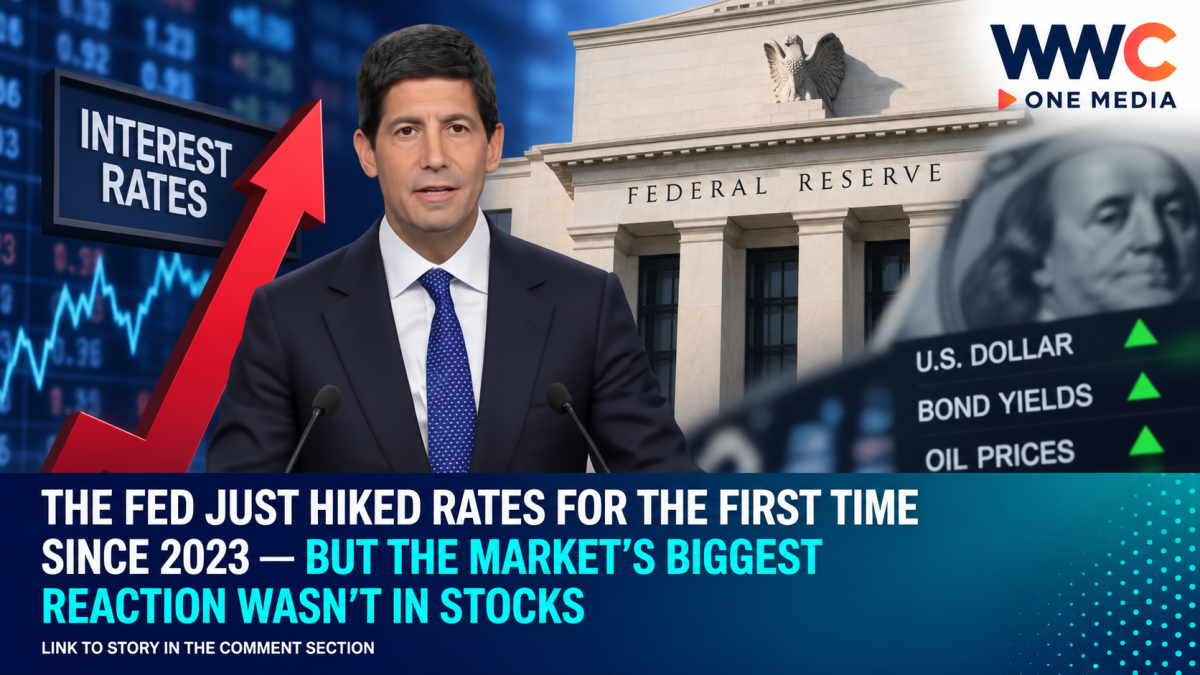
SYDNEY — Global markets delivered an unusual verdict after the U.S. Federal Reserve raised interest rates for the first time in more than three years: stocks barely flinched, the dollar surged, short-term Treasury yields jumped — and the long end of the bond market actually calmed down.
Asian shares edged higher on Thursday, September 17, after the Fed lifted its benchmark rate by 25 basis points to a 3.75%–4.00% target range, while signalling that policymakers expect further tightening as they try to push stubborn inflation back toward 2%.
The move was unanimously approved by the Federal Open Market Committee and marked the first U.S. rate increase since July 2023. The Fed said economic activity was expanding at a solid pace, domestic spending remained resilient and inflation was still elevated.
But the market reaction showed investors were trading something bigger than a single quarter-point increase.
They were trying to determine whether September represents a one-off correction — or the beginning of an entirely new rate-hiking cycle.
And by Thursday morning, markets were increasingly betting on the second possibility.
The dollar jumped to its highest level in seven weeks
One of the clearest reactions came from the currency market.
The U.S. dollar index climbed to around 100.33, reaching its highest level in seven weeks after gaining roughly 0.7% overnight.
Why?
Because higher interest rates generally make dollar-denominated assets more attractive to investors seeking yield.
The effect was particularly strong at the short end of the Treasury market.
The yield on the two-year U.S. Treasury, which is especially sensitive to expectations for Federal Reserve policy, rose to about 4.71%, after jumping roughly six basis points following the Fed announcement. That was its highest level since July 2024.
In simple terms, traders concluded that the Fed might not be finished.
The central bank’s latest projections reinforce that interpretation.
Sixteen of 18 Fed policymakers expect at least one additional quarter-point increase before the end of 2026, according to Reuters’ analysis of the new projections.
That would put the policy rate in a 4.00%–4.25% range by year-end.
Goldman Sachs thinks the next hike could come next month
Wall Street is already moving its forecasts.
Goldman Sachs said Thursday that it now expects another 25-basis-point rate increase at the Fed’s October meeting, rather than waiting until later in the year.
The bank argued that consecutive moves would fit the Fed’s stated goal of achieving a more timely return to its 2% inflation target.
Markets are not fully convinced the Fed will move that quickly.
Futures pricing implied roughly a 50% probability of another hike as soon as October, according to Reuters, while at least one further increase by December was fully priced into markets Thursday morning.
Reuters reported that traders were pricing roughly three additional hikes across the broader tightening cycle.
Those expectations can change rapidly with inflation, employment and economic data, but they represent a dramatic change from the rate-cut hopes that dominated markets in earlier periods.
So why did stocks actually rise?
Normally, higher rates are bad news for equities.
They increase corporate borrowing costs, make bonds more competitive with stocks and reduce the present value investors assign to companies’ future profits — particularly highly valued growth and technology stocks.
Yet Asian equities mostly moved higher Thursday.
MSCI’s broad index of Asia-Pacific shares excluding Japan gained around 0.4%, while Japan’s Nikkei 225 climbed 0.5%.
U.S. equity futures also rebounded. Nasdaq futures gained about 0.6%, while S&P 500 futures advanced roughly 0.5% after Wall Street had fallen modestly following the Fed announcement.
One explanation is that the rate increase was widely expected.
Another is more important: investors may be concluding that the Fed is finally moving forcefully enough to prevent the current inflation problem from becoming embedded.
That interpretation showed up most clearly in the Treasury market.
The strange part: the 10-year Treasury yield went down
Short-term yields jumped after the Fed announcement.
Long-term yields did not.
The benchmark 10-year Treasury yield hovered around 4.99% on Thursday, below the psychologically significant 5% level and down from the 5.041% peak reached on September 15, its highest level since 2007.
Thirty-year yields also eased by roughly two basis points to around 5.33%, moving away from a 19-year high of approximately 5.40%.
That produced what bond traders call a bear flattening of the yield curve: shorter-dated yields rose more sharply than longer ones.
It sounds technical, but the message is relatively straightforward.
Investors believe rates will be higher in the near term.
At the same time, some appear more confident that those higher rates could eventually contain inflation — reducing the inflation premium demanded on longer-term bonds.
That is why the Fed can raise rates while the 10-year yield falls.
The bond market had been flashing a much more dangerous warning
The relief matters because long-term borrowing costs had been rising at an alarming pace before the Fed meeting.
On September 15, the U.S. 10-year Treasury yield briefly reached 5.041%, the highest since 2007.
Across the Group of Seven economies, average 10-year government bond yields climbed to around 4.285%, their highest level since the global financial crisis era in 2008.
Japan’s 10-year government bond yield reached a three-decade high above 3%, while German yields traded near levels not seen since 2009 and British 10-year yields reached their highest since 2007.
This matters far beyond professional bond traders.
The U.S. Treasury market acts as a global pricing benchmark.
If the 10-year yield remains near or above 5%, financing becomes more expensive for governments, corporations, property developers and consumers.
Mortgage rates, corporate bonds and many other forms of borrowing are influenced by long-term Treasury yields.
AP reported that the average U.S. 30-year fixed mortgage rate was already approaching 6.8% around the Fed decision.
So although Thursday’s movement offered some relief, long-term borrowing costs remain historically high compared with much of the post-financial-crisis period.
Inflation forced the Fed’s hand
The central bank’s change in direction has been driven by inflation that has proven more persistent than policymakers wanted.
U.S. consumer prices were 3.4% higher in August than a year earlier, still well above the Fed’s 2% goal.
Energy prices have been an important contributor amid conflict in the Middle East, but Fed Chair Kevin Warsh indicated that policymakers are increasingly concerned that inflation pressure is broader than a temporary oil shock.
The Fed notably removed language from its latest policy statement that had previously emphasised supply shocks as an explanation for elevated inflation.
Warsh also pointed to strong domestic spending, productivity growth, capital investment and a resilient labour market as evidence that the U.S. economy could tolerate tighter policy.
That is important.
Central banks are generally more willing to raise rates when economic growth and employment remain strong enough to absorb the impact.
The Fed is effectively betting that the greater risk now comes from allowing inflation to remain elevated for too long.
Wall Street initially disliked the message
American stocks ended Wednesday lower after the rate decision.
The S&P 500 fell 0.4% to 7,551.81, while the Dow Jones Industrial Average dropped 1.2%, or 631 points, to 51,461.90.
The Nasdaq Composite finished almost flat at 25,978.42, while the Russell 2000 fell about 0.4%.
The weakness reflected concern that higher borrowing costs may persist longer than investors previously assumed.
But by Asian trading Thursday, U.S. futures were already rebounding.
That suggests investors may be differentiating between two scenarios.
A Fed forced to chase runaway inflation would be dangerous.
A Fed acting early enough to contain inflation could ultimately be less damaging.
Thursday’s bond-market response suggests at least some investors are leaning toward the second interpretation.
Hong Kong and China moved the other way
The Asian rally was not universal.
Hong Kong’s Hang Seng Index fell around 0.9%, while China’s CSI 300 declined roughly 0.4% in early trading.
Hong Kong has an additional complication because its currency is pegged to the U.S. dollar.
The Hong Kong Monetary Authority raised its Base Rate by 25 basis points to 4.25% on Thursday following the Fed’s move, transmitting some of Washington’s tighter monetary conditions into Hong Kong.
That does not automatically mean Hong Kong retail mortgage rates rise by the same amount, because individual banks determine their own prime and mortgage rates.
But it underscores how a Fed decision can spread through financial systems well beyond the United States.
Japan could be next
The Fed is not the only major central bank investors are watching.
The Bank of Japan is widely expected to raise its policy rate by 25 basis points to 1.25% on Friday, which would take Japanese rates to their highest level in more than three decades.
Japan has spent much of the past generation dealing with the opposite problem: weak inflation and ultra-low interest rates.
The prospect of Japan now joining the global tightening trend illustrates how dramatically the inflation environment has changed.
Higher Japanese yields could also have global implications.
Japanese investors hold enormous amounts of overseas assets, including U.S. Treasuries. As returns at home become more attractive, changes in Japanese capital flows can influence bond and currency markets internationally.
The Bank of England faces a different decision
The Bank of England is expected to leave its policy rate unchanged at 3.75% on Thursday, despite Britain’s inflation rate rising to 3.1% in August.
However, higher energy prices have increased speculation that the BoE could eventually be forced to tighten again.
Reuters reported that markets have been pricing substantial additional British rate increases over the next year, although economists remain divided over whether energy-driven inflation will prove persistent enough to justify them.
That leaves global markets confronting an unusual possibility:
The Fed, European Central Bank and Bank of Japan could all be tightening policy within a relatively short period after years in which investors expected inflation to steadily retreat.
Oil gave markets some badly needed relief
Energy markets moved in the opposite direction Thursday.
Brent crude fell about 0.7% to US$105.05 a barrel, extending a 2.7% overnight decline.
Reuters reported that Saudi Arabia was offering additional crude cargoes through Oman, easing some concerns about Middle Eastern supply disruptions.
That decline matters enormously for the interest-rate outlook.
Oil above US$100 feeds into petrol, diesel, transportation, airline, manufacturing and shipping costs.
If crude continues falling, central banks may gain some breathing room.
If oil surges again, inflation could prove much harder to contain and expectations for further rate hikes could return quickly.
That makes energy markets almost as important to investors right now as Fed speeches.
Gold rose even as the dollar strengthened
Gold offered another unusual market signal.
Spot gold climbed roughly 1% to US$4,305 an ounce on Thursday, recovering from a 0.7% decline overnight.
Normally, a stronger dollar and rising short-term U.S. yields can weigh on gold because bullion pays no interest.
Its resilience therefore suggests investors still want protection from geopolitical risk, inflation uncertainty and volatility in government bond markets.
That combination — higher rates, a stronger dollar and expensive gold — illustrates just how unusual the current macroeconomic environment has become.
The bigger question is no longer whether the Fed would hike
For weeks, markets debated whether the Federal Reserve would finally reverse course and raise rates.
That question has been answered.
The new debate is about how far it goes from here.
The Fed itself is signalling at least one more increase in 2026. Goldman Sachs thinks it could come in October. Futures traders see a meaningful probability of consecutive hikes, while the broader market has priced several moves across the cycle.
Every upcoming inflation, employment and spending report will now be judged through that lens.
Strong economic data may no longer automatically be good news for stocks because stronger activity could justify more rate increases.
Weak data may reduce rate pressure — but could raise recession concerns.
That puts markets into a difficult phase where both growth and inflation must cool by just the right amount.
Why the 10-year yield may be the number that matters most
The dollar’s seven-week high will attract headlines.
So will the Fed’s 3.75%–4.00% policy rate.
But the number investors may need to watch most closely is still the 10-year Treasury yield.
Its move above 5% earlier this week helped trigger the global bond selloff and put pressure on equities.
Thursday’s retreat to just under 5% suggested that the Fed’s hike temporarily restored some confidence that inflation could be contained.
But ING’s Padhraic Garvey told Reuters that the relief may not last, saying his team sees 5.25% as a possible next target for the U.S. 10-year yield. That is an analyst forecast, not a certainty.
If long-term yields resume their climb, stock valuations, mortgages, business financing and government debt costs could all come under renewed pressure.
If they continue falling while the Fed raises short-term rates, investors may interpret that as evidence the central bank is regaining inflation credibility.
That is why Thursday’s market reaction is more complicated than saying “Fed hikes, stocks rise.”
The Fed increased borrowing costs.
The dollar surged.
Short-term Treasury yields jumped.
Yet the part of the market that had frightened investors most — long-term government bonds — finally stopped selling off.
For the moment, Wall Street appears willing to tolerate higher rates if those higher rates convince investors that inflation will eventually come down.
The cliffhanger is what happens if inflation doesn’t cooperate.



Leave a Reply