
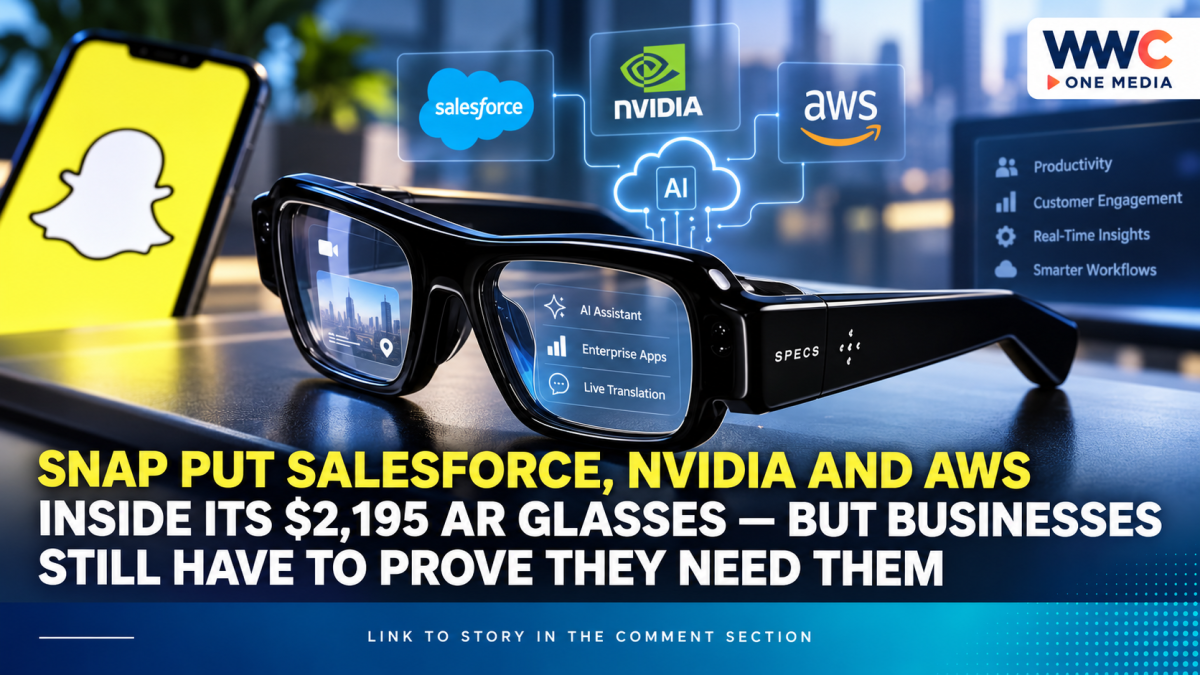
LOS ANGELES — Snap is making an aggressive move to turn its futuristic augmented-reality glasses into something businesses might actually pay for.
The Snapchat parent has announced partnerships with Salesforce, Nvidia, Amazon Web Services, Trifork and Hololight, putting enterprise AI, company data, remote assistance and spatial computing tools inside its new $2,195 Specs augmented-reality glasses.
The strategy could give Snap a second route into a market where convincing ordinary consumers to spend more than $2,000 on face-worn computing remains a formidable challenge.
Instead of pitching Specs only as a device for entertainment, navigation and social experiences, Snap now wants factory technicians, retail employees and field-service workers to use the glasses as a hands-free computer — pulling information directly into their field of view while they work.
That could be crucial for Snap.
Specs are not simply another gadget launch. They represent one of the company’s biggest long-term bets, arriving after years of investment in augmented reality and amid pressure to prove that AR can eventually become a meaningful business rather than an expensive experiment.
Salesforce wants workers to access company systems without reaching for a screen
One of the clearest examples comes from Salesforce.
Snap says Salesforce is bringing its Agentforce AI-agent platform to Specs, allowing workers to identify what they are looking at, create a service case, retrieve relevant information and update workflows without constantly switching to a laptop, tablet or phone.
Imagine a technician looking at malfunctioning equipment.
Instead of stopping the job to search a database, the employee could potentially ask the glasses for information, view instructions in front of them and update a service record while keeping both hands available.
For retailers, a similar system could allow employees to pull up customer or product information while remaining on the shop floor.
Salesforce separately unveiled AIforce at Dreamforce this week, describing it as a layer designed to bring Salesforce data, permissions, workflows and business logic into different AI interfaces. That broader strategy fits closely with Snap’s attempt to make Specs another interface through which enterprise software can operate.
Nvidia wants the glasses to understand what a worker is seeing
Nvidia’s contribution goes deeper into the AI infrastructure.
Snap says it is working with Nvidia to bring agents built on the Nvidia XR AI stack to Specs.
The goal is to let the glasses understand a worker’s surroundings, connect that visual context with company information and provide relevant guidance in real time.
That could have practical uses in maintenance, manufacturing and technical support.
A worker looking at a machine, for example, could potentially receive information about components, procedures or troubleshooting steps without needing to manually describe everything they see.
This is where Snap’s pitch starts looking less like traditional smart glasses and more like an attempt to create an AI-powered computer worn on the face.
AWS could turn Specs into an inventory assistant
Amazon Web Services is adding another workplace layer.
Snap says it is working to connect Specs with Amazon Quick, AWS’s AI assistant for work.
In a retail environment, an employee could theoretically ask where a certain product is located, how many units are left in inventory or retrieve other workplace information, with answers appearing directly in the glasses.
The underlying idea is simple: reduce the need for employees to walk back to a terminal, unlock a phone or search through several applications to retrieve information.
Whether companies see enough productivity gains to justify deploying expensive AR glasses at scale is the much harder question.
Snap is also targeting technicians and remote support
Two smaller partners make the industrial ambitions even clearer.
Trifork’s Tandem platform is designed to connect technicians in the field with remote experts and AI agents. A remote expert can see what the technician sees and place visual annotations into the worker’s field of view to help guide repairs or identify components.
Meanwhile, Hololight is working to make Specs a spatial workstation capable of streaming business tools, documents and 3D models into the glasses.
These are precisely the kinds of settings where augmented reality has long been considered potentially useful: manufacturing, maintenance, engineering, logistics and training.
The challenge has historically been making the hardware light enough, powerful enough, reliable enough — and cheap enough — for workers to use for extended periods.
The $2,195 price is difficult to ignore
Specs cost $2,195, with preorders already open and a $200 refundable deposit.
Snap expects shipments to begin later this fall in the United States, United Kingdom and France.
That price immediately puts the product outside the impulse-purchase range for most consumers.
It is also substantially more expensive than many of Meta’s smart-glasses products, although Specs offer a more ambitious augmented-reality display rather than primarily camera, audio and AI functions.
When Snap unveiled the glasses in June, Reuters reported that Meta’s competing smart-glasses products ranged roughly from $379 to $799, while Apple’s Vision Pro headset started at approximately $3,499.
That leaves Snap occupying an unusual middle ground.
Its glasses are vastly more expensive than mainstream smart eyewear, but cheaper and significantly more portable than Apple’s headset.
Enterprise buyers could therefore be particularly important because businesses may be more willing than consumers to pay thousands of dollars for a device if they can demonstrate measurable productivity gains.
Snap’s AR bet already carries billions of dollars of baggage
The enterprise push also comes with significant financial pressure.
Activist investor Irenic Capital Management previously urged Snap to consider spinning off or shutting down the Specs operation, arguing that the company had already invested more than $3.5 billion in the project.
Snap CEO Evan Spiegel has pushed back against calls to abandon the effort.
He told Reuters in June that Specs form part of Snap’s long-term strategy and said management’s job is to pursue the company’s long-term profitability and success rather than focus solely on short-term investor demands.
Snap has already reorganised the operation into Specs Inc., a wholly owned subsidiary focused on the glasses, AR technology and the company’s new artificial-intelligence service.
That structure could give Snap more flexibility as it seeks partners and potentially outside capital for the project.
Snap’s main business is improving — but it is still losing money
Snap enters this AR expansion from a somewhat stronger financial position than it had a year ago.
For the second quarter of 2026, revenue rose 19% year over year to $1.599 billion, while daily active users increased 5% to 493 million.
The company reported a $164 million net loss, although that improved from a $262.6 million loss a year earlier. Adjusted EBITDA climbed to about $250 million, while free cash flow reached roughly $121 million.
Advertising remains Snap’s biggest business.
Second-quarter advertising revenue reached about $1.28 billion, while other revenue — including subscription-related businesses — increased sharply to $316 million.
Reuters reported that stronger advertising demand surrounding the FIFA World Cup helped Snap beat revenue expectations in the quarter.
Those improvements give Snap more room to keep funding longer-term projects.
But Specs still have to prove that years of spending can ultimately create an economically significant business.
Specs Intelligence could be just as important as the glasses
Alongside its enterprise partnerships, Snap also unveiled Specs Intelligence, an AI service designed to work across Specs, iPhones and Macs.
Unlike an assistant that waits for the user to ask a question, Snap describes Specs Intelligence as an “anticipatory” service.
It is designed to understand a user’s goals, priorities, relationships and routines from apps and services that the person chooses to connect, then surface information when it believes that information will be useful.
A preview became available on iOS in the United States on September 16, while Snap has opened a waitlist for invitation-only early access on Mac.
The Verge reported that the service can connect with services including Gmail and Slack and is intended to help with tasks such as preparing for meetings, planning travel and managing reminders.
That makes Specs more than a display device.
Snap is effectively betting on a future where AI understands not only what a person asks, but also what the person is seeing and doing in the physical world.
Privacy will be another test
Putting cameras and AI into eyewear inevitably raises privacy questions.
Snap says Specs do not use facial recognition to identify people and do not continuously save audio, video or photographs.
The company also says a prominent external LED activates when the wearer intentionally captures a photo, video or audio, alerting people nearby that recording is taking place.
Those safeguards may become particularly important if the glasses move into workplaces, where companies must consider employee privacy, confidential data and security requirements.
Snap says it is working with device-management providers on security controls and enterprise-management systems that could allow businesses to deploy and administer fleets of Specs.
The charging case is becoming a mobile network connection
Snap is also trying to reduce the glasses’ dependence on Wi-Fi.
A new Specs Charging Case with Cellular will provide four additional charges and cellular connectivity.
In the United States, Snap is working with Verizon, while Orange will support connectivity in France and BT Group’s EE will participate in the UK.
The Specs Connected Case bundle will cost $2,395 in the U.S., according to Snap.
Verizon customers will be offered connected-device plans starting at $10 per month, while plans for non-Verizon customers will start at $20 monthly.
That connectivity could matter more for enterprise applications than consumer entertainment.
Field technicians and other mobile workers may need access to cloud systems in locations where reliable workplace Wi-Fi is unavailable.
Snap is fighting Meta — but the bigger opponent may be consumer indifference
Snap’s AR ambitions unfold in a market packed with some of the world’s richest technology companies.
Meta has become the most prominent player in smart eyewear through its Ray-Ban products and continues investing heavily in augmented reality.
Apple entered spatial computing with Vision Pro but has faced difficulties turning its expensive headset into a mass-market product — an example of how technically impressive hardware does not automatically create widespread demand.
Other companies are also chasing similar opportunities as AI makes wearable computers more capable.
The industry’s biggest unanswered question is therefore not whether smart glasses can perform impressive demonstrations.
It is whether enough people — or businesses — will use them every day.
Why enterprise customers may be Snap’s smartest route
Snap’s latest partnerships show that the company understands this problem.
A consumer deciding whether to spend $2,195 on glasses may compare them with a smartphone, laptop, television, gaming console or holiday.
A business can make a different calculation.
If a pair of Specs allows a highly paid technician to finish repairs faster, reduces training costs, prevents mistakes or lets one remote expert support several workers simultaneously, the economics could look considerably better.
That does not mean enterprise success is guaranteed.
Companies typically require long testing cycles, security reviews, device-management systems, integrations and evidence of return on investment before buying new hardware at scale.
And Snap has not disclosed the financial terms of its new partnerships with Salesforce, Nvidia, AWS, Trifork or Hololight.
For now, these are partnerships and integrations — not evidence of mass enterprise adoption.
That distinction matters.
The real test starts when Specs leave the demo stage
Consumers will get another chance to judge the product beginning October 1, when Snap opens a Specs demonstration location at Westfield Century City in Los Angeles.
The glasses are expected to begin shipping later this fall.
By then, the debate around Snap’s AR strategy may shift from what Specs can do to something more important:
Who will actually buy them?
Snap now has Salesforce supplying enterprise AI, Nvidia helping the glasses understand the physical world, AWS connecting workplace information, telecom carriers providing mobile connectivity and a new AI service designed to anticipate what users need.
That is a considerably stronger ecosystem than Snap had when it first showed the $2,195 device in June.
But partnerships alone will not solve the biggest problem facing augmented reality.
After billions of dollars in investment, Snap still needs to demonstrate that putting a computer in front of someone’s eyes solves enough real-world problems to justify the price.
And if consumers are not ready to make that leap, the factory floor may be where Snap discovers whether Specs can finally become a business.




Leave a Reply