
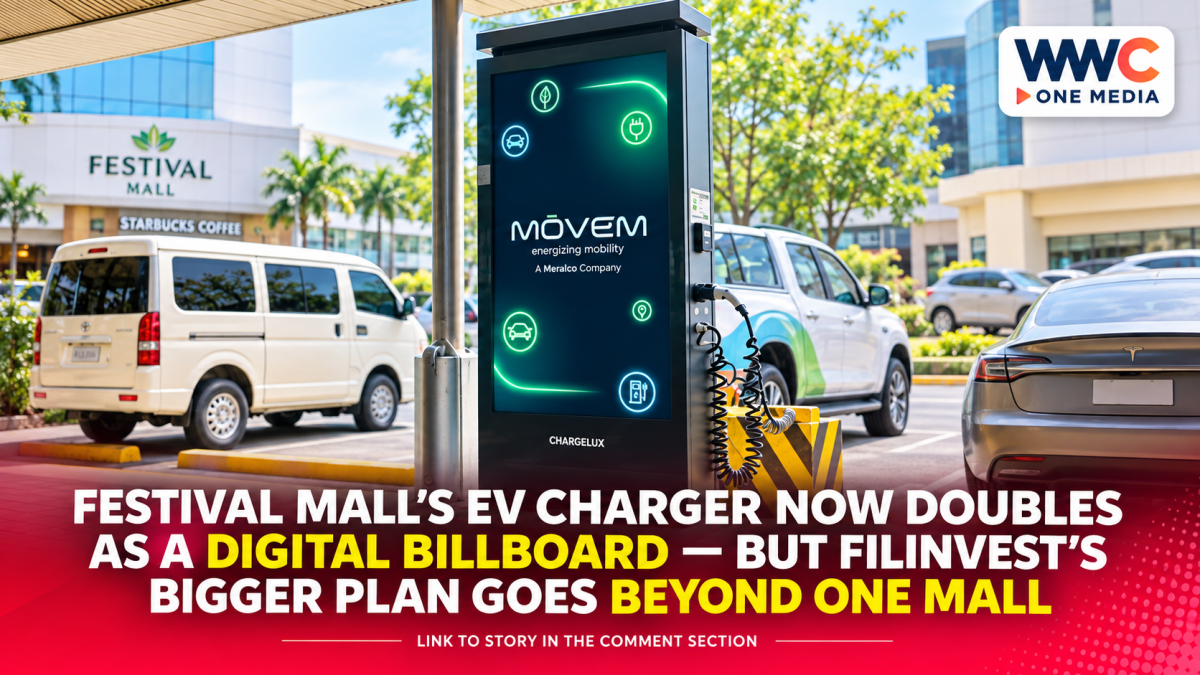
MUNTINLUPA CITY, Philippines — Filinvest Malls and Meralco-backed Movem Electric are combining two businesses that normally occupy different corners of a parking lot: charging electric cars and selling advertising.
At Festival Mall in Alabang, an electric-vehicle charging facility at the Alabang-Zapote parking area is being positioned not simply as another plug for EV drivers but as a digital advertising platform where brands can reach motorists and shoppers while vehicles are charging.
The project is part of a broader partnership between Filinvest Malls and Movem Electric Inc., the wholly owned electric-mobility subsidiary of Manila Electric Co., or Meralco.
And Festival Mall is only the starting point.
Movem says it intends to support Filinvest’s EV requirements across the group’s commercial, residential and office developments, potentially turning charging stations into another piece of infrastructure embedded across Filinvest properties.
But there is one important detail behind the word “launch.”
The charger itself is not brand new.
Filinvest says the charger was installed in October 2025
Filinvest Land’s own 2025 annual report says the Festival Mall EV charging station was installed in October 2025 in partnership with Movem.
The annual report identifies it as a 22-kilowatt AC charger with dual charging ports, allowing two vehicles to charge simultaneously, and says the facility is available to mall tenants and visitors.
That means the latest September 2026 announcement is more accurately viewed as an expanded commercial rollout and partnership push—particularly around the digital-advertising capability—rather than the first installation of an EV charger at Festival Mall.
Power Philippines similarly noted that the new media announcement did not specify the charger capacity, but Filinvest’s earlier annual report establishes the installed Festival Mall unit as a 22-kW dual-port AC charger.
That distinction may sound technical.
For EV owners, it matters.
A 22-kW AC charger serves a different use case from a high-powered highway fast charger.
It makes particular sense at a mall because motorists may leave their vehicles parked for an extended period while shopping, eating, watching a movie or handling other errands.
The charger is also becoming media inventory
What makes the latest iteration more commercially interesting is the advertising component.
Movem’s ad-display charging platform combines EV charging equipment with a large digital display capable of showing commercial content.
Movem’s own product material lists 22-kW AC and 60-kW DC variants and describes its ad-display equipment as featuring a 75-inch touchscreen, an impression-counting sensor and demographic-measurement capability.
The company has not publicly confirmed that every one of those specifications applies to the particular Festival Mall installation, so they should not automatically be attributed to that unit.
But the business model is clear.
A conventional charging station earns money primarily from electricity and charging-service fees.
A digital-ad charger potentially creates a second revenue stream—or at least a second source of commercial value—by transforming the charger itself into advertising real estate.
That is especially relevant in malls, where drivers typically remain on-site far longer than customers at highway fuel stations.
The vehicle charges.
The driver shops.
And the screen continues showing advertisements.
But Filinvest and Movem haven’t disclosed what the ads are worth
There is still an important unanswered business question.
Neither company has publicly disclosed:
advertising rates, expected advertising revenue, revenue-sharing arrangements between Movem and Filinvest, charger utilization rates, or how much charging revenue the Festival Mall unit currently generates.
So it would be premature to describe digital advertising as a major new profit center for Festival Mall.
At this stage, it is better characterized as an additional commercial layer attached to infrastructure the mall already wants for another reason: keeping its properties relevant as more motorists switch to electrified vehicles.
Movem itself markets its ad-display charging solution to property owners as a way of increasing property value while adding EV infrastructure.
The economics of the specific Filinvest agreement, however, have not been disclosed.
ChargeM puts the charging session on a phone
The Festival Mall facility is supported by ChargeM, Movem’s mobile platform.
The app lets motorists locate and access compatible Movem chargers and manage their charging sessions digitally.
Movem President Ralph Menchavez said placing charging infrastructure in destinations such as Festival Mall makes EV use more practical because drivers can charge where they already spend time.
That may prove crucial to EV infrastructure development.
One of the most persistent obstacles to electric-car adoption is not simply the number of chargers in a country but where those chargers are located.
A charger that requires a driver to make a dedicated stop has a different value proposition from one located at a workplace, condominium, mall or other destination the motorist was already planning to visit.
This is often referred to as destination charging.
And large property companies control many of the locations best suited to it.
Philippine charging infrastructure is growing quickly
Filinvest’s expansion comes as the Philippine charging network is getting substantially larger.
The Department of Energy reported 1,569 charging points nationwide as of March 31, 2026.
By September, DOE officials were reporting 1,876 registered charging points, according to GMA News.
That is an increase of more than 300 charging points, or roughly 20%, from the March figure.
The number of companies participating in the industry has also grown.
DOE listed 258 accredited EV charging-station providers in March. By July 31, the department’s official registry had grown to 402 accredited providers.
Those numbers suggest charging infrastructure is moving beyond an experimental phase.
Competition is expanding as utilities, property developers, automakers, charging specialists and other companies position themselves for a larger EV fleet.
More than 66,000 electrified vehicles were sold this year
Demand on the vehicle side has also accelerated.
DOE said this week that 66,685 electrified vehicles had been sold in the Philippines in 2026, representing 24.68% of the 270,124 vehicles counted in the department’s cited sales figures.
But that number requires an important qualification.
The government’s broad EV or electrified-vehicle figures include hybrid electric vehicles, along with plug-in hybrids and fully battery-electric vehicles.
Ordinary hybrids generate their own electricity while driving and do not need to plug into public charging stations.
So 66,685 should not be interpreted as 66,685 new vehicles competing for public chargers.
The more relevant categories for charging-network demand are full battery EVs and plug-in hybrids.
Independent industry figures nevertheless show strong growth in those categories.
From January through May, battery-electric vehicle sales among CAMPI and TMA members surged 193% year on year to 5,204 units, while plug-in hybrid sales jumped more than thirtyfold to 3,853.
In June alone, the industry groups reported another 3,193 battery EVs and 1,681 plug-in hybrids sold.
That is the customer base charging operators are preparing for.
High fuel prices have strengthened the argument for EVs
The timing is particularly relevant because Philippine motorists have been dealing with extremely volatile gasoline and diesel prices.
The DOE has increasingly presented electric transport as one way to reduce exposure to imported petroleum.
In March, it put nationwide average commercial charging rates at about ₱24.03 per kilowatt-hour for AC charging and ₱30.15/kWh for DC fast charging, although actual rates vary by operator and location.
Those figures cannot be converted into a universal peso-per-kilometer advantage without knowing a vehicle’s efficiency.
A large electric SUV and a small EV consume different amounts of electricity, just as conventional vehicles differ in fuel economy.
Still, electricity prices generally fluctuate differently from imported gasoline and diesel, giving EV owners a different operating-cost profile.
And with the Philippines heavily dependent on imported petroleum, government policy increasingly treats electrification as an energy-security strategy as well as an environmental one.
Government policy is pushing charging stations into more properties
The infrastructure rollout is also being supported by the Electric Vehicle Industry Development Act, or EVIDA, and the government’s Comprehensive Roadmap for the Electric Vehicle Industry.
DOE has been preparing policies intended to expand charging-station installation at key establishments while incorporating future EV charging demand into electricity-distribution planning.
In July, the government also launched the Electric Vehicle Incentive Strategy Program, implementing the manufacturing component of the national EV roadmap.
For large property developers, that direction creates a strong incentive to prepare early.
EV charging can become another amenity tenants and shoppers expect in the same way that reliable mobile connectivity, parking and digital payments eventually became standard features.
And unlike a stand-alone charging company, Filinvest already controls the destinations.
Festival Mall is becoming Filinvest’s sustainability laboratory
The EV charger is only one of several energy projects being deployed at Festival Mall.
Filinvest Land’s annual report says the mall operates a 2.8-megawatt rooftop solar installation, reducing some of its reliance on grid electricity.
Filinvest Development Corp. is also pursuing a more than ₱400-million cooling-system modernization at the property through Philippine DCS Development Corp., its joint venture with French energy company ENGIE.
The company says that upgrade is expected to reduce cooling-related energy consumption by roughly 36%.
Together, the projects reveal a broader strategy.
Solar panels reduce some electricity purchases.
Efficient cooling reduces demand.
EV chargers support lower-carbon transport.
And now digital advertising could add a commercial layer to the charging infrastructure itself.
That turns Festival Mall into something more than a retail site with an EV plug.
It is increasingly becoming a demonstration project for how Filinvest intends to combine property infrastructure with energy technology.
Filinvest wants to take the model across its portfolio
The bigger clue lies in what Movem says happens next.
The company says its partnership with Filinvest is intended to support EV infrastructure requirements across the group’s commercial, residential and office properties, not just Festival Mall.
No rollout schedule or target number of chargers has been publicly disclosed.
That is an important limitation.
It means Filinvest and Movem have announced the direction of the partnership, but not yet the scale.
Still, the logic is straightforward.
A residential development needs overnight charging.
An office building can provide workplace charging.
A mall offers destination charging.
Mixed-use estates combine all three.
For a property group with assets across those categories, charging stations can eventually become a network rather than isolated equipment.
The real business may be the time drivers spend waiting
There is another reason the digital-advertising feature deserves attention.
Charging an electric car takes longer than filling a gasoline tank.
That waiting time has traditionally been viewed as one of EV charging’s disadvantages.
At a shopping mall, it can become commercially useful.
A driver who parks for an hour has time to eat.
Shop.
Buy groceries.
Watch entertainment.
Or interact with advertising.
The charging station therefore has the potential to increase not only electricity consumption but customer dwell time and advertising inventory.
That could make malls unusually attractive locations for charging companies.
But whether the model works will depend on utilization.
A beautifully equipped charger that sits empty most of the day produces little charging revenue and limited advertising exposure.
The key metric eventually will not be how many charging stations a property company installs.
It will be how often people actually plug into them.
And that number has not been disclosed yet
Filinvest and Movem have not released Festival Mall’s charger usage data.
They have not disclosed the number of charging sessions.
They have not published average charging duration.
They have not revealed advertising revenue.
And they have not announced how many Filinvest properties will get chargers next.
Those are the figures that will eventually show whether this is primarily a sustainability amenity or a scalable new commercial platform.
For now, however, the direction of travel is clear.
Philippine EV sales are rising.
The public charging network has expanded to roughly 1,876 charging points.
The number of accredited charging providers has climbed above 400.
And one of the country’s major property groups is no longer treating the EV charger as just a socket in a parking space.
At Festival Mall, the charger can now sell electricity and advertising attention at the same time.
The bigger question is how many Filinvest parking spaces will eventually do the same.




Leave a Reply