
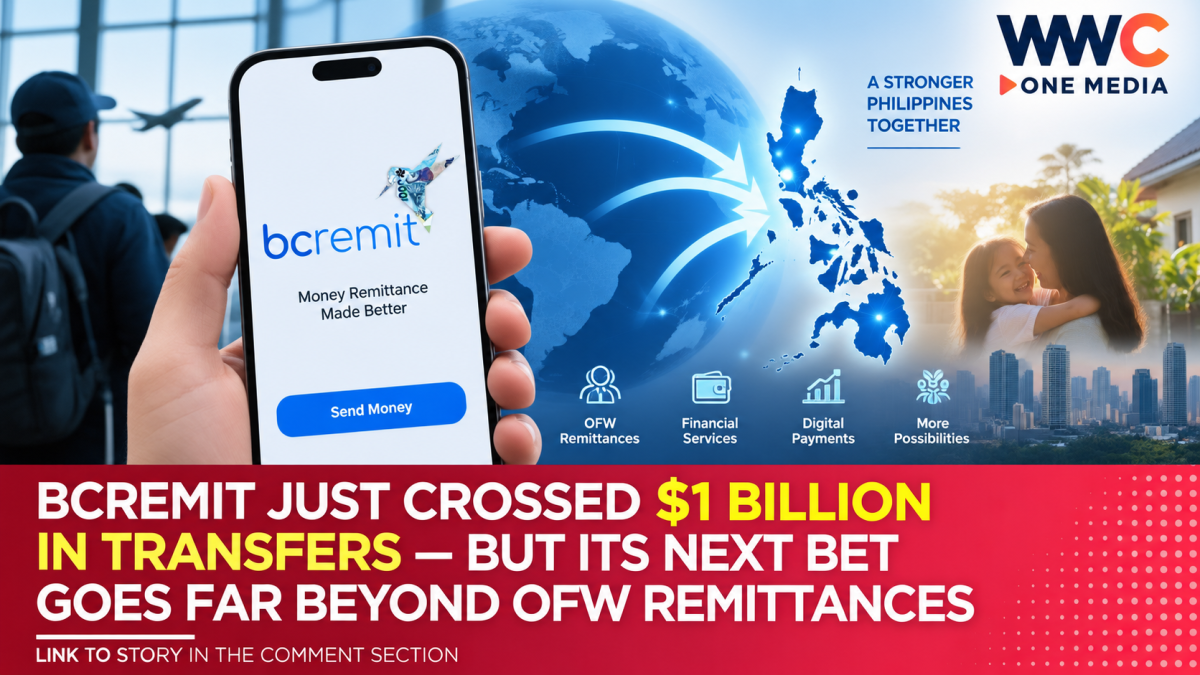
MANILA, Philippines — Filipino-founded remittance company BCRemit has crossed US$1 billion in cumulative cross-border transactions after a decade in business, but its next phase is no longer centered only on overseas Filipinos sending money home.
BCRemit says it has processed more than one million transactions since launching in 2016, expanding from an online remittance service initially focused on Filipinos in the United Kingdom into a payment platform with operations across 24 countries.
The company is now preparing to move deeper into business payments, white-label financial infrastructure and additional remittance corridors in the Middle East and Asia-Pacific.
Its priority expansion markets include Saudi Arabia, Australia, Japan and South Korea, according to the company.
That makes the $1-billion milestone less of an ending than a transition point.
For its first decade, BCRemit built much of its business around the familiar problem of helping Filipinos abroad move money home.
For the next one, it wants the same infrastructure to move money for companies, financial institutions and workers who may not be Filipino at all.
The $1-billion number needs context
The milestone sounds enormous—and for a homegrown financial-technology company, it is significant.
But it should be described precisely.
BCRemit has surpassed US$1 billion in total transactions processed cumulatively since its launch.
It did not process $1 billion in a single year, and the figure should not be confused with the Philippines’ overall annual remittance market.
The distinction becomes obvious when compared with Bangko Sentral ng Pilipinas data.
Cash remittances coursed through Philippine banks reached a record $35.63 billion in 2025, up 3.3% from $34.49 billion in 2024. Broader personal remittances reached $39.62 billion for the year.
From January through July 2026 alone, overseas Filipino cash remittances reached about $20.39 billion, compared with $19.93 billion in the same period a year earlier, according to the latest BSP data.
BCRemit’s $1 billion is therefore a company-scale cumulative milestone inside a Philippine remittance market that processes tens of billions of dollars every year.
The company started with an OFW problem
BCRemit traces its origins to founder and chief executive Oliver “Bong” Calma, a former overseas worker, and his son Jose Angelo “Gio” Calma.
The company says their experience with the cost and delays involved in sending money to the Philippines shaped the business they launched in 2016.
Its early proposition was relatively straightforward: allow migrant workers to transfer funds digitally rather than relying solely on physical remittance branches.
The service eventually expanded beyond direct bank deposits.
Customers can now send funds to Philippine bank accounts, cash-pickup outlets and supported electronic wallets such as GCash and Maya.
Through BCRemit Pay, customers can also directly settle certain Philippine obligations, including SSS and Pag-IBIG contributions, loan payments, property bills and mobile-phone loads.
That gives overseas workers another option besides sending money to a family member and asking that person to pay the bill.
From Britain to Europe, Canada and the US
BCRemit’s geographic expansion has occurred in stages.
After establishing itself in the UK-Philippines corridor, it expanded its European presence through BC Remittance S.L. in Spain in June 2021.
The company says its Spanish authorization provides a regulatory foundation for serving additional European Union markets.
Expansion into Canada followed in January 2022, while the United States followed in August of that year.
BCRemit now states that its services extend across 24 countries, up from the 23-country footprint cited in some earlier 2026 reports.
That changing figure is worth noting because it reflects an expanding network rather than a contradiction that all sources captured at the same moment.
Blockchain is working behind the scenes
One of the more unusual parts of BCRemit’s model is something most customers may never directly see.
The company has incorporated blockchain settlement technology and the dollar-linked stablecoin USDC into parts of its cross-border payments infrastructure.
BCRemit says customers themselves do not need to handle cryptocurrency to use the service.
Instead, the technology operates behind the scenes to help move and settle money across borders.
Circle, the company behind USDC, says the arrangement reduced BCRemit’s combined transfer fees and foreign-exchange margins to just over 1% and dramatically shortened settlement times compared with some traditional cross-border banking processes.
Those figures should be treated as BCRemit and Circle’s reported performance claims, rather than as an independent finding that every customer transaction always costs exactly 1% or settles instantly.
Actual consumer costs can depend on the sending country, exchange rate, payout method and transaction conditions.
That distinction is especially important in remittances because a low advertised fee does not necessarily mean the recipient receives the best overall value; foreign-exchange spreads can also affect the final payout.
Why lowering remittance costs matters
Even a small percentage difference can become significant when migrant workers send money repeatedly over many years.
The remittance industry has therefore faced continuing pressure to reduce fees, improve foreign-exchange transparency and speed up payments.
Digital providers argue that online onboarding, direct wallet transfers and newer settlement infrastructure can remove some costs associated with physical branches and multi-step correspondent banking.
BCRemit is betting that this cost advantage can travel beyond Filipino remittances.
Its partnership with RTGS.global, announced in March 2026, is intended to broaden its cross-border infrastructure and support payments for consumers as well as banks, payment providers and other financial institutions.
That marks a significant strategic change.
Instead of only competing for the person who wants to send £500 or $500 home, BCRemit increasingly wants other companies to use its payment network.
The next market is businesses
BCRemit says it is expanding its infrastructure to support small and medium-sized enterprises, BPO companies and freelancers.
It is also developing white-label payout integrations, effectively allowing other financial institutions to use BCRemit’s underlying infrastructure while presenting the service under their own platforms or brands.
That could materially alter the economics of the business.
Consumer remittances typically involve large numbers of relatively small transactions.
Business payments can involve different volumes, compliance requirements and transaction sizes.
Serving banks or other payment firms can push the company even further toward becoming infrastructure rather than simply a remittance app.
That is the larger strategic message behind its 10th-anniversary announcement.
BCRemit does not want to remain only the company an OFW sees on a phone screen. It increasingly wants to become part of the financial plumbing underneath other companies’ payments.
Saudi Arabia could be particularly important
Among BCRemit’s planned markets, Saudi Arabia stands out because of its longstanding role as a source of Philippine remittances.
BSP data show Saudi Arabia remains one of the important originating markets for money sent home by overseas Filipinos, while Asia as a whole accounted for more than $14.5 billion of Philippine cash remittances in 2025.
BCRemit is also targeting Australia, Japan and South Korea, broadening the company’s push beyond its original Western markets.
But those launches remain forward-looking.
Reporting should therefore distinguish between countries where BCRemit says it already operates and markets it identifies as targets for future expansion.
Saudi Arabia, Australia, Japan and South Korea belong to the latter group in the company’s latest announcement.
Remittances remain much bigger than any one fintech
BCRemit’s expansion comes against a Philippine economic backdrop in which money sent from overseas remains enormously important.
The BSP recorded $35.63 billion in bank-channel cash remittances in 2025, equivalent to about 7.3% of Philippine gross domestic product, according to reporting based on central-bank figures.
That money finances everything from food and education to healthcare, housing, debt payments and household savings.
It also creates one of the most attractive financial-technology markets in the country.
Every percentage point removed from the cost of moving those billions potentially leaves more money with senders or their recipients.
That helps explain why banks, established remittance companies, digital wallets, fintech startups and blockchain-based payment providers are all competing for the same cross-border flows.
For BCRemit, crossing $1 billion proves it has captured a portion of that market.
The next challenge is much larger.
The $1 billion is the milestone—the infrastructure is the bet
BCRemit’s first decade can be summarized relatively easily.
A father and son created a digital remittance platform around a problem familiar to millions of migrant workers.
The company expanded from Britain into Europe, Canada and the United States.
It added bank, wallet, cash-pickup and bill-payment services.
And after more than one million transactions, cumulative processed value crossed US$1 billion.
But its second decade will test a different proposition.
Can the infrastructure developed for Filipino migrant workers compete in international business payments?
Can blockchain settlement continue reducing costs as transaction volumes and regulatory obligations increase?
Can BCRemit expand successfully into Saudi Arabia, Australia, Japan and South Korea?
And can a Filipino-founded remittance company persuade other banks and payment companies to run transactions through technology it built?
The first $1 billion came largely from helping people send money home.
The next billion may depend on whether BCRemit can convince the rest of the financial world to use the same rails.




Leave a Reply