
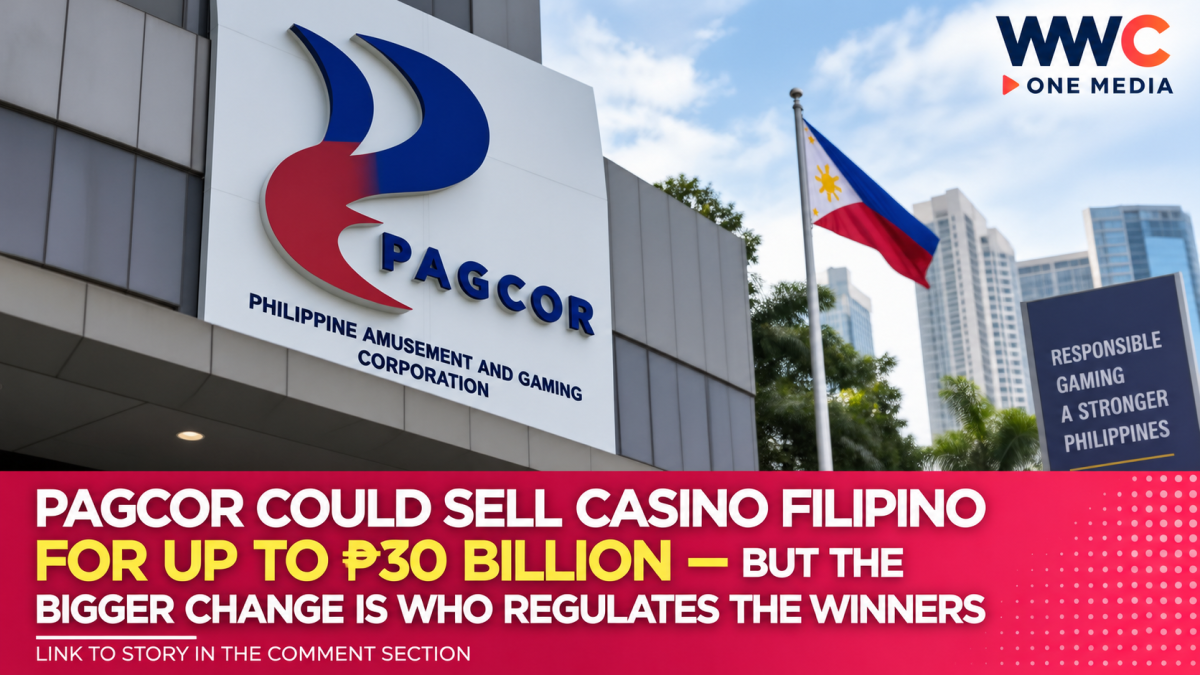
MANILA, Philippines — The Philippine government is moving closer to a fundamental overhaul of its gambling regulator, one that could end PAGCOR’s decades-old role as both casino operator and industry watchdog and open the door to a sale of Casino Filipino assets estimated to raise between ₱20 billion and ₱30 billion.
But the money may ultimately be only one part of the story.
If the plan is approved, the Philippine Amusement and Gaming Corp. would withdraw from directly operating casinos and concentrate on regulating the private companies that run them—removing the unusual arrangement in which the agency simultaneously writes the rules for an industry and competes inside it.
PAGCOR Chairman and CEO Alejandro Tengco said the Governance Commission for GOCCs, or GCG, is in the final stages of reviewing the proposed separation, commonly referred to as “decoupling.”
Once that review is finished, the GCG is expected to make its recommendation to the Office of the President, which will evaluate whether to proceed with the restructuring. Tengco said an executive order implementing the change could come in early 2027, although no final approval has yet been announced.
That distinction matters.
Casino Filipino has not been sold yet. The ₱20-billion-to-₱30-billion figure is an estimate, not an agreed transaction price.
PAGCOR has spent decades being both referee and player
PAGCOR’s proposed transformation addresses an institutional structure that has long made the Philippines unusual among major gambling markets.
The government corporation regulates licensed casinos and other gambling businesses while at the same time operating its own Casino Filipino network.
Tengco has repeatedly described the arrangement using a sports analogy: a regulator should not be the “referee” while also being a “player” on the field. PAGCOR says separating the functions would allow it to regulate competitors without simultaneously operating against them.
The agency has been publicly pursuing that restructuring for several years.
In 2024, PAGCOR was targeting the start of privatization in early 2026 and estimated that selling more than 40 casinos could raise at least ₱50 billion.
By mid-2026, Tengco was still discussing possible proceeds of roughly ₱30 billion to ₱50 billion.
But the estimate has since become more conservative.
The latest InsiderPH report puts expected proceeds at ₱20 billion to ₱30 billion, while BusinessMirror separately reported Tengco saying the assets could generate about ₱20 billion.
That means headlines describing the transaction as a guaranteed ₱30-billion sale would go too far.
The price will ultimately depend on what assets are included, bidding conditions and what buyers are prepared to pay.
The casino network itself is already shrinking in importance
The timing of the proposed sale reflects a major shift inside the Philippine gambling industry.
Casino Filipino once represented a much more significant part of PAGCOR’s business.
Today, privately operated integrated resorts and electronic gambling generate most industry revenue.
In the first half of 2026, PAGCOR-operated casinos produced ₱6.081 billion in gross gaming revenue, representing only about 3.46% of total Philippine industry GGR. That was down 6.57% from ₱6.481 billion a year earlier.
Second-quarter figures tell a similar story.
PAGCOR reported total industry GGR of ₱88.13 billion for April through June. Licensed private casinos contributed ₱45.37 billion, or 51.49%, while electronic gambling generated ₱39.85 billion, or 45.21%.
Casinos operated directly by PAGCOR generated just ₱2.90 billion, or approximately 3.3% of the quarter’s total.
That dramatic shift helps explain why PAGCOR increasingly sees regulation—not running casino floors—as its most important long-term function.
And Casino Filipino operations are under pressure
PAGCOR’s own financial performance has also weakened.
The state corporation reported ₱43.32 billion in total revenue during the first half of 2026, down 26.64% from ₱59.05 billion a year earlier.
Gaming revenue fell 27.11% to ₱38.92 billion, while revenue from PAGCOR-operated casinos declined 8.67%.
Tengco has described Casino Filipino sites as financially difficult to maintain, telling reporters that the network was “bleeding heavily” as PAGCOR considered the economics of privatization.
The wider gambling market has also slowed.
PAGCOR now expects Philippine gross gaming revenue to reach at least ₱350 billion in 2026, below its previous ₱397-billion target.
Industry GGR during the first six months fell 18.16% to ₱175.74 billion, from ₱214.75 billion a year earlier.
PAGCOR has attributed the downturn partly to inflation, weaker discretionary spending and geopolitical disruptions, alongside a sharp correction in electronic gambling.
The privatization therefore comes at a moment when the government is not simply selling a fast-growing casino business.
It is trying to restructure a legacy operation while the industry around it changes rapidly.
Why private companies are still interested
Weakening Casino Filipino revenue does not necessarily mean the assets are unattractive.
Tengco said foreign companies, Philippine business groups and existing gambling licensees have expressed interest in potential acquisitions.
Their attraction may lie partly in location.
Casino Filipino sites operate in established markets around the country, and some could offer buyers access to geographic areas where building an entirely new gambling operation would be more difficult or expensive.
Industry reporting has identified sites across major urban and tourism markets, while some prospective bidders may be established casino operators that already understand the Philippine regulatory environment.
But potential buyers still do not know all of the final terms.
Those will depend on the privatization framework approved by government, including exactly which physical assets, operating rights and employee obligations accompany each transaction.
Even the number of casinos needs careful wording
Published reports currently differ on the precise size of the Casino Filipino estate.
InsiderPH refers to 40 casinos, while BusinessMirror’s latest report refers to 38 sites and branches. Other recent industry reporting has described more than 40 venues.
PAGCOR, meanwhile, announced in August that 16 Casino Filipino sites and branches had received ISO 9001:2015 certification—but that figure covers the sites included in that certification, not necessarily the full network.
For publication, the safest description is therefore “PAGCOR’s Casino Filipino network” rather than presenting one disputed branch count as definitive.
The toughest issue may be the employees
Buildings, tables and slot machines are not the only assets affected by privatization.
Casino Filipino employs government personnel whose jobs could change or disappear when operations transfer to private owners.
PAGCOR has previously said employees would be addressed through a combination of redeployment within the organization, possible absorption by private operators, or competitive retirement or separation packages.
But employee absorption is not automatic.
A July analysis reported by Manila Bulletin said prospective buyers could resist requirements forcing them to retain all existing Casino Filipino employees.
Private bidders may prefer to select only the positions they need, particularly specialized workers such as dealers, surveillance personnel and gaming technicians.
How the government designs those employment conditions could therefore affect both workers and the bids the assets eventually attract.
The stricter the obligations imposed on a buyer, the greater the possibility that bidders factor those costs into the price they are willing to offer.
There is also a healthcare funding question
Another issue lies far beyond the casino floor.
Part of the government’s share of PAGCOR gaming revenue helps finance public programs, including Universal Health Care.
Under existing law, PAGCOR gaming income is among the government revenue streams connected to health financing, with statutory provisions protecting the share earmarked for Universal Health Care.
A study by Geronimo Law, cited by Manila Bulletin and Philippine Star, estimated that transferring Casino Filipino operations to private owners could reduce recurring UHC funding by roughly ₱1.7 billion to ₱2.1 billion annually, because direct operating earnings would be replaced by smaller regulatory or licensing collections.
That estimate is not an official government forecast, and the final effect will depend on the eventual privatization structure and future gaming revenues.
Still, it highlights an important distinction between two kinds of government money.
Selling assets could produce a large one-time cash inflow.
Operating casinos generates recurring income.
Replacing one with the other changes not only how much government receives, but also when and through what legal channel the money becomes available.
The sale proceeds may not simply replace gaming income
The distinction becomes more important because proceeds from the disposal of government assets are legally different from ordinary PAGCOR gaming revenue.
Republic Act No. 11954, which created the Maharlika Investment Fund, separately identifies government asset privatization proceeds and the National Government’s PAGCOR income share as different funding sources.
Geronimo Law’s analysis argues that Casino Filipino sale proceeds would therefore not automatically flow through the same statutory mechanisms used for recurring gambling earnings.
That creates a fiscal trade-off policymakers will have to manage.
The government could receive tens of billions of pesos upfront.
But it would give up the direct operating income generated by Casino Filipino.
PAGCOR’s counterargument is that removing loss-making operations could reduce costs while allowing the corporation to concentrate resources on regulation and licensing.
Regulation is becoming harder just as PAGCOR wants to become a pure regulator
That transition is happening at a particularly sensitive moment for the Philippine gambling sector.
Electronic and online gambling expanded rapidly in recent years, forcing PAGCOR to tighten identity verification, advertising standards, responsible-gambling safeguards and anti-money-laundering controls.
In February, PAGCOR told a Senate hearing that it was enforcing stricter know-your-customer requirements, advertising restrictions and responsible-gambling measures for online platforms.
In July, the regulator directed casino operators to strengthen their anti-money-laundering and counter-terrorism-financing frameworks after completing a sector-wide risk assessment.
PAGCOR officials said this week that they are continuing to review the regulatory system as online gambling technologies and business models evolve.
That gives the decoupling proposal a rationale beyond asset disposal.
PAGCOR argues that it needs to devote its staff, expertise and resources to overseeing an industry that is increasingly digital, technologically complex and exposed to consumer-protection and financial-crime risks.
The next decision is not PAGCOR’s
Despite years of preparation, PAGCOR cannot finalize the restructuring on its own.
Tengco said the agency has already provided the documents and information requested by the Governance Commission for GOCCs, which could make its recommendation within roughly 30 days.
The proposal would then move to the Office of the President.
Tengco said an executive order could potentially be issued in early 2027 if the administration decides the proposal has merit.
That means several things still have to happen before a privatization transaction can actually close:
The institutional restructuring must receive the required approvals; government must settle the sale framework; assets must be valued; employment issues must be handled; bidders must emerge; and acceptable offers must actually be submitted.
The ₱20-billion-to-₱30-billion figure therefore remains a projected range.
There is no ₱30-billion cheque waiting for the government yet.
The bigger reform is not the sale
PAGCOR’s privatization story is easy to frame around a large number.
Up to ₱30 billion is attention-grabbing.
But the more lasting consequence may be institutional.
For decades, PAGCOR has generated income by both regulating gambling companies and competing with them through Casino Filipino.
If decoupling proceeds, the government corporation would instead depend increasingly on the success of its role as licensor, rule-maker and enforcement authority.
It would no longer need to decide how to make its own casinos more competitive.
It would have to decide how to keep everyone else’s casinos compliant.
That could eliminate one longstanding source of regulatory conflict while creating new questions about government revenues, employee transitions and how aggressively a regulator funded by industry fees should police the companies providing those fees.
The Casino Filipino sale could bring the government ₱20 billion to ₱30 billion once.
What PAGCOR becomes after the sale could matter for decades.


Leave a Reply