
JAKARTA — Indonesia has changed finance ministers again.
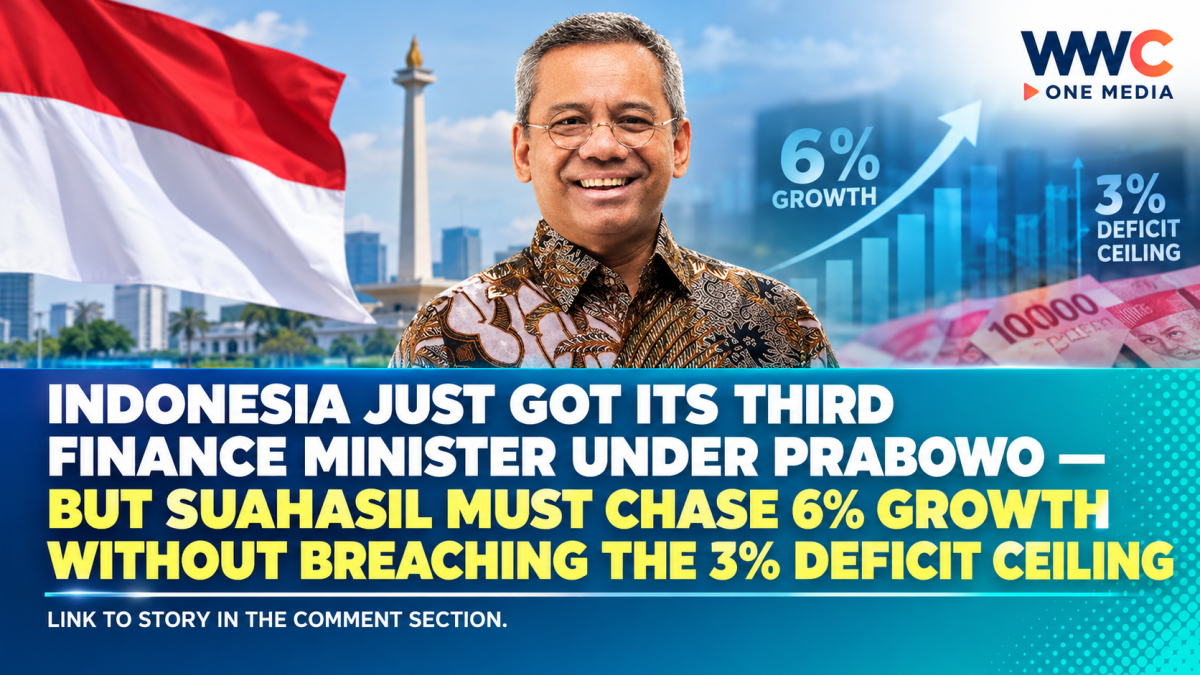
President Prabowo Subianto abruptly removed Purbaya Yudhi Sadewa after barely a year in office and promoted longtime deputy finance minister Suahasil Nazara, handing the veteran technocrat one of the most difficult economic balancing acts in Southeast Asia.
Suahasil must help deliver faster economic growth, finance Prabowo’s major government programs, reassure investors and protect Indonesia’s state finances—all while keeping the annual budget deficit below the legally mandated 3% of gross domestic product.
And the change came with remarkable speed.
Purbaya was still attending a parliamentary hearing on September 14 when he received a call and left the meeting. Hours later, Suahasil was sworn in at the presidential palace. Suahasil himself said he was informed about the process only that morning.
The Indonesian State Secretariat confirms that Prabowo formally appointed Suahasil under Presidential Decree No. 97/P of 2026. It did not give a detailed public explanation for Purbaya’s dismissal.
That distinction matters because several explanations have emerged since the reshuffle—but not all have been officially confirmed.
Purbaya admitted there were disagreements
One day after losing the job, Purbaya acknowledged that he had partly expected his dismissal.
He said he did not have a fundamental policy disagreement with Prabowo but acknowledged differences with other officials. He also told reporters that the large personnel reshuffle he had recently conducted inside the Finance Ministry was partly connected to his removal, while declining to identify all the factors involved.
CNA reported that Purbaya had recently overseen a sweeping ministry restructuring involving hundreds of personnel and around 50 director-level officials. Analysts interviewed by CNA said the exercise had generated internal friction.
Reuters went further on September 16, reporting—citing three government sources—that a dispute involving senior Finance Ministry officials contributed to Purbaya’s removal.
According to Reuters’ sources, customs and excise chief Djaka Budhi Utama and tax chief Bimo Wijayanto objected to aspects of the personnel shake-up and said they had not been sufficiently consulted. Reuters reported that Djaka, a former military officer who had served with Prabowo in Indonesia’s special forces, took the dispute to the president. The government has not publicly confirmed that account as the official reason for the dismissal.
That makes the internal-restructuring explanation significant—but still sourced reporting rather than an official presidential explanation.
Then there was the Danantara dispute
Another controversy erupted only days before Purbaya’s departure.
CNA reported that Purbaya said Indonesia’s sovereign wealth fund Danantara Indonesia would transfer approximately Rp120 trillion, or around US$6.8 billion, in profits to the government to help meet fiscal requirements.
Danantara officials subsequently said such a plan had not been discussed.
The public contradiction added to questions over coordination between some of Indonesia’s most important economic institutions.
CNA’s analysts also pointed to Purbaya’s earlier decision to subject tax refunds to more extensive verification, a policy that he said could save government money but that generated complaints from parts of the business community.
None of those episodes individually proves why Prabowo replaced him.
Taken together, however, they help explain why speculation about Purbaya’s position had intensified before the reshuffle.
Purbaya had never been a conventional finance minister
Purbaya entered the job in September 2025 after Prabowo replaced veteran finance minister Sri Mulyani Indrawati, who had served multiple Indonesian presidents.
He quickly developed a very different public profile.
Purbaya was unusually outspoken for a finance minister and frequently promoted aggressive policies intended to push growth higher.
His tenure coincided with strong headline economic expansion. Indonesia’s GDP grew 5.61% year-on-year in the first quarter of 2026, its fastest annual rate in more than three years, before easing to a still stronger-than-expected 5.29% in the second quarter.
But faster growth came alongside mounting fiscal and market concerns.
CNA reported that the government in July revised its expected 2026 budget deficit to 2.85% of GDP, up from the original 2.68% projection and increasingly close to Indonesia’s statutory 3% ceiling.
Fitch and Moody’s also moved Indonesia’s sovereign-rating outlook to negative during 2026, with Reuters and CNA reporting that policy predictability, fiscal pressures and spending plans were among the concerns cited.
The rupiah, meanwhile, came under intense pressure amid domestic concerns and wider global risk aversion.
Those were the conditions Suahasil inherited.
Suahasil is not an outsider brought in to tear everything up
The most striking thing about Prabowo’s replacement choice is how familiar Suahasil is with the institution he now leads.
He served as deputy finance minister from 2019 until his promotion in September 2026, spanning both the Joko Widodo and Prabowo administrations. Before that, he headed the Finance Ministry’s Fiscal Policy Agency from 2016 to 2019.
The 55-year-old economist also spent decades in academia.
CNA reports that he began teaching at the University of Indonesia in 1999, became an economics professor in 2009, earned a master’s degree from Cornell University and completed a doctorate in economics at the University of Illinois at Urbana-Champaign.
That institutional background is one reason some investors and analysts quoted by Reuters viewed his promotion as potentially providing greater predictability.
But those are outside assessments—not a guarantee that Indonesian policy itself will fundamentally change.
Suahasil has already stressed continuity.
Following his appointment, he described the transition as a continuation rather than a wholesale change and said Prabowo had instructed him to maintain healthy, credible state finances while ensuring the budget supports government priorities.
The first hard number is 3%
Suahasil’s clearest commitment is also one of the most consequential.
He says Indonesia will keep the budget deficit within the country’s legal ceiling of 3% of GDP.
The draft 2027 state budget currently provides some room.
Prabowo’s official budget proposal calls for:
- Rp3,426 trillion in state revenue;
- Rp4,097.2 trillion in expenditure;
- Rp671.2 trillion in financing;
- a budget deficit equal to 2.40% of GDP;
- and economic growth of 6% in 2027.
That proposed 2.4% deficit is safely below the legal ceiling on paper.
But the difficult part will be keeping it there as spending pressures accumulate.
Prabowo wants 6% growth next year—and eventually 8%
Prabowo has repeatedly set an ambition of eventually pushing Indonesian economic growth toward 8%, while the formal government target for 2027 currently stands at 6%.
Reaching the near-term target itself will require acceleration.
Indonesia grew 5.29% year-on-year during the second quarter of 2026. To reach 6% sustainably, the government expects stronger investment, consumption and productive government spending.
Before being removed, Purbaya said investment growth of around 7% would be needed to support the 2027 target.
Suahasil therefore cannot simply slam on the fiscal brakes.
His job is to maintain enough government support to help economic activity accelerate while preventing expenditure from undermining the credibility of the budget.
That tension is at the heart of the new minister’s assignment.
Free school meals alone are becoming a huge budget item
One program illustrates the challenge.
Prabowo’s flagship Free Nutritious Meals initiative has expanded rapidly.
According to figures cited by CNA, Indonesia’s National Nutrition Agency has a proposed Rp240.2 trillion budget ceiling for 2027, representing around 5.9% of planned government spending.
Approximately Rp232.5 trillion of that is earmarked for the free-meals program, which the government expects to cover roughly 72.46 million beneficiaries.
The program is a presidential priority.
At the same time, economists interviewed by CNA argue that Suahasil will face pressure to scrutinize the cost and economic effectiveness of major programs as the government finalizes the 2027 budget.
That is analysis from those economists, not an indication that the government has decided to reduce the meals program.
Regional transfers are another pressure point
There is also tension over how Jakarta distributes money to provincial and local governments.
CNA reported that central-government transfers used by provinces and districts fell from around Rp919 trillion last year to Rp693 trillion this year, as the government redirected resources toward national priorities. Analysts cited by CNA said the reduction had contributed to delays in some infrastructure and local-service spending.
For Suahasil, that creates another balancing act.
More funding for central priorities leaves less fiscal room elsewhere unless government revenue grows faster, existing programs become more efficient or borrowing increases.
And borrowing cannot rise indefinitely while the government is committed to staying below the 3% deficit ceiling.
Investors are watching policy credibility as much as growth
Reuters reported that several market analysts welcomed Suahasil’s appointment because of his long-standing relationships with policymakers and familiarity with the Finance Ministry.
Some described his arrival as potentially creating a more predictable policy environment after months of investor unease.
That reaction should not be interpreted as a guarantee of market stability.
Indonesia continues to face external risks ranging from high energy prices to global interest rates, while domestic questions remain over subsidies, budget priorities, state funds and the relationship between fiscal and monetary policy.
Reuters noted that higher global oil prices could increase Indonesia’s subsidy burden, particularly when the rupiah is weak because oil is priced internationally in US dollars.
The business community is also asking for continuity rather than another abrupt policy reset.
Shinta Kamdani, chair of the Indonesian Employers Association, told Reuters that businesses wanted the leadership transition to avoid sudden changes while preserving support for purchasing power, investment and productivity.
Three finance ministers in less than two years
The speed of leadership turnover is itself notable.
When Prabowo took office in October 2024, Sri Mulyani remained finance minister.
She was replaced by Purbaya in September 2025.
A little more than one year later, Purbaya was replaced by Suahasil.
That makes Suahasil Prabowo’s third finance minister in less than two years in office.
The appointment therefore carries significance beyond one personnel change.
Indonesia is Southeast Asia’s largest economy, and its finance minister sits at the intersection of virtually every major government priority—from food subsidies and school meals to infrastructure, industrial policy, taxation and debt management.
Suahasil now has to manage all of them with a budget that is expected to spend more than Rp4 quadrillion next year.
The biggest challenge is arithmetic, not personality
Much of the coverage surrounding the reshuffle has focused on contrasting styles.
Purbaya was outspoken and willing to publicly challenge conventional economic thinking. Analysts cited by CNA expect Suahasil to communicate more cautiously because of his long institutional experience.
But communication alone will not determine whether the new finance minister succeeds in meeting the government’s own targets.
The arithmetic is harder.
Prabowo wants 6% economic growth in 2027 and ultimately has ambitions for substantially faster expansion. The administration is simultaneously funding expensive social and development programs. Yet Suahasil has pledged to protect fiscal credibility and keep deficits below 3% of GDP.
Indonesia’s draft 2027 budget currently threads that needle with a planned 2.4% deficit.
Whether reality follows the spreadsheet will depend on tax collections, economic growth, subsidy costs, the rupiah, global commodity prices and how aggressively ministries spend.
Purbaya’s departure may have changed the person occupying Indonesia’s most important economic cabinet post.
The fundamental equation has not changed: Jakarta wants significantly faster growth, major government programs and fiscal discipline at the same time. Suahasil Nazara now has to show whether those three objectives can coexist.



Leave a Reply