
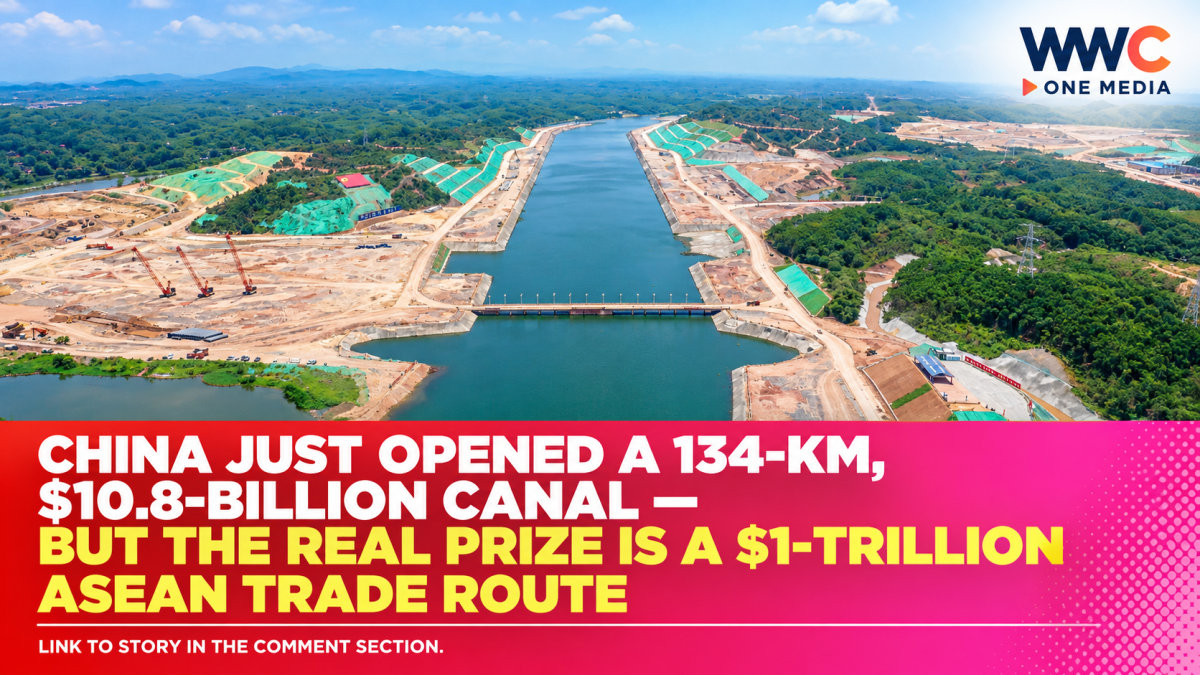
NANNING, China — China has opened a 134.2-kilometer canal that could redraw the logistics map of its southwest, giving inland manufacturers a dramatically shorter water route to the sea—and putting Southeast Asia even closer to one of China’s biggest industrial hinterlands.
The Pinglu Canal officially opened to navigation on September 16, connecting the Xijiang river shipping network near Nanning in Guangxi with the Beibu Gulf, also known internationally as the Gulf of Tonkin.
Built over four years at an estimated cost of 72.7 billion yuan, or about US$10.8 billion, the waterway is designed for ships of up to 5,000 tonnes. Chinese authorities say it can shorten some routes between southwestern China and ASEAN by around 560 kilometers.
The engineering is impressive.
The commercial stakes may be considerably bigger.
China-ASEAN trade exceeded US$1 trillion for the first time in 2025, reaching US$1.05 trillion. In just the first seven months of 2026, bilateral trade reached US$744.41 billion, up 24.7% from the same period a year earlier, according to China’s Ministry of Commerce.
The Pinglu Canal therefore opens just as Southeast Asia is becoming even more central to China’s trade strategy.
The old route sent cargo hundreds of kilometers east
Before the canal, much of the cargo moving by water from Guangxi and parts of China’s southwest had to travel east through the Xijiang-Pearl River system toward Guangzhou before reaching the coast.
Pinglu creates a southern exit instead.
The canal links the inland waterway network directly with the Beibu Gulf at Qinzhou, giving cargo from areas including Guangxi and potentially parts of Yunnan, Guizhou, Sichuan and Chongqing a shorter path toward Southeast Asian shipping routes. CNA, citing Xinhua, said the new alignment removes more than 560 km from some journeys to the sea.
Chinese officials estimate that the shortcut could reduce logistics costs by 18% to 30% and produce more than 5 billion yuan in annual transport savings.
Those are forecasts from Chinese authorities rather than independently demonstrated savings from actual long-term commercial operations, which have only just begun.
That distinction matters.
The canal may be finished, but whether companies save as much money as projected will depend on cargo volumes, lock waiting times, port charges, fuel costs and how quickly manufacturers adjust their supply chains.
Two new shipping routes began with the opening
The canal did not open only as an engineering showcase.
Two new freight services were launched immediately: an international route between Nanning and Can Tho in Vietnam, and a domestic route linking Nanning with Yangpu Port in Hainan, according to CCTV reporting cited by the South China Morning Post.
Around 30 cargo vessels carrying products including building materials, coal, minerals, steel and fertilizer were expected to pass through on opening day.
The symbolism is obvious.
One route goes directly into Southeast Asia.
The other links the canal with Hainan, where China has been developing a major free-trade port.
Taken together, they show that Pinglu is designed not merely to move ships through Guangxi but to plug western China more tightly into maritime trade networks.
It is not simply a 134-km trench
Much of Pinglu involved widening, deepening and modifying existing waterways rather than excavating an entirely new channel from beginning to end.
But builders still faced a major topographical problem: a water-level difference of roughly 65 meters along the route.
To move ships through those changing elevations, the project includes three navigation hubs equipped with twin-line ship locks. China Daily described the vertical difference as comparable to the height of a building of more than 20 storeys.
The canal has been built to China’s Class I inland-waterway standard and can handle vessels in the 5,000-tonne class.
Authorities had already certified 570 vessels and 681 crew members for operations shortly before the canal opened, according to China Daily.
That suggests Beijing wants traffic to ramp up quickly rather than spend months operating the canal largely as a trial project.
Why ASEAN makes the economics much more compelling
If Pinglu had opened a decade ago, it would still have been a major Chinese infrastructure project.
In 2026, however, the surrounding trade landscape is very different.
ASEAN is now China’s largest trading partner, while China has remained ASEAN’s largest trading partner for 17 consecutive years, according to Chinese government data.
The relationship has also become deeply integrated at the factory level.
Chinese customs officials said intermediate goods—components, machinery and materials used to manufacture other products—account for more than 60% of China-ASEAN trade, meaning much of the relationship is based on connected supply chains rather than simply finished goods moving from seller to buyer.
That makes logistics improvements disproportionately important.
A lower-cost route for industrial inputs can affect factories on both sides of the border repeatedly as components move through different stages of production.
Beibu Gulf Port was already booming before the canal opened
The southern end of the Pinglu Canal feeds into a port system that has been growing rapidly.
Container throughput at Beibu Gulf Port reached roughly 10 million twenty-foot equivalent units in 2025, up from about five million in 2020 and just over one million in 2013, according to reporting by The Straits Times.
The port already handles Chinese exports such as electric vehicles and consumer products, as well as incoming Southeast Asian commodities including iron ore and durians.
Chinese government data put Beibu Gulf Port’s throughput at 10.06 million TEUs in 2025, compared with 2.28 million in 2017.
Pinglu gives that growing coastal hub something it previously lacked: a high-capacity direct waterway into the interior.
That is potentially more consequential than the canal’s headline length.
Western China has historically paid a geography penalty
Much of China’s export infrastructure developed around its eastern and southern coastal provinces.
Factories in Guangdong, Jiangsu and Zhejiang are comparatively close to major container ports.
Interior provinces have faced longer and more complicated journeys.
Pinglu is part of a wider Chinese effort to reduce that disadvantage through the New International Land-Sea Trade Corridor, which combines railways, roads, river transport and seaports linking western China with Southeast Asia and global markets.
For manufacturers in the southwest, the canal could make water transport more competitive for commodities and heavy goods such as coal, ore, grain, chemicals, new-energy materials and automotive components.
CNA reported that Chinese state media specifically highlighted rural and less-connected areas of Sichuan, Chongqing and Yunnan as potential beneficiaries.
Water transport is generally most attractive for high-volume cargo where speed matters less than cost.
That means Pinglu is unlikely to replace railways, trucks or air freight.
Instead, it creates another option—and potentially a much cheaper one for bulk freight.
It also gives China another trade route at a tense moment
The canal’s opening comes during a broader shift in China’s trade patterns.
Reuters reported in January that Chinese exports to the United States fell sharply in 2025 amid renewed tariff pressure, while shipments to Southeast Asia, Africa and other non-US markets helped China post a record trade surplus.
That does not mean Pinglu was built as a direct response to US tariffs. Construction began in August 2022, years before the latest tariff escalation.
But its commercial value has arguably increased as China tries to diversify its trade relationships and make its western manufacturing regions more competitive.
ASEAN is particularly important because it is both a huge consumer market and a manufacturing base increasingly intertwined with Chinese supply chains.
China says the canal will save money. Businesses now have to prove it.
This is where the next stage of the story begins.
A canal can be completed on schedule.
Ports can be expanded.
Governments can publish estimated savings.
But commercial success depends on whether shippers actually reroute enough freight through the new waterway.
For Pinglu to meet its promise, manufacturers must find its combined transport time and price more attractive than alternatives involving rail, road or established river routes.
The canal must also avoid congestion at its locks and connect efficiently with ports and logistics parks at both ends.
Those practical questions will take years—not opening-day ceremonies—to answer.
The environmental engineering was unusually large too
The project generated roughly 315 million cubic meters of excavated earth and rock.
Chinese contractors say more than 98% of that material was reused for purposes including land reclamation, industrial-park backfilling and construction materials.
The canal also includes a fish passage more than 480 meters long and a wildlife corridor intended for species including leopard cats and squirrels, according to China Daily.
At the estuary, contractors say they relocated thousands of mature mangrove trees and replanted hundreds of thousands of saplings as part of mitigation efforts. These are project-reported environmental measures; their long-term ecological effectiveness will require continued monitoring.
That qualification is important because a waterway of this scale inevitably changes landscapes and ecosystems even when mitigation measures are built into construction.
Another giant canal could eventually follow
Pinglu may also become a test case for something larger.
Chinese planners and researchers have discussed additional waterway links that could connect more inland river systems with Guangxi and the sea.
South China Morning Post reported earlier this year on renewed discussion around a much larger Xianggui Canal concept that could help connect central China’s waterways more directly toward Southeast Asia. Such projects remain proposals rather than completed commitments and would face major financial, environmental and engineering hurdles.
For now, Pinglu is the project that actually exists.
And its immediate scale is already enormous.
The real number to watch is not 134 km
China’s new canal is 134.2 km long.
It cost an estimated 72.7 billion yuan.
It can handle 5,000-tonne vessels.
And officials say it removes roughly 560 km from some southwest-to-sea shipping journeys.
But the most consequential number may be US$1.05 trillion—the value of China-ASEAN trade last year.
That is the commercial flow Pinglu is being positioned to tap.
The canal gives China’s southwest something its geography has long denied it: a shorter water route south to the sea.
Whether that translates into the projected billions in savings remains to be demonstrated.
But for manufacturers looking toward Southeast Asia, the map has already changed.




Leave a Reply