
MANILA, Philippines — The battle over how many senators are actually needed to convict Vice President Sara Duterte in her impeachment trial has moved beyond simple arithmetic and into a potentially consequential constitutional dispute.
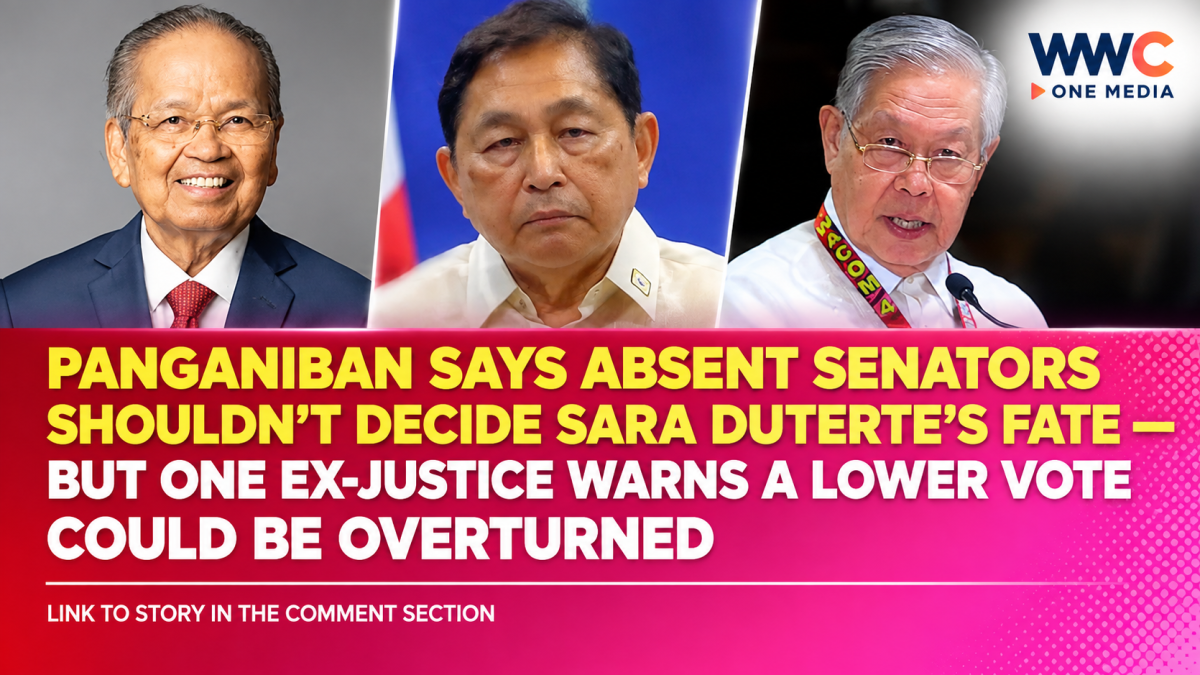
Retired Chief Justice Artemio Panganiban told the Senate impeachment court on Wednesday, September 16, that senators who did not meaningfully participate in the proceedings should not automatically be allowed to determine either the conviction threshold or Duterte’s ultimate fate.
Panganiban argued that judgment in an impeachment case requires senators to personally engage with the evidence, testimony and arguments presented before the court.
“Fairness [in judgment] can be rendered by two-thirds of those present,” Panganiban said while answering questions from senator-judge Panfilo Lacson. He said senators who were absent from the proceedings may not have been in a position to properly evaluate the evidence before casting a vote.
The dispute matters because the 1987 Constitution states that no person may be convicted in an impeachment case without the concurrence of “two-thirds of all the Members of the Senate.” With a full Senate of 24 members, the conventional calculation produces a threshold of 16 votes. The same constitutional language is reflected in legal materials discussing Article XI, Section 3(6).
But the Senate impeachment court is operating under unusual circumstances.
Several senator-judges have not been participating in the trial for different reasons. Senators Jinggoy Estrada and Rodante Marcoleta have been detained in connection with plunder cases; Ronald “Bato” dela Rosa has been absent while wanted by the International Criminal Court; and Loren Legarda has been away on medical leave abroad, according to reports on the proceedings.
That has created a difficult constitutional question: Does “all the Members of the Senate” always mean all 24 Senate seats, or should senators legally or practically unable to participate be excluded from the calculation?
Three former chief justices challenge a fixed 16-vote rule
Panganiban is not alone in questioning whether 16 must remain the automatic threshold.
Former Chief Justice Hilario Davide Jr., who submitted a written memorandum to the impeachment court, argued that the denominator should consist of senators who are legally qualified and physically capable of participating in the proceedings.
Davide said senators prevented from acting because of legal or physical restraints should not necessarily be counted when calculating the constitutional two-thirds requirement. He also noted that the framers of the Constitution did not specifically debate every possible circumstance surrounding the phrase “all the Members of the Senate.”
Former Chief Justice Reynato Puno likewise argued that the constitutional provision cannot be viewed only through a strictly literal interpretation. Puno described competing approaches to constitutional interpretation, including a textual reading and a broader contextual approach that considers related constitutional provisions and their purpose.
GMA News reported that Panganiban, Davide and Puno generally supported the view that the conviction threshold should take account of senators who actually participated in the impeachment process rather than automatically relying on the full 24-seat Senate.
Azcuna pushes back: “All” means all senators
But retired Supreme Court Associate Justice Adolfo Azcuna took the opposite position.
Azcuna, who was also a member of the 1986 Constitutional Commission that drafted the present Constitution, argued that an incumbent senator remains part of the constitutional denominator as long as that person is still legally a member of the Senate.
In his interpretation, the words “all the Members of the Senate” should be applied literally.
Azcuna warned that if the impeachment court convicted Duterte using fewer than the constitutionally required number of votes, the judgment could potentially be challenged before the Supreme Court.
He gave the example of a conviction based on 15 votes after reducing the Senate membership used for calculating two-thirds. Such a ruling, he argued, could be attacked as inconsistent with the Constitution’s express language.
That warning exposes the legal risk behind either interpretation.
A strict 24-member denominator preserves the ordinary 16-vote requirement even when some senators cannot participate. A smaller denominator, on the other hand, could lower the number of affirmative votes necessary for conviction—but would have to survive constitutional scrutiny if challenged.
Why the Avelino case may not settle the issue
The senators and amici curiae have also examined the Supreme Court’s landmark 1949 Avelino v. Cuenco ruling, which dealt with how senators unable to participate should be treated when determining a quorum.
Davide considered the case potentially persuasive, noting that senators who could not effectively participate were treated differently in calculating the Senate majority involved in that dispute.
But Panganiban, Davide and Azcuna have all acknowledged that Avelino is not directly controlling because it involved a Senate quorum and the election of a Senate president—not the separate constitutional requirement governing conviction in an impeachment trial.
That distinction leaves the impeachment court with a constitutional question for which there is no perfectly identical precedent.
Why the decision could reshape the trial
Presiding officer Francis “Chiz” Escudero ruled when the trial began on July 6 that 16 affirmative votes would be required to convict Duterte, interpreting two-thirds of all 24 senators literally.
Senator-judge Erwin Tulfo later challenged the practical implications of that rule given the absence of several senator-judges, prompting the impeachment court to seek advice from Panganiban, Puno, Davide and Azcuna.
The four former justices were invited as amici curiae, or “friends of the court.” Their views are advisory and do not themselves decide the threshold.
The Senate impeachment court must ultimately resolve the matter.
The disagreement now leaves senator-judges confronting two competing principles: the Constitution’s explicit reference to “all” members of the Senate, and the argument that impeachment judgment should be rendered by senators who actually heard and evaluated the case.
Whatever interpretation the Senate adopts could affect not only the arithmetic of Duterte’s trial but also how future impeachment courts deal with senators who are detained, suspended, incapacitated, absent or otherwise unable to participate.
And that is why the fight over a single word—“all”—could become one of the most consequential procedural questions of Sara Duterte’s impeachment trial.




Leave a Reply