
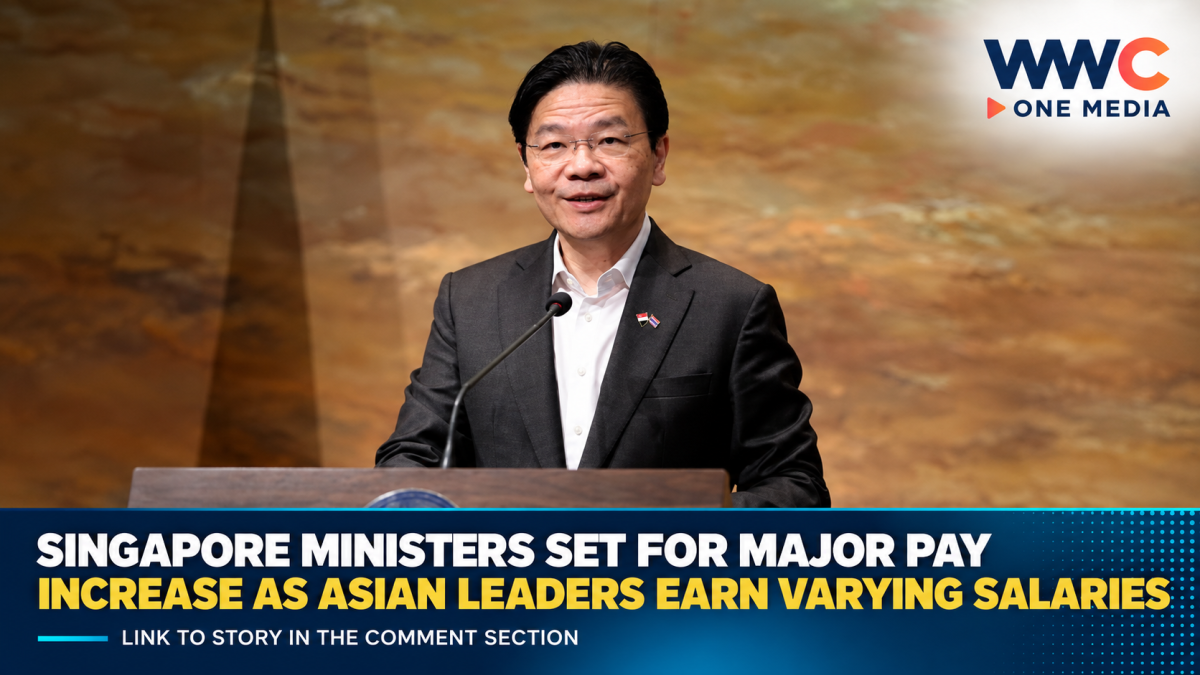
Singapore’s political leaders are set to receive higher salaries from October, bringing renewed attention to how much heads of government and senior politicians are paid across Asia.
Prime Minister Lawrence Wong’s annual benchmark salary will rise to S$3.6 million (US$2.83 million), up from S$2.2 million, under a revised political salary framework approved by the Singapore government. The new arrangement takes effect on October 15, 2026.
The benchmark for an entry-level minister will increase from S$1.1 million to S$1.8 million. However, existing ministers will not immediately receive the full benchmark amount. They will receive a one-off adjustment of up to 9 per cent, with subsequent changes linked to individual performance and responsibilities.
Singapore’s system is unusual in the region because political salaries are linked to private-sector income benchmarks. The framework was designed to keep public-sector compensation competitive while applying a discount to reflect public service. The government has also argued that transparent salaries and the absence of hidden perks support its approach.
Wong has defended the increase as necessary to maintain a system capable of attracting people into political leadership. He has also said he will donate his additional salary from the increase to charity for five years.
The move has revived discussion about political pay across Asia, where compensation systems differ considerably. Some governments use formal salary structures, while others place greater emphasis on relatively modest official salaries alongside different benefits, allowances or institutional arrangements.
Comparisons between countries can also be difficult because leaders’ compensation packages are not always structured in the same way. Some figures include bonuses and allowances, while others refer only to basic salaries. Benefits such as official housing, transportation and security may also be treated differently.
Singapore’s revised framework also increases monthly allowances for members of parliament from S$13,750 to S$18,500. The changes are part of a broader review of political remuneration, the first major adjustment after salaries remained unchanged for 15 years.
The government says the revised system will also update the National Bonus, which links part of political remuneration to socioeconomic indicators. The changes are intended to reflect Singapore’s current economic conditions and priorities.
The debate over political salaries extends beyond Singapore. Across Asia, governments have adopted different approaches to balancing public-service compensation, fiscal considerations and the expectations placed on political office holders.
Singapore’s latest adjustment therefore provides another opportunity to examine how countries in the region structure political pay — and how those systems reflect differing approaches to public service, leadership recruitment and government spending.


Leave a Reply