
GENEVA — Global trade is still growing.
Cargo ships are still moving.
Factories are still selling across borders.
And nearly three-quarters of world merchandise trade continues to operate under the basic non-discrimination rules that have underpinned international commerce for decades.
But the institution sitting at the centre of that system is issuing an unusually stark warning:
the rules-based global trading order is undergoing its most serious and sustained disruption since the system was created 80 years ago.
The World Trade Organization says escalating tariffs, geopolitical rivalry, state subsidies, competing economic systems and increasingly fragmented trade agreements are pushing international commerce toward a world where political alignment matters more than common rules.
And its new modelling suggests the economic cost could be enormous.
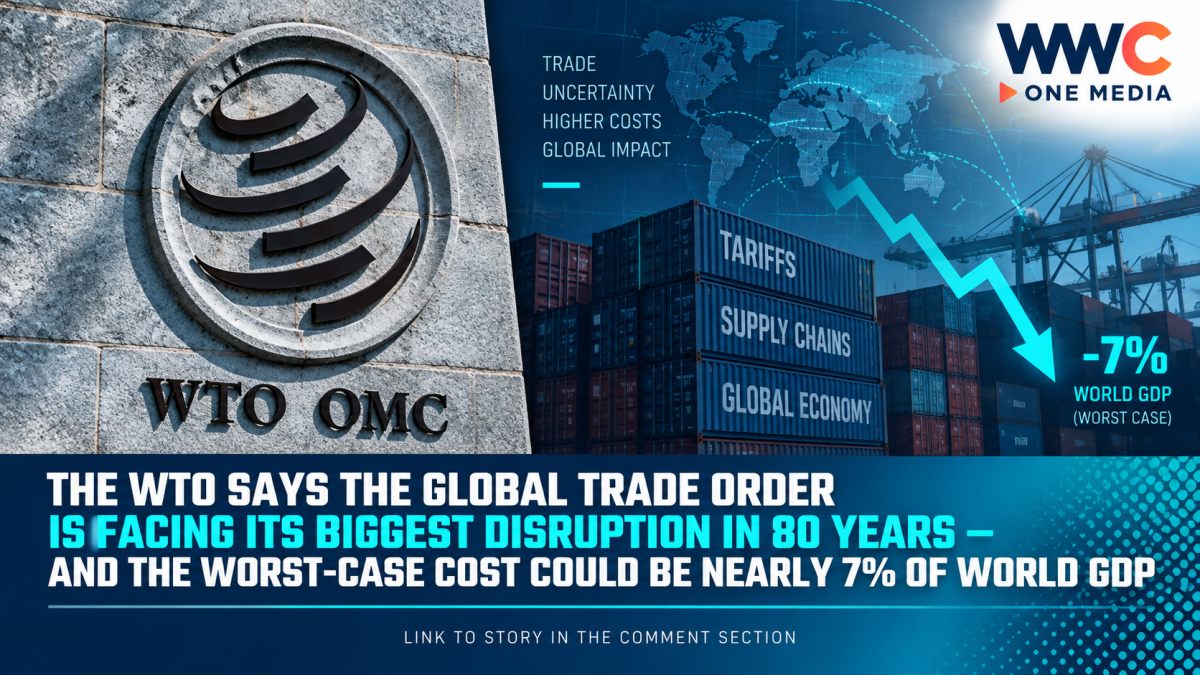
If the global economy fractures into rival geopolitical trade blocs, WTO economists estimate world GDP could eventually be 5.1% lower and global exports 18.6% lower than under the baseline considered in their simulations.
If the WTO disappeared altogether and countries instead relied on a web of separate free-trade agreements, the losses could be even larger:
6.9% of global GDP and 26.9% of exports.
The opposite scenario is equally striking.
A strengthened and modernised multilateral system could raise global GDP by around 2.9% and exports by 17.9%, according to the WTO.
That creates a potential gap approaching 10% of global real GDP between a world of stronger cooperation and one in which common trade rules continue eroding.
The WTO’s message is therefore not simply that tariffs are rising.
It is that the architecture governing nearly US$35 trillion in annual global trade is reaching a point where countries must decide whether to repair it — or increasingly bypass it.
The WTO says this is the deepest disruption since the postwar system began
The language in the 2026 World Trade Report, released on Sept. 15, is unusually direct.
“Global trade policy and the WTO are experiencing the most serious and sustained disruptions since the multilateral trading system was created 80 years ago,” the report says.
The system traces its roots to the General Agreement on Tariffs and Trade in 1947, created after the protectionist breakdown of the 1930s and the Second World War.
What began with 23 participating economies eventually became the WTO, which now has 166 members representing roughly 98% of global trade.
Over that period, global trade expanded almost 50-fold, according to the WTO.
Trade barriers declined.
Supply chains became international.
Developing economies became major manufacturing centres.
And businesses increasingly made investment decisions on the assumption that tariff rules would remain reasonably predictable.
That assumption is now becoming less secure.
Donald Trump’s tariffs accelerated a trend already underway
The immediate backdrop is the broad use of tariffs by U.S. President Donald Trump since returning to office in January 2025.
Trump has argued that tariffs can protect domestic industries, encourage companies to manufacture in the United States, reduce trade imbalances and provide leverage in negotiations.
Other governments have responded with a combination of retaliatory duties, bilateral negotiations, new trade arrangements and their own industrial policies.
The WTO does not attribute all of the system’s problems to Washington.
Its report says the deeper pressures include shifting global economic power, increased government intervention in markets, differences between economic models, digitalisation, artificial intelligence, climate policies and geopolitical tensions.
But the recent tariff surge has made those tensions much harder to ignore.
The WTO’s chief economist, Robert Staiger, told AFP that new tariffs and trade restrictions now cover about 11% of global imports, the highest coverage in more than 15 years.
That does not mean 11% of global trade has stopped.
It means a growing portion of international commerce is being affected by measures that make trade more restrictive, expensive or uncertain.
The most important number may be 72%
Despite the alarming language, the WTO is not saying its system has already become irrelevant.
Quite the opposite.
Around 72% of global merchandise trade still takes place under WTO most-favoured-nation, or MFN, tariff terms.
Under the MFN principle, a WTO member generally gives other members the same basic tariff treatment rather than arbitrarily favouring one trading partner over another, subject to recognised exceptions such as free-trade agreements.
That 72% figure demonstrates how deeply the WTO remains embedded in global commerce.
But it is also a warning sign.
CNA reported that just two years ago, the equivalent share was around 80%.
The direction matters.
More trade is moving into preferential deals, special tariff arrangements and politically negotiated exceptions rather than flowing through the common framework.
Why would that matter to an ordinary consumer?
Because trade rules ultimately affect prices.
Consider a company making a laptop.
The processor may be designed in one country.
Manufactured in another.
Packaged somewhere else.
Memory chips may come from a different supplier.
The display from another economy.
Final assembly may occur in a separate country entirely.
Then the finished computer may cross another border before reaching the customer.
A tariff imposed at one stage can therefore affect businesses and consumers far beyond the two governments involved.
The WTO says global value chains have made national economies so interconnected that tariffs, export controls and subsidies increasingly create spillovers across several countries simultaneously.
That is why the return of more unilateral trade policy can be much more complicated than placing one tax on one finished product.
AI is actually making world trade look healthier right now
There is an extraordinary twist in the latest data.
For all the warnings about tariffs and war, global merchandise trade has remained surprisingly resilient.
The WTO’s Goods Trade Barometer reached 102.0 in September, above its baseline of 100 and slightly higher than its June reading of 101.7.
That indicates merchandise trade was running above recent trend during the middle of 2026.
One major reason is artificial intelligence.
Trade in AI-related electronics — servers, semiconductor components, networking equipment and other computing infrastructure — has surged as companies race to build data centres.
In the first quarter of 2026, the dollar value of trade in AI-enabling goods increased by more than 40% from a year earlier, according to WTO data.
Asia’s exports rose 12.9% year on year during that quarter, while imports climbed 14.6%.
The WTO says AI-linked trade helped outweigh part of the damage from conflict and higher trade barriers.
In 2025, AI accounted for an extraordinary share of trade growth
The phenomenon began even earlier.
World merchandise-trade volume expanded 4.6% in 2025.
The WTO estimates that around 42% of that growth came from AI-related products.
That is a remarkable concentration.
WTO Director-General Ngozi Okonjo-Iweala summed up the relationship bluntly:
AI itself depends on trade.
Semiconductors are designed in one place, fabricated elsewhere, packaged in another economy, installed in servers and eventually deployed in data centres around the world.
No international supply chain, no global AI infrastructure.
But that strength could also be hiding weakness elsewhere.
The AI boom may be masking the damage
Staiger cautioned that strong headline trade numbers can create false comfort because AI infrastructure is exceptionally trade intensive.
Huge investment in chips, servers and data centres can lift total trade even if other categories are being hurt by tariffs and geopolitical disruption.
And the benefits are concentrated.
Not every country manufactures advanced semiconductors.
Not every economy hosts major server factories.
Not every exporter supplies critical minerals, networking gear or data-centre equipment.
That means a boom in a relatively narrow set of products can keep global aggregate numbers strong without telling the whole story about smaller exporters.
The WTO’s warning is essentially:
Do not assume the system is healthy simply because the headline trade number is still growing.
The next WTO forecast comes on Oct. 8
The WTO will publish an updated global trade forecast next month.
Its previous March forecast expected merchandise-trade volume to grow about 1.9% in 2026, sharply slower than the 4.6% recorded in 2025.
That March estimate was produced during the early stages of the Middle East conflict.
The organisation warned that prolonged disruption, high energy prices and problems around the Strait of Hormuz could reduce trade growth further.
At the same time, stronger-than-expected AI investment could push trade in the opposite direction.
The October update should therefore reveal which force is proving stronger.
The WTO’s problem is not just tariffs
The organisation says the global economy has changed much faster than the rulebook.
When the original postwar trading architecture was created, policymakers were primarily concerned with customs duties and straightforward discrimination against imported goods.
Today’s disputes are very different.
Governments subsidise semiconductor factories.
They use tax credits to steer clean-energy manufacturing.
They restrict exports of strategic minerals.
They regulate cross-border data.
They impose carbon-related border measures.
They use national-security rules to control technology.
And they increasingly view supply chains as strategic assets rather than purely economic ones.
The WTO calls some of these “interface” problems — conflicts created when radically different economic and regulatory systems interact within one set of common trade rules.
China’s state-supported economic model is one obvious source of those tensions.
But industrial policy has also expanded in the United States, Europe, India and elsewhere.
Governments rediscovered industrial policy
For decades, mainstream trade policy generally moved toward reducing barriers and allowing production to locate where companies believed it was most efficient.
That philosophy has weakened.
Governments increasingly want certain industries at home.
Semiconductors.
Electric vehicles.
Batteries.
Defence manufacturing.
Critical minerals.
Pharmaceuticals.
Energy infrastructure.
The motivations differ.
Some governments cite national security.
Others want jobs.
Some want resilience after pandemic-era supply shortages.
Others want to reduce dependence on geopolitical rivals.
The result is a global economy in which subsidies, tariffs and investment restrictions are increasingly being used strategically.
WTO rules were not originally designed for this intensity of state intervention.
Free-trade agreements cannot necessarily replace the WTO
One tempting answer is to let the WTO weaken and simply replace it with regional or bilateral trade agreements.
Countries are already doing exactly that.
More than 380 regional trade agreements have been notified to the WTO.
Such agreements can go deeper than global WTO rules.
Countries that broadly agree on regulation, digital commerce or environmental standards may find it easier to negotiate among themselves than among 166 WTO members.
But the WTO’s new modelling says relying entirely on that approach could produce the worst economic outcome it examined.
In its hypothetical “FTA world”, where the WTO disappears and trade is governed only by networks of preferential agreements, global GDP falls 6.9% and exports 26.9%.
Why?
Because free-trade agreements discriminate by design.
Members receive preferred treatment.
Countries left outside do not.
And companies increasingly have to navigate overlapping rules of origin, standards and tariff schedules.
What looks like deeper integration among friends can also mean greater fragmentation globally.
Smaller economies would have much more to lose
Large economic powers have leverage.
The United States can offer access to one of the world’s largest consumer markets.
China can offer access to an enormous manufacturing base.
The European Union can use the scale of its single market.
Smaller economies cannot bargain in the same way.
That is one reason the WTO says erosion of multilateral rules would hit poorer and smaller economies disproportionately hard.
Its modelling suggests they could lose more than three times as much as high-income economies under a scenario involving geopolitical trade friction.
A rules-based system does not eliminate differences in economic power.
But it can give smaller countries agreed procedures and tariff commitments that reduce the extent to which every commercial dispute becomes a negotiation based purely on market size.
The WTO’s dispute system has already been crippled for years
One of the clearest examples of institutional weakness is the WTO’s Appellate Body.
Its appeals mechanism has been unable to function normally since late 2019 after the United States blocked new appointments, objecting to what successive U.S. administrations viewed as judicial overreach and other problems in the dispute-settlement system.
As of July 2026, 130 WTO members were supporting a proposal to restart the appointment process.
It was the 99th time such a proposal had been introduced.
The United States again opposed it, arguing that fundamental concerns about dispute settlement remain unresolved.
That leaves the WTO in an awkward position.
It can issue trade rules.
But one of its key mechanisms for settling disagreements over those rules remains incomplete.
Governments promised to fix that by 2024
They missed the deadline.
WTO members had committed to creating a fully functioning dispute-settlement system by 2024.
Negotiators made progress but failed to resolve core differences.
Talks continued into 2026.
But views remain divided over how a reformed appeals system should operate.
That is a central part of the WTO’s broader credibility problem.
Rules are much less powerful when parties cannot reliably enforce them.
March’s ministerial meeting exposed how difficult reform has become
The WTO’s 14th Ministerial Conference in Yaoundé, Cameroon, was supposed to provide momentum.
Instead, it demonstrated many of the institution’s internal divisions.
The March meeting failed to produce agreement on several major reform questions, including the long-running moratorium on imposing customs duties on electronic transmissions.
The United States responded by saying it would pursue alternative trade arrangements outside the WTO framework for some digital-commerce issues.
At the same meeting, however, 66 WTO members representing roughly 70% of global trade moved ahead with baseline digital-trade rules among themselves after broader consensus proved impossible.
That may be a preview of where global trade governance is going:
not one universal agreement,
but groups of willing countries moving at different speeds.
The WTO itself admits the old model needs reform
One of the most significant elements of the new report is what it does not say.
The WTO is not asking governments simply to restore the world of 1995.
Its conclusion is explicitly that preserving the institution does not mean preserving the status quo.
The system must adapt to artificial intelligence, digital trade, environmental measures, subsidies, global value chains and a wider distribution of economic power.
Okonjo-Iweala’s argument is essentially:
keep what works,
repair what does not,
and avoid allowing frustration with outdated rules to destroy the benefits of having common rules at all.
The US is not the only country questioning old assumptions
European policymakers have also called for major reform.
At the Cameroon ministerial conference, the European Union and members of the CPTPP said the WTO had reached a critical juncture and needed significant change.
Their concerns included industrial overcapacity, state support, economic coercion and market-access imbalances.
That is important because the current crisis cannot accurately be described as the rest of the world defending an unchanged WTO against the United States.
Many governments believe the system is no longer fit for significant parts of the modern economy.
They disagree over how to fix it.
The world is already becoming more politically organised
Trade policy increasingly follows security relationships.
Governments talk about friend-shoring.
They seek critical minerals from allies.
They scrutinise foreign investment.
They restrict advanced technology exports.
They subsidise domestic production.
And companies are urged to reduce dependence on countries viewed as strategic risks.
But supply chains do not always move as easily as political strategy assumes.
Reuters reported this week that some companies which moved production out of China to avoid tariffs are now moving at least part of it back because they struggled to reproduce China’s dense network of suppliers, skilled workers, logistics and industrial infrastructure elsewhere.
That illustrates the economic cost of fragmentation in a very concrete way.
Political leaders can redraw trade relationships on paper.
Rebuilding an industrial ecosystem takes much longer.
Trade restrictions can also produce unexpected detours
Businesses adapt.
If a product is hit with a tariff, companies may change suppliers.
They may ship components through another country.
They may move one stage of production.
They may redesign products to fit a different tariff classification.
They may build a new factory.
Or they may decide the cost of relocation is greater than simply paying the duty.
That adaptability means tariffs do not always produce the result policymakers expect.
They can redirect trade instead of eliminating it.
The WTO’s concern is that as more governments introduce overlapping restrictions, these adjustments become increasingly costly and inefficient.
There is a historical reason economists worry about this
The modern trading system was created partly because of what happened in the 1930s.
Countries responded to economic crisis with tariffs, quotas and competitive protectionism.
Trade contracted dramatically.
Economic nationalism intensified.
The founders of the postwar system concluded that predictable rules and negotiated tariff reductions could make a repeat less likely.
The world of 2026 is obviously very different.
No serious WTO analysis says current conditions are identical to the Great Depression.
But the institutional memory matters.
The WTO was specifically created to prevent a cycle in which each country responds to another country’s barrier by raising one of its own.
Trade has also produced genuine losers — and the WTO admits it
The new report is not an unqualified defence of globalisation.
It acknowledges that the benefits of trade opening were distributed unevenly.
In advanced economies, some workers and communities experienced long-lasting losses from import competition.
New export jobs were often created in different places and different sectors from those where industries disappeared.
At the international level, the poorest countries have also not captured an equal share of globalisation.
Least-developed countries still account for less than 1% of world trade.
Their trade costs in manufacturing and services are about 50% higher than those faced by high-income economies, according to the WTO Trade Cost Index.
That matters politically.
If people conclude that an open trading system benefits corporations and particular regions while leaving them behind, support for that system weakens.
That may be the WTO’s deepest problem
Trade rules are not merely economic equations.
They depend on political consent.
A system can generate higher total income while still creating concentrated groups of people who feel worse off.
Those groups vote.
Governments respond.
Protectionist measures become politically attractive.
The WTO therefore argues that trade openness must increasingly be accompanied by domestic policies that help workers and communities adapt and participate in the benefits.
That is a much broader prescription than simply cutting tariffs.
What would a “geo-fragmented world” actually look like?
Not necessarily a complete end to international trade.
China would still export.
America would still import.
Europe would still trade with Asia.
The change would be in who receives preferred access and under what rules.
Countries could increasingly organise around competing political blocs.
Technology standards might diverge.
Critical products might face national-security restrictions.
Tariffs could depend more heavily on diplomatic relationships.
Companies might duplicate supply chains to serve rival markets.
Investment could be redirected based on political alliances rather than cost.
Trade would continue.
It would simply become less globally integrated — and potentially more expensive.
That is what the WTO’s 5.1% GDP-loss scenario is attempting to model.
Even the worst WTO scenario is a projection, not a forecast
This distinction is essential.
The WTO is not predicting that global GDP will definitely fall 6.9%.
Its economists modelled hypothetical scenarios to estimate what might happen under different institutional arrangements.
The 5.1% and 6.9% figures describe the estimated long-run difference relative to a baseline if fragmentation deepens dramatically.
Similarly, the 2.9% gain represents a scenario in which trade cooperation is strengthened.
They are designed to illustrate the stakes.
They are not guaranteed economic outcomes.
For now, the system remains surprisingly resilient
That may be the biggest contradiction in the entire story.
Trade policy looks deeply unstable.
Yet trade itself continues.
World merchandise trade grew strongly in early 2026.
The Goods Trade Barometer remains above trend.
Seventy-two percent of merchandise trade still flows under WTO MFN terms.
And governments continue negotiating trade agreements even as they impose new restrictions.
The global economy has not divided cleanly into rival camps.
Not yet.
That “not yet” is exactly what the WTO is worried about
The organisation’s warning is fundamentally forward-looking.
Today’s trading order is damaged but functioning.
The concern is cumulative.
One unilateral tariff does not destroy the system.
One subsidy does not destroy it.
One bilateral deal does not destroy it.
One blocked appeal does not destroy it.
But if enough governments decide common rules no longer matter, the system can gradually become something very different.
The WTO says that world would be more discriminatory, more fragmented and more dependent on economic power.
And its modelling suggests smaller countries would pay the highest relative price.
The world now has a choice between reform and erosion
That may be the most consequential line running through the 2026 report.
The choice is not between the old WTO and no change.
The old system already needs updating.
AI is transforming trade.
State intervention has returned.
China occupies an economic position nobody imagined when the WTO was founded in 1995.
Digital commerce barely existed then.
Climate policy is creating new cross-border disputes.
And national security increasingly shapes commercial decisions.
A trade system designed for one era has to operate in another.
The WTO says countries can either rewrite the rules together — or increasingly replace them with tariffs, bilateral bargains and geopolitical blocs.
Global trade is still growing.
That is precisely why the warning could be easy to ignore.
The real danger, the WTO argues, is that by the time the headline numbers finally show how much fragmentation has cost, the rules that kept the system together may already be much harder to rebuild.

Leave a Reply